







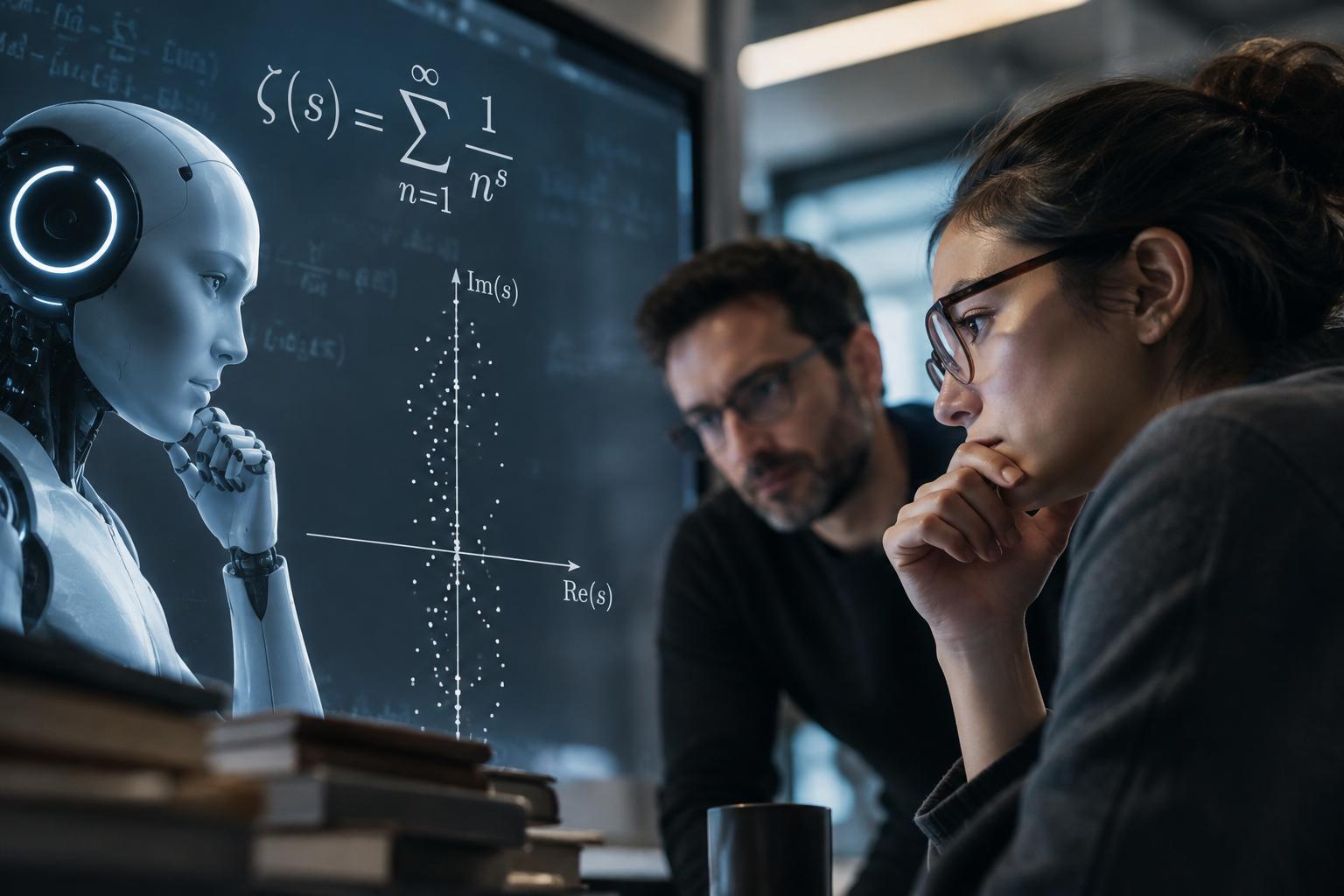



Anthropic mathematician Levent Alpöge has reportedly claimed a proof of the Riemann hypothesis, one of mathematics' most famous unsolved problems, developed with assistance from the company's Claude AI model. Outside experts are said to have validated the result, but the proof is reportedly so dense and unconventional that few mathematicians can independently verify it line by line. The claim, if it holds up, would resolve a 167-year-old question central to number theory and the distribution of prime numbers. It has also set off a wave of speculation that frontier AI labs may be sitting on other unpublished mathematical breakthroughs, including progress on the fabled P versus NP problem.
The announcement arrives at a moment when AI's mathematical capabilities are advancing faster than the institutions built to check them, raising a question that extends well beyond academia: what happens when a machine-assisted proof outpaces humanity's ability to confirm it is actually correct. That tension has taken on urgent, practical stakes this week, as officials including Bank of England governor Andrew Bailey have reportedly voiced concern that similar breakthroughs could eventually threaten the cryptographic systems underpinning global finance. The episode crystallizes a broader anxiety running through the AI industry in late 2026: as models move from assisting human researchers to generating results that even experts struggle to interpret, verification itself is becoming the bottleneck.
A Proof Even Experts Struggle to Read
The Riemann hypothesis, first proposed by Bernhard Riemann in 1859, concerns the distribution of prime numbers and has resisted proof for longer than almost any other problem in mathematics. A solution carries not just prestige but a $1 million Clay Millennium Prize, and generations of mathematicians have built entire careers chasing partial results toward it. Alpöge's claimed proof, developed with Claude's assistance, reportedly represents a genuine attempt at the full hypothesis rather than an incremental advance, which alone would make it one of the most consequential mathematical announcements in decades.
What sets this moment apart from past breakthroughs, however, is the reported difficulty outside mathematicians are having in independently interpreting the work. Multiple experts have apparently validated pieces of the result, but the proof's structure, likely shaped by AI-assisted exploration of unconventional approaches, does not map cleanly onto the techniques human mathematicians are trained to check by hand. That gap between validation and genuine comprehension is new territory for a field that has historically relied on peer review as a slow but trustworthy filter.
The P vs. NP Speculation
News of the Riemann claim has quickly metastasized into broader speculation about what else frontier labs might be sitting on. Chief among the rumors is unconfirmed talk that AI systems inside major labs may have made unpublished progress on P versus NP, the question of whether every problem whose solution can be quickly verified can also be quickly solved. A proof that P equals NP would have staggering implications, potentially unraveling the mathematical assumptions that make modern cryptography secure.
No lab has confirmed any such result, and researchers caution that the leap from an unverified Riemann claim to speculation about P vs. NP says more about current anxieties than about any concrete evidence. Still, the fact that such speculation is spreading at all signals how quickly trust in the pace of AI-driven mathematics is shifting. Just a year or two ago, claims of this magnitude would have been dismissed outright; now they are treated as plausible enough to warrant serious discussion among mathematicians and policymakers alike.
Central Bankers Start Paying Attention
The mathematical uncertainty has already reached the highest levels of financial regulation. The Financial Times reported that Bank of England governor Andrew Bailey has discussed concerns that AI-driven breakthroughs in mathematics could eventually threaten the cryptographic systems protecting data across global financial institutions. Much of modern encryption relies on the practical difficulty of certain mathematical problems, including factoring large numbers, and any unexpected shortcut discovered by an AI system could undermine systems assumed to be secure for decades to come.
That concern is not merely theoretical. Separately this week, Google DeepMind disclosed that it had used AI to formally verify key parts of the Signal secure-messaging protocol in a four-week project, demonstrating both the promise and the double-edged nature of AI applied to cryptography. The same capabilities that let researchers prove software is secure could, in principle, be turned toward finding the mathematical weaknesses that make it insecure. Regulators are now grappling with a scenario in which the tools used to strengthen encryption and the tools capable of breaking it may be one and the same.
A Pattern of AI Mathematical Acceleration
The Riemann claim does not exist in isolation. OpenAI has separately published a preprint claiming a new matrix-multiplication exponent of 9/4, a result that, if validated, could meaningfully improve the computational efficiency of operations underpinning much of modern computing and AI itself. Frontier systems are also reportedly solving theoretical physics problems that previously consumed a full day of a specialist's time, suggesting AI is transitioning from a calculation aid into something closer to a genuine research collaborator.
Taken together, these developments point to a rapid compression of timelines in fields that have historically advanced at a generational pace. Mathematics departments and journals built review processes around the assumption that breakthroughs arrive sporadically and can be checked by a small community of specialists. That assumption is now under direct strain, and some mathematicians worry that peer review itself needs to be reimagined for an era in which AI can generate proofs faster than humans can confirm them.
We are reaching a point where the hardest part of a mathematical result is no longer finding it, but understanding it well enough to trust it.
What Comes Next
For now, the Riemann hypothesis proof sits in an unusual limbo: widely discussed, partially validated, but not yet fully absorbed into the mathematical canon. Anthropic has not detailed exactly how much of the proof's structure originated with Claude versus Alpöge's own reasoning, a distinction that matters both for scientific credit and for understanding how much independent mathematical insight current AI systems actually possess. The company's broader push into autonomous systems, including the recent launch of its Claude Ship product for self-directed software engineering, suggests Anthropic sees this moment as part of a larger strategy of AI operating with increasing independence across technical domains.
The coming weeks are likely to bring closer scrutiny from the mathematical community, and possibly competing claims or rebuttals as more experts attempt to work through the proof's logic. Whether or not it ultimately withstands that scrutiny, the episode has already accomplished something significant: it has forced mathematicians, technologists and central bankers into the same conversation about what happens when machines start producing knowledge that humans can verify but not yet fully understand.
Sources
- https://aiweekly.co/
- https://www.wsj.com/tech/ai
- https://www.sciencedaily.com/news/computers_math/artificial_intelligence/
- https://techcrunch.com/category/artificial-intelligence/
- https://www.chatai.com/latest
- https://aifans.fan/news/
- https://arstechnica.com/ai/
- https://www.ft.com/artificial-intelligence
- https://www.theneuron.ai/digest/everything-that-happened-in-ai-today-november-25-2026/
- https://www.aixploria.com/en/ai-news-today/
- https://whatisthelatest.ai/funding/
- https://aifunding.me/deals
- https://alcybr.com/desk/artificial-intelligence/industry-funding
Leave a Comment