












A new generation of foundation models is emerging that doesn't just learn from data, it learns from physics. Researchers led by Hsu have built EVENET, a foundation model pretrained on simulated particle-collision data that combines self-supervised learning with explicit physics labels, and shown it transfers across multiple collider-analysis tasks while also working on real experimental data. Alongside it, a separate hybrid method merges Lagrangian and Eulerian descriptions of fluid motion to reconstruct high-resolution, physically consistent flow fields from sparse sensor readings. Together, the two efforts mark a turning point in how scientific machine learning is built: not as narrow classifiers tuned to a single dataset, but as reusable representations constrained by the laws governing the systems they model.
For years, machine learning in the physical sciences has largely followed the same playbook as consumer AI: scrape huge amounts of data, train a large model, and hope it generalizes. That approach has worked unevenly in physics and fluid dynamics, where data is often sparse, expensive to generate, and governed by strict conservation laws that a purely statistical model can silently violate. EVENET and the new fluid-dynamics method represent a deliberate correction, baking physical constraints directly into the architecture and training signal so that models are not just accurate on held-out test sets but plausible according to the rules of nature. If the approach scales, it could reshape how national laboratories, particle colliders, and climate and engineering simulators build their next generation of AI tools.
A Foundation Model Built for Colliders
EVENET departs from the standard approach to particle-physics machine learning, where researchers typically train a bespoke classifier for each specific analysis task, such as identifying a particular decay signature or separating signal from background noise. Instead, Hsu and colleagues pretrained the model on large volumes of simulated particle-collision data using a combination of self-supervised objectives, which let the model learn structure without labeled examples, and physics labels drawn from known collision outcomes. The result is a single reusable representation that can be fine-tuned or adapted across multiple downstream collider-analysis tasks rather than rebuilt from scratch each time.
Crucially, the researchers report that EVENET's learned representations transfer not only across simulated tasks but to real collider data as well, a nontrivial claim given the well-documented gap between simulation and experimental reality in high-energy physics. That transferability is the detail most likely to interest experimentalists, since models trained purely on simulation often degrade sharply when confronted with the noise, detector quirks, and unmodeled effects present in actual accelerator output. If EVENET's performance holds up under further scrutiny, it would suggest that domain-specific pretraining, done carefully, can produce scientific tools with the kind of reusability that has made foundation models so commercially valuable in language and vision.
Reconstructing Chaos From Incomplete Data
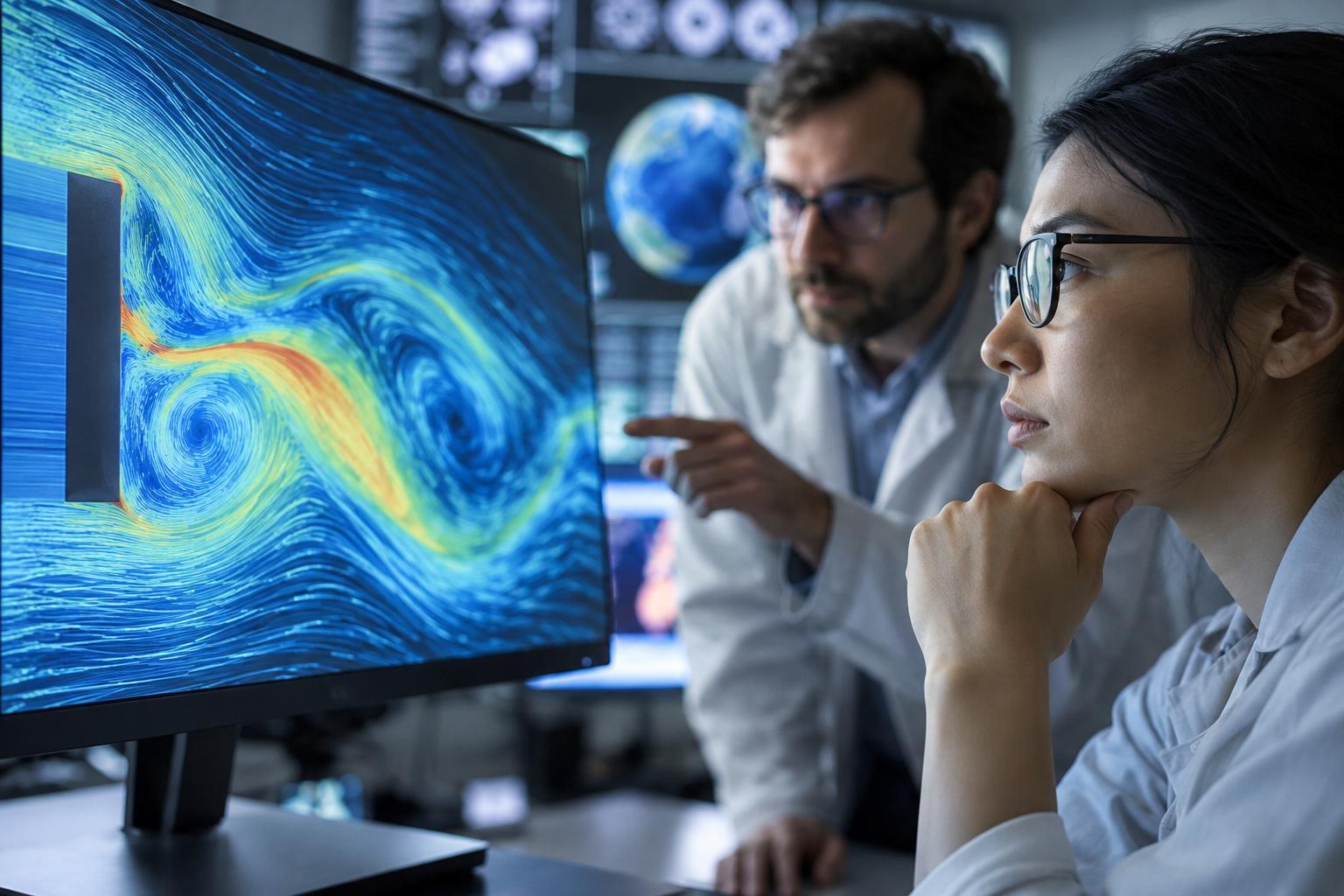
The second major development tackles a different but related problem: predicting fluid behavior when sensors capture only a fraction of what is actually happening. Fluid dynamics has long been described through two complementary mathematical lenses, the Lagrangian view, which tracks individual fluid parcels as they move, and the Eulerian view, which observes fixed points in space as fluid passes through. The new hybrid method fuses both descriptions into a single learning framework, allowing it to reconstruct high-resolution, physically consistent flow fields even when the underlying observational data is sparse and the dynamics themselves are chaotic.
This matters well beyond academic fluid mechanics. Engineers designing aircraft, ships, and industrial systems, along with climate scientists modeling ocean and atmospheric circulation, routinely face exactly this challenge: they have limited sensors and incomplete measurements but need simulations that remain faithful to physical conservation laws. A model that can fill in the gaps without producing physically implausible artifacts, a common failure mode for purely data-driven simulators, would reduce the computational cost of high-fidelity simulation while improving trust in the outputs for safety-critical engineering decisions.
Why Physics Constraints Are Having a Moment
EVENET and the fluid-dynamics work are not isolated curiosities; they reflect a broader pattern emerging across scientific machine learning in late 2026. Purely data-driven models, however large, can produce outputs that fit training distributions well but violate basic physical principles when extrapolated to new conditions. By embedding physics labels, conservation constraints, or dual mathematical descriptions directly into training, researchers are attempting to narrow the gap between statistical accuracy and physical plausibility, a gap that has quietly undermined trust in AI-driven scientific tools.
This shift also echoes developments in adjacent fields highlighted in the same wave of November research, including multimodal medical foundation models and genomics systems that increasingly favor broad, reusable representations over narrowly tuned classifiers. The common thread is a recognition that scientific domains have structure, biological hierarchies, physical laws, molecular interactions, that generic deep learning architectures do not automatically respect. Encoding that structure into pretraining, rather than hoping a large enough model will infer it from data alone, is emerging as a more disciplined and arguably more defensible path toward trustworthy scientific AI.
We wanted a model that behaves like a physicist first and a classifier second, one that carries forward real physical structure rather than just memorizing patterns in simulated collisions.
The Reliability Question Looms Large
Even as these architectures show promise, the broader machine-learning community is increasingly focused on whether such models can be trusted in practice, not just whether they perform well on benchmark tasks. A November 2026 study on AI reliability examined phenomena like calibration inversion, where a model's stated confidence becomes misleading as the underlying data distribution shifts, and data freshness, the risk that a model's apparent competence erodes as the world it describes changes. These concerns are directly relevant to physics-informed foundation models, which are explicitly designed to generalize across tasks and conditions that may differ meaningfully from their training environment.
Separately, a review of five leading AI conferences found genuine progress on research transparency, with the share of papers sharing both code and data rising from just 11 percent in 2014 to 64 percent in 2024. Yet the same review cautioned that reproducibility itself was often estimated rather than directly tested, meaning the field's confidence in its own progress may still outpace rigorous verification. For physics-aware models like EVENET, where claims of transfer to real collider data are especially consequential for how seriously the physics community takes AI-generated results, that gap between reported success and independently verified success is likely to be the central point of scrutiny in the months ahead.
Sources
- https://www.nature.com/natmachintell/articles?year=2026
- https://www.nature.com/subjects/machine-learning
- https://link.springer.com/subjects/artificial-intelligence
- https://www.nature.com/subjects/artificial-intelligence
- https://www.nature.com/subjects/machine-learning/ncomms
- https://link.springer.com/subjects/machine-learning
- https://letsdatascience.com/news/topic/ai-research
- https://www.jmlr.org/
- https://frontierresearch.co/fields/ai
- https://www.nature.com/subjects/statistical-learning
- https://benchlm.ai/model-updates
- https://www.benchleader.com/releases
- https://aiquickbites.com/
Leave a Comment