





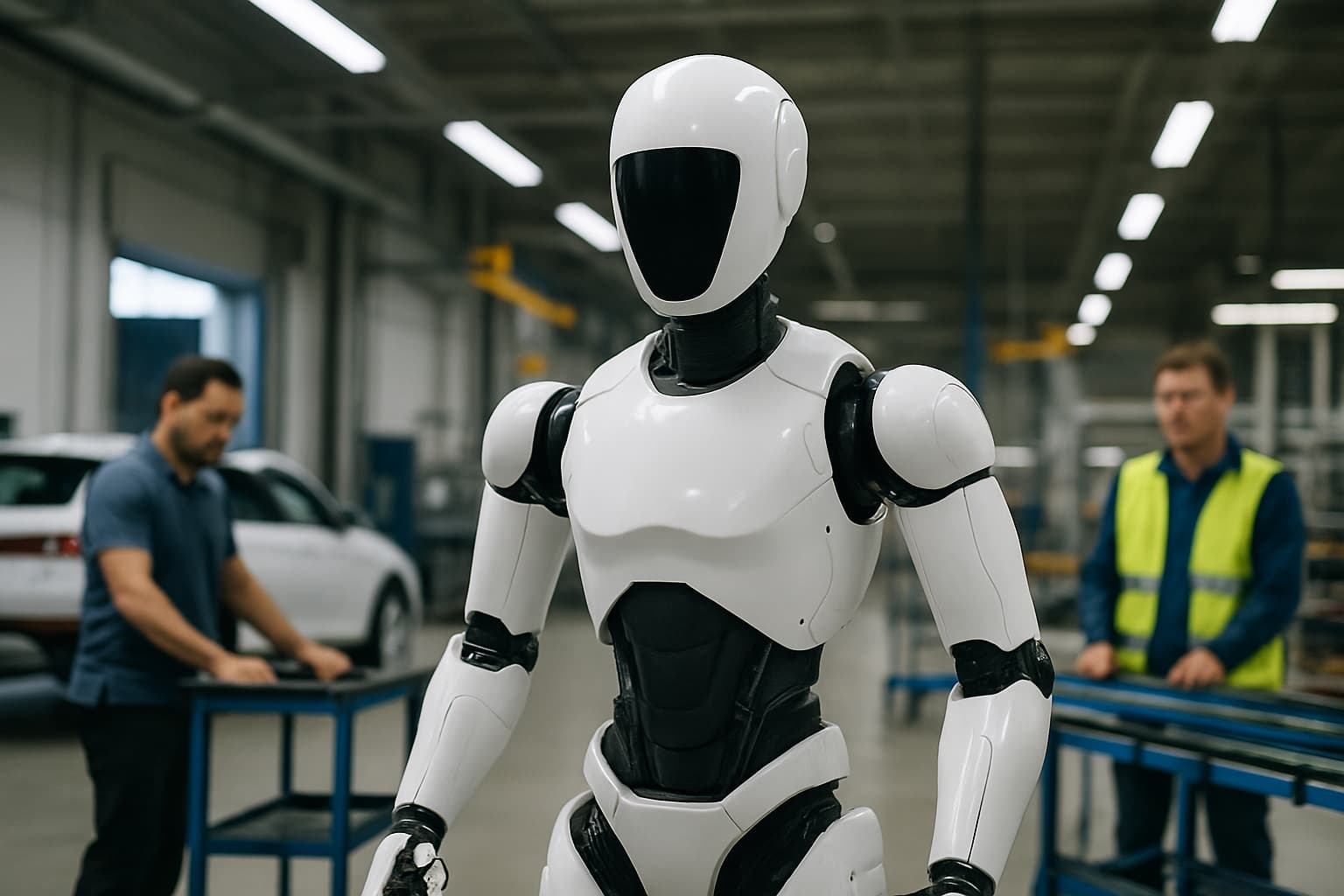
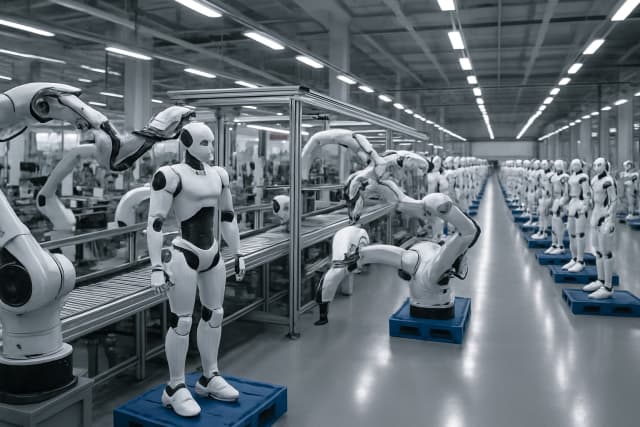
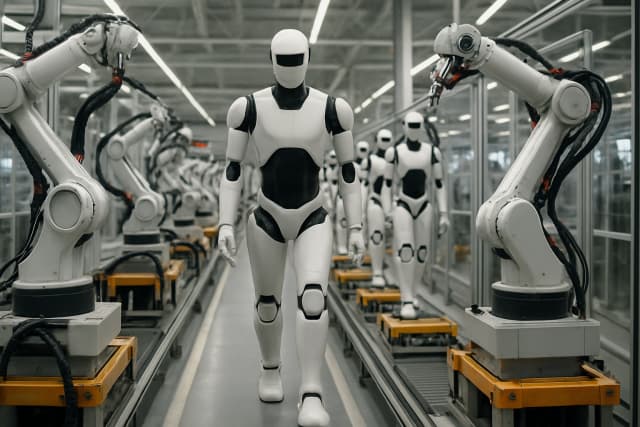








At Siemens' electronics factory in Erlangen, Germany, a wheeled humanoid robot called HMND 01 Alpha spent recent weeks autonomously picking, carrying, and placing totes on the production floor, completing roughly 60 tote moves per hour across more than eight hours of uptime with better than 90 percent success. It is a modest-sounding statistic, but it represents something the humanoid robotics industry has struggled to produce for years: a real factory, running a real workflow, with a machine that was not scripted for a demo reel. Humanoid, the UK robotics company behind the deployment, has now signed a phased agreement with industrial supplier Schaeffler to put its robots into live German manufacturing operations before the end of 2026. Similar pilots are underway at Hyundai, BMW, GXO Logistics, and Toyota, marking a shift from showcase choreography to paid, measurable work.
For much of the past three years, humanoid robotics has been defined by viral videos: robots dancing, backflipping, pouring drinks. That era is ending. Through 2026, the industry's center of gravity has moved toward factories, warehouses, and logistics docks, where companies are testing whether bipedal and wheeled humanoids can hold up to the unglamorous demands of eight-hour shifts, repetitive tote handling, and measurable error rates. The stakes are significant: Gartner projects that fewer than 100 companies will move beyond proof-of-concept by 2028, and fewer than 20 will scale humanoids into full production, meaning the current wave of pilots at Siemens, Hyundai, BMW, and Schaeffler will likely determine which vendors survive the transition from spectacle to commodity.
From Demo Stage to Shift Work
The Siemens trial in Erlangen is emblematic of where the humanoid robotics industry is actually placing its bets in late 2026. Rather than attempting dexterous assembly or unstructured human collaboration, Humanoid's HMND 01 Alpha was tasked with a narrowly defined logistics job: autonomously picking up totes, transporting them across the floor, and placing them at designated points. The reported results, 60 tote moves per hour, over eight hours of continuous uptime, and better than 90 percent autonomous success, are unglamorous by viral-video standards but represent exactly the kind of operational data that industrial buyers require before committing capital.
That pilot has already translated into a commercial agreement. Humanoid's phased deployment deal with automotive supplier Schaeffler will see the company's platforms integrated into live manufacturing operations, with the first systems scheduled to enter German facilities before the end of 2026. The timeline matters: it compresses the gap between pilot and paid deployment to a matter of months, suggesting that at least some humanoid vendors believe their hardware and software stacks are ready for recurring industrial use rather than one-off exhibitions.
Automakers Lead the Charge
Hyundai and Boston Dynamics have taken the most ambitious long-term stance among automakers. The companies established a Robotics Metaplant Application Center at Hyundai Motor Group Metaplant America in Georgia, dedicated to training and integrating electric Atlas robots into manufacturing workflows. Initial tasks are deliberately constrained, sequencing automotive parts and preparing them for assembly, but Hyundai has discussed a long-term target of deploying 25,000 Atlas units across its global plant network, a figure that would represent one of the largest committed humanoid robot orders in the industry's history if realized.
BMW is pursuing a more cautious, multi-vendor approach. Figure AI's robots recently completed a ten-month pilot at BMW's Spartanburg, South Carolina plant, focused on intrafactory logistics sequencing, while BMW is separately bringing Hexagon's AEON humanoid into its Leipzig facility for evaluation. Running parallel pilots with different robot makers allows BMW to compare uptime, cost, and integration complexity before committing to a single platform, a strategy that reflects broader industry uncertainty about which hardware architecture, wheeled or bipedal, fully actuated or simplified, will prove most reliable in daily production.
Logistics Operators Bet on Recurring Contracts
Outside the automotive sector, logistics companies are structuring humanoid deployments as ongoing services rather than experiments. Agility Robotics' Digit has been moving totes at a GXO logistics center in Georgia under a multiyear robots-as-a-service contract, a commercial model that shifts the burden of uptime and maintenance onto the robotics vendor rather than the client. Agility is preparing additional manufacturing deployments at Toyota sites in Canada, extending the same service-based approach into automotive supply chains.
China, meanwhile, is pursuing scale more aggressively than precision. UBTECH Robotics has opened a 14,000-square-metre, Siemens-backed facility in Liuzhou capable of producing more than 10,000 humanoid robots annually, assembling them with the help of other humanoids, automated guided vehicles, and robotic arms at a reported rate of one robot every ten minutes. Chinese manufacturers including Aitu and PIABOT Robotics are simultaneously testing humanoids on narrow industrial tasks, garment handling, electronics sorting, and automotive line work, with PIABOT's G2 reportedly completing more than 2,283 tasks without error during an eight-hour trial. China is targeting 10,000 humanoid robots in industrial deployment by the end of 2026.
The breakthrough is not that a humanoid can walk into a factory. The breakthrough is that it can walk into a factory, move totes for eight hours, and still be working when the shift ends.
The Economics Still Favor Caution
Despite the flurry of pilots, the underlying economics remain unresolved. Prototype humanoid units are estimated to cost between 150,000 and 500,000 dollars apiece, a price point that still struggles to compete with fixed automation or human labor for many repetitive tasks. One market estimate cited by Manufacturing Dive put global humanoid installations at roughly 2,000 units in 2024, with projections reaching 60,000 units in 2026, a dramatic growth curve that nonetheless implies deployment remains concentrated in a small number of carefully mapped work zones rather than spreading across full factory floors.
Industry executives have been candid about the barriers ahead: scalability, cost, and deployment complexity remain the dominant concerns, and humanoids are still considerably less mature than conventional industrial robots and collaborative arms that have decades of reliability data behind them. The near-term opportunity, according to evidence from Siemens, Hyundai, BMW, and GXO, lies in structured, repetitive work such as tote handling, kitting, machine tending, and parts sequencing, rather than general-purpose assembly or fine manipulation alongside human workers. Whether humanoid robotics becomes a durable category of industrial equipment or another overhyped technology cycle will likely be decided not by viral demonstrations, but by whether these machines can sustain high uptime and low error rates at a cost that beats the alternatives already on the floor.
Sources
- https://www.weforum.org/stories/emerging-technologies/advances-in-autonomous-robotics-what-comes-next/
- https://www.businesswire.com/newsroom/industry/technology/robotics
- https://techxplore.com/robotics-news/
- https://www.automate.org/robotics/news
- https://www.hannovermesse.de/en/news/news-articles/big-challenge-tiny-solution-breakthrough-in-autonomous-micro-robots
- https://itbrief.co.uk/tag/robotics?page
- https://blogs.nvidia.com/blog/national-robotics-week-2026/
- https://www.roboticsintl.com/article/unitrees-wang-xingxing-says-gpt-6-could-trigger-robotics-breakthrough-by-2027
- https://spectrum.ieee.org/topic/robotics/
- https://www.automate.org/automation-news-center
- https://www.wionews.com/photos/humanoids-and-cobots-5-advanced-robots-changing-manufacturing-forever-1791878781338
Leave a Comment