









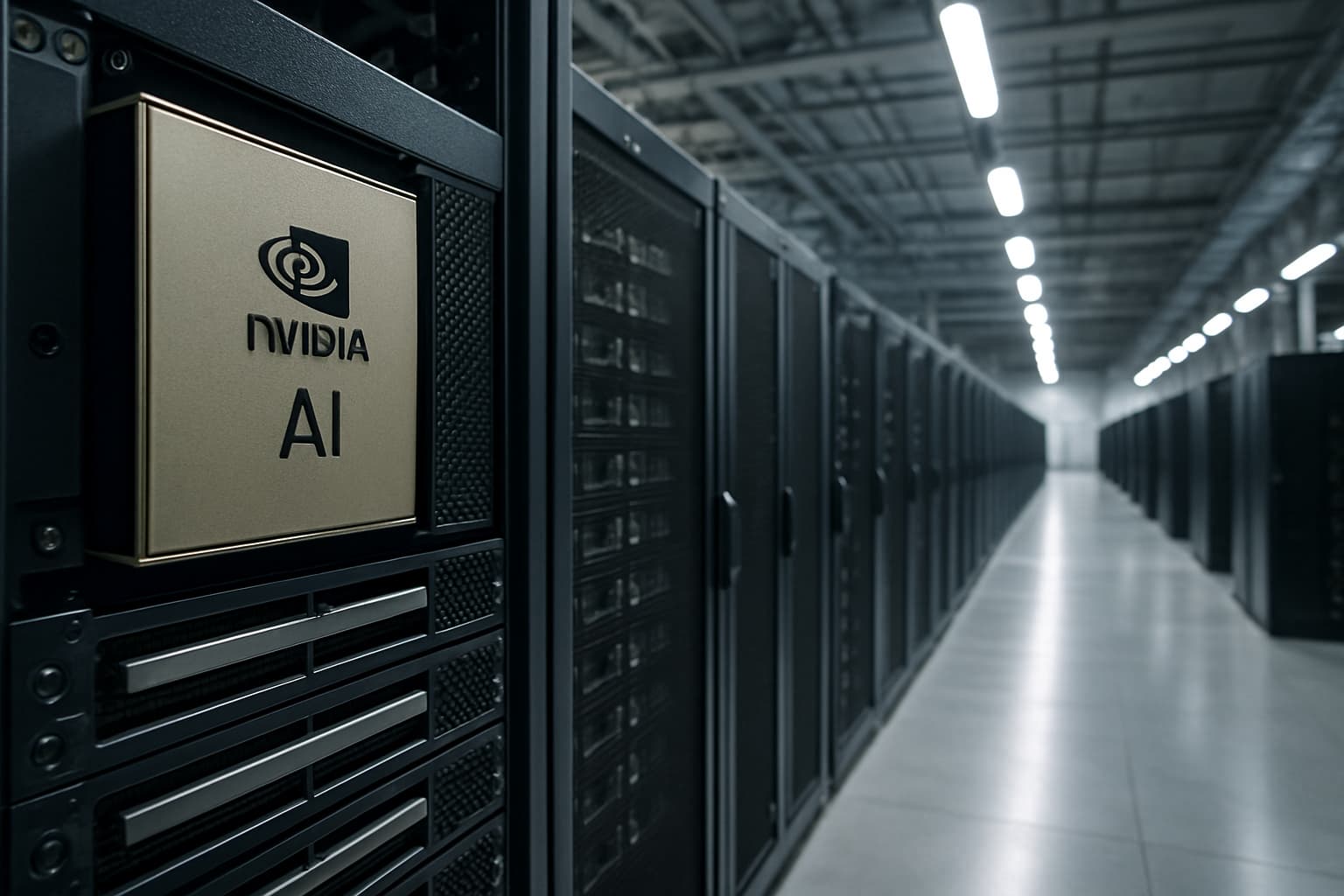



Nvidia has agreed to guarantee up to $105 billion in leases over 20 years for a massive 8-gigawatt data center OpenAI is building in Ohio, according to reporting this week, marking one of the largest infrastructure commitments in the history of the technology industry. The arrangement is part of a broader financing push in which Nvidia is working alongside Apollo, BlackRock, Blackstone, Brookfield, Goldman Sachs, and KKR to mobilize more than $500 billion in third-party capital for AI infrastructure. The scale of the deal dwarfs even the biggest AI model funding rounds of the past year, underscoring how the center of gravity in AI spending has shifted from training breakthroughs to the physical buildout of compute. It also deepens Nvidia's already extensive financial entanglement with OpenAI, its largest customer.
The announcement lands at a moment when the AI industry's appetite for computing power has begun to outstrip even the most aggressive private financing models, pushing chipmakers, cloud providers, and Wall Street's largest asset managers into increasingly unconventional arrangements. Data centers of this size, measured in gigawatts rather than megawatts, represent a new category of infrastructure project more comparable to utility-scale power plants than traditional server farms. That reality is forcing companies like Nvidia to move beyond selling chips and into guaranteeing the very financing structures that make such facilities possible, a shift with significant implications for how AI capacity gets built, who bears the risk, and how concentrated the industry's financial dependencies become.
Inside the $105 Billion Guarantee
The core of the deal centers on an 8-gigawatt data center OpenAI is constructing in Ohio, a facility whose power requirements alone rival those of a mid-sized city. Nvidia has committed to guarantee up to $105 billion in leases over a 20-year period, effectively derisking the project for lenders and investors who might otherwise balk at financing infrastructure tied to a single customer's AI ambitions. That guarantee structure allows OpenAI to secure the capital needed for construction without Nvidia directly funding the project outright, instead using its balance sheet and market position as collateral of sorts.
This is not the first time Nvidia has used its financial muscle to support OpenAI's infrastructure ambitions, but the scale here represents a marked escalation. Twenty-year lease guarantees are unusual even in traditional real estate and infrastructure finance, reflecting how confident Nvidia is in sustained, long-term demand for AI compute. It also reveals how deeply intertwined the fortunes of chipmakers and frontier AI labs have become, with each essentially underwriting the other's growth trajectory.
A $500 Billion Capital Mobilization Effort
Beyond the Ohio project, Nvidia is participating in a broader financing platform designed to mobilize more than $500 billion in AI infrastructure capital, working alongside some of the largest names in global finance: Apollo, BlackRock, Blackstone, Brookfield, Goldman Sachs, and KKR. The involvement of these firms signals that AI infrastructure has officially entered the realm of institutional-grade asset classes, comparable to how these same firms have historically financed toll roads, airports, and power grids. It also suggests that traditional venture capital and even hyperscaler balance sheets are no longer sufficient to fund the scale of buildout the industry believes it needs.
This kind of capital mobilization effort represents a structural shift in how AI growth gets financed. Rather than relying solely on equity raises or corporate cash reserves, the industry is now leaning on structured finance vehicles, lease guarantees, and long-duration debt instruments typically reserved for infrastructure megaprojects. Analysts note that this approach spreads risk across a wider pool of capital providers, but it also means that a slowdown in AI demand or a shift in the economics of inference could have ripple effects across parts of the financial system not traditionally exposed to tech volatility.
The Broader Infrastructure Arms Race
The Nvidia-OpenAI arrangement is the largest single item in a week full of major infrastructure and sovereign AI financing news. SoftBank is reportedly considering issuing a record ¥1 trillion bond, roughly $6.3 billion, to help repay bridge financing tied to its OpenAI stake and fund further AI deals. Meanwhile, Alibaba is raising $10.2 billion via a share placement specifically earmarked for deeper AI investment, and Tencent-backed chipmaker Enflame Technology is preparing a 6 billion yuan, or roughly $892 million, IPO on Shanghai's STAR Market.
These moves collectively point to a global race to secure both the compute capacity and the capital structures needed to sustain it. Mistral's multi-hundred-million-euro sovereign AI partnership with Saudi Arabia's HUMAIN reflects a parallel trend: nations and regional powers racing to build independent AI infrastructure rather than depending entirely on US hyperscalers. Taken together, these deals suggest 2026 may be remembered less for any single model breakthrough and more for the infrastructure financing arms race that made those breakthroughs possible.
We are entering an era where the constraint on AI progress isn't algorithms, it's gigawatts and capital, and the companies that can guarantee both will define the next decade of computing.
Risks and Ripple Effects
Not everyone views the scale of these commitments favorably. Critics point out that guaranteeing $105 billion in leases for a single data center creates concentrated exposure that could prove problematic if AI demand growth decelerates or if more efficient models reduce the compute intensity per query, a trend some smaller model releases have already begun to demonstrate. The circular nature of the financing, where a chipmaker guarantees leases for its largest customer's infrastructure, has also drawn scrutiny from analysts who see echoes of vendor financing arrangements that have caused problems in other capital-intensive industries.
Still, proponents argue that the sheer demand for inference and training capacity, driven by everything from enterprise adoption of coding agents to consumer use of chatbots, justifies the aggressive buildout. Smaller deals this week, including Stability AI's $76 million raise and Gatik's $200 million funding round for autonomous freight, illustrate that startup-level financing continues alongside the infrastructure megadeals, but the disparity in scale is stark. Whether the current pace of infrastructure investment proves prescient or overextended may become one of the defining economic questions of the AI era over the next several years.
Sources
- https://www.sciencedaily.com/news/computers_math/artificial_intelligence/
- https://www.crescendo.ai/news/latest-ai-news-and-updates
- https://ai.google/research/
- https://www.linkedin.com/top-content/innovation/ai-trends-and-innovations/recent-breakthroughs-in-ai-technology/
- https://www.reuters.com/technology/artificial-intelligence/
- https://binaryverseai.com/the-newest-ai-breakthroughs-this-week/
- https://techstartups.com/2026/03/06/this-week-in-ai-the-biggest-ai-news-breakthroughs-and-power-moves/
- https://www.artificialintelligence-news.com/
- https://www.youtube.com/watch?v=WoMitMc895A
- https://news.mit.edu/topic/artificial-intelligence2
- https://medium.com/no-time/17-recent-ai-breakthroughs-everyone-should-know-about-e6a3a2f15d31
Leave a Comment