






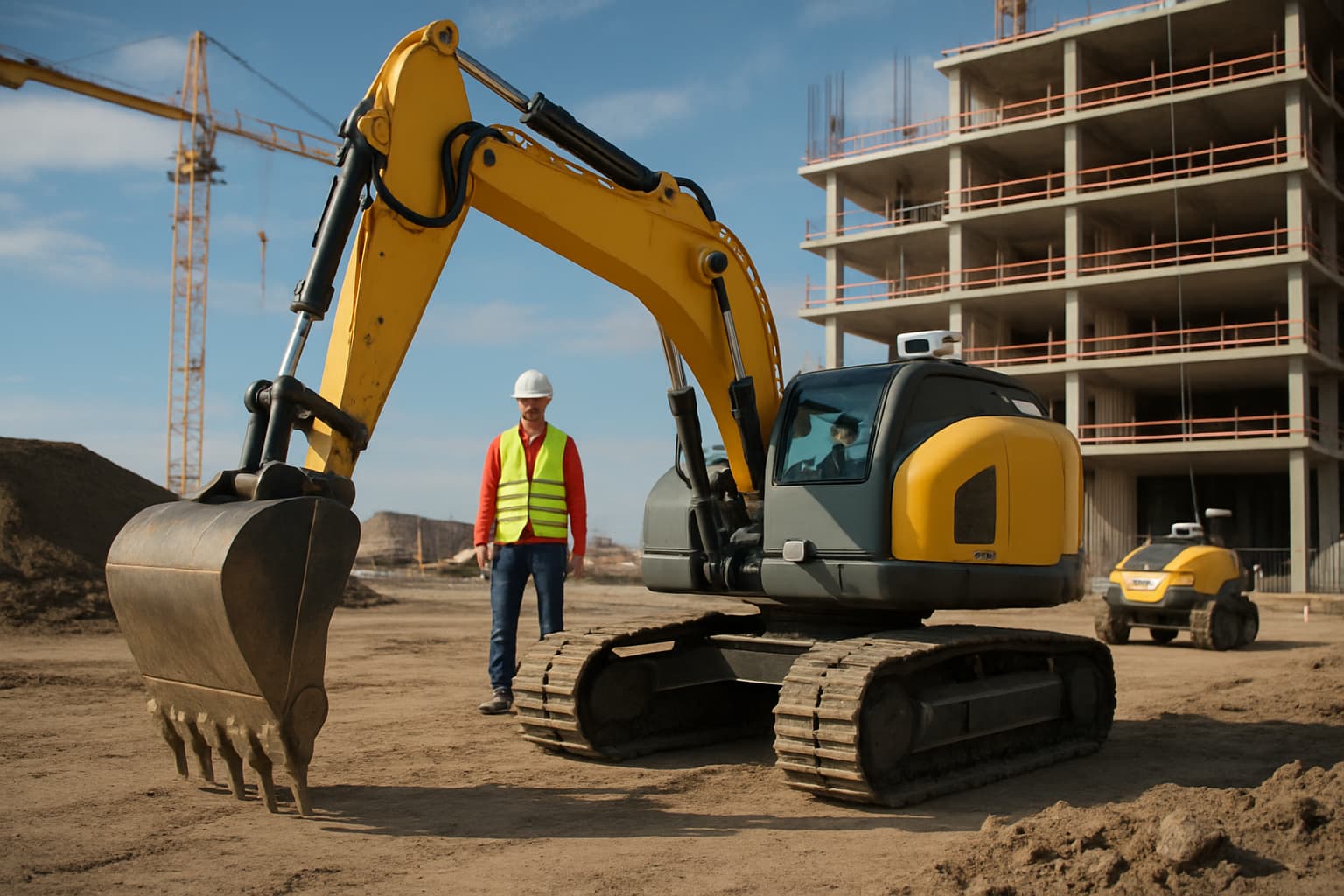



Gravis Robotics has raised $200 million to accelerate the deployment of autonomous construction equipment, marking one of the largest robotics financing events of 2026 and signaling that heavy industry is ready to bet big on machines that can grade, excavate, and move materials without a human operator in the seat. The round, disclosed this week, positions Gravis among a small group of well-capitalized startups racing to bring physical AI to one of the economy's most stubbornly manual sectors. Construction has long resisted automation due to unstructured terrain, shifting job sites, and safety liabilities, but investors are increasingly convinced that recent advances in robot perception and simulation have finally made the problem tractable. The infusion of capital comes as autonomous systems are also surging in adjacent sectors, from warehouse fulfillment to rail logistics, suggesting 2026 is becoming a pivotal year for physical AI leaving the lab.
The construction industry has been called the last major frontier for automation, hampered for decades by outdoor environments too chaotic for the rigid, cage-bound robots that transformed factories. Labor shortages, rising material costs, and tightening project timelines have made the case for autonomy more urgent, while breakthroughs in robot vision, simulation, and reinforcement learning have made it more technically feasible. Gravis Robotics' $200 million raise arrives alongside a wave of related announcements, including new autonomous warehouse and logistics systems and industrial-grade simulation tools from companies like NVIDIA, suggesting the capital markets and the technology stack are finally converging to make autonomous heavy equipment commercially viable rather than experimental.
A Record Bet on Autonomous Job Sites
The $200 million raised by Gravis Robotics ranks among the largest single funding events in the robotics sector so far in 2026, rivaling major rounds in warehouse and industrial automation. The scale of the investment underscores how quickly investor appetite has shifted toward physical AI companies that can demonstrate real-world deployment rather than laboratory prototypes. Construction automation has historically attracted smaller, more cautious rounds because of the capital intensity of heavy equipment and the liability risks of operating autonomous machinery around workers and public infrastructure.
Gravis's raise suggests that calculus is changing. Backers appear convinced that the same forces reshaping warehouse robotics and industrial manipulation, including cheaper compute, better simulation environments, and more robust machine vision, can now be applied to excavators, graders, and other heavy equipment operating on unstructured terrain. The funding will reportedly go toward scaling autonomous fleets, expanding software capabilities, and moving from pilot projects to sustained commercial deployment across active construction sites.
Why Construction Resisted Automation for So Long
Unlike factory floors, where robots operate within fixed, predictable environments, construction sites change daily. Ground conditions shift, materials arrive unpredictably, and dozens of workers, vehicles, and subcontractors move through the same space simultaneously. Traditional industrial robotics, which relies on rigid programming and controlled environments, simply does not translate to this chaos, which is why construction has lagged far behind manufacturing and logistics in automation adoption despite chronic labor shortages in the sector.
What has changed, according to industry observers, is the maturation of robot learning and simulation tools that can train autonomous systems on the kind of variability construction sites present. Advances in reinforcement learning, of the sort AgiBot has demonstrated by teaching robots new skills in minutes rather than weeks, combined with improved synthetic-data generation and simulation platforms, have given companies like Gravis a technical foundation that simply did not exist a few years ago. That foundation is what has allowed autonomous construction to move from novelty demonstrations to fundable, scalable businesses.
Part of a Broader Physical AI Funding Wave
Gravis's raise does not exist in isolation. It arrives amid a broader surge of capital and product announcements across physical AI, including Locus Robotics' launch of Locus Array for autonomous warehouse fulfillment, Logic Robotics' new autonomous pallet system for rail-to-road transloading, and ABB's expansion of its autonomous mobile robot lineup with the Flexley Stack F712 forklift. Collectively, these developments show that investors and manufacturers are no longer treating autonomy as a future bet but as an immediate operational necessity across logistics, warehousing, and now construction.
The common thread across these announcements is a shift away from rigid, purpose-built automation toward flexible systems that can adapt to changing environments and tasks. Locus Array, for example, moves robots to inventory rather than forcing inventory through fixed conveyor infrastructure, a philosophy that mirrors what Gravis appears to be attempting on construction sites: building autonomy that adapts to the job rather than requiring the job to be restructured around the machine.
The Technology Stack Making It Possible
Much of the recent progress in autonomous heavy equipment traces back to advances in simulation and perception tooling originally built for other robotics applications. NVIDIA's expanding physical AI stack, including Isaac GR00T open models, Cosmos world models, and updated simulation platforms like Isaac Sim 6.0, Isaac Lab 3.0, and Newton 1.0, has given robotics developers access to synthetic-data generation and training environments that were previously available only to well-funded research labs. These tools allow companies to train autonomous systems on millions of simulated scenarios before ever deploying hardware in the field, dramatically reducing the cost and risk of real-world testing.
For a company like Gravis, operating in an industry where mistakes can be costly and dangerous, this simulation-first approach is critical. Being able to expose an autonomous excavator or grader to thousands of edge cases in a virtual environment, from unstable soil to unexpected obstacles, before it ever touches a real job site, is precisely the kind of capability that has made investors comfortable writing nine-figure checks into construction robotics for the first time.
Construction sites are among the most dynamic and unpredictable environments in the physical world. What's changed is that we finally have the perception and learning systems to handle that unpredictability at scale, not just in a demo.
What Comes Next
The real test for Gravis will be whether its $200 million can translate into sustained commercial deployments rather than a handful of high-profile pilot projects. Construction firms have been burned before by automation promises that failed to survive contact with real job sites, and the sector's fragmented, project-based structure makes scaling notoriously difficult compared to the centralized operations of a warehouse or factory. Success will likely hinge on whether Gravis can prove reliability and safety across varied geographies, weather conditions, and regulatory environments.
Still, the size of the raise and its timing alongside major moves in warehouse robotics, industrial software, and robot vision suggest that 2026 may be remembered as the year physical AI infrastructure matured enough to tackle construction seriously. If Gravis can convert its capital into working fleets on active job sites, it could open the door for a wave of follow-on investment into a sector that has, until now, remained largely untouched by the automation revolution reshaping logistics and manufacturing.
Sources
- https://www.therobotreport.com/
- https://www.roboticstomorrow.com/stream/news/
- https://roboticsandautomationnews.com/
- https://www.therobotreport.com/robotics-news/
- https://www.therobotreport.com/category/robots-platforms/industrial-robots/
- https://techxplore.com/robotics-news/
- https://www.therobotreport.com/category/news/
- https://www.turingpost.com/p/roboticsupdates
- https://thesiliconreview.com/robotics
- https://www.therobotreport.com/top-10-robotic-stories-june-2026/
- https://robohub.app/news
- https://www.therobotreport.com/top-10-robotics-stories-of-may-2026/
- https://blogs.nvidia.com/blog/national-robotics-week-2026/
Leave a Comment