










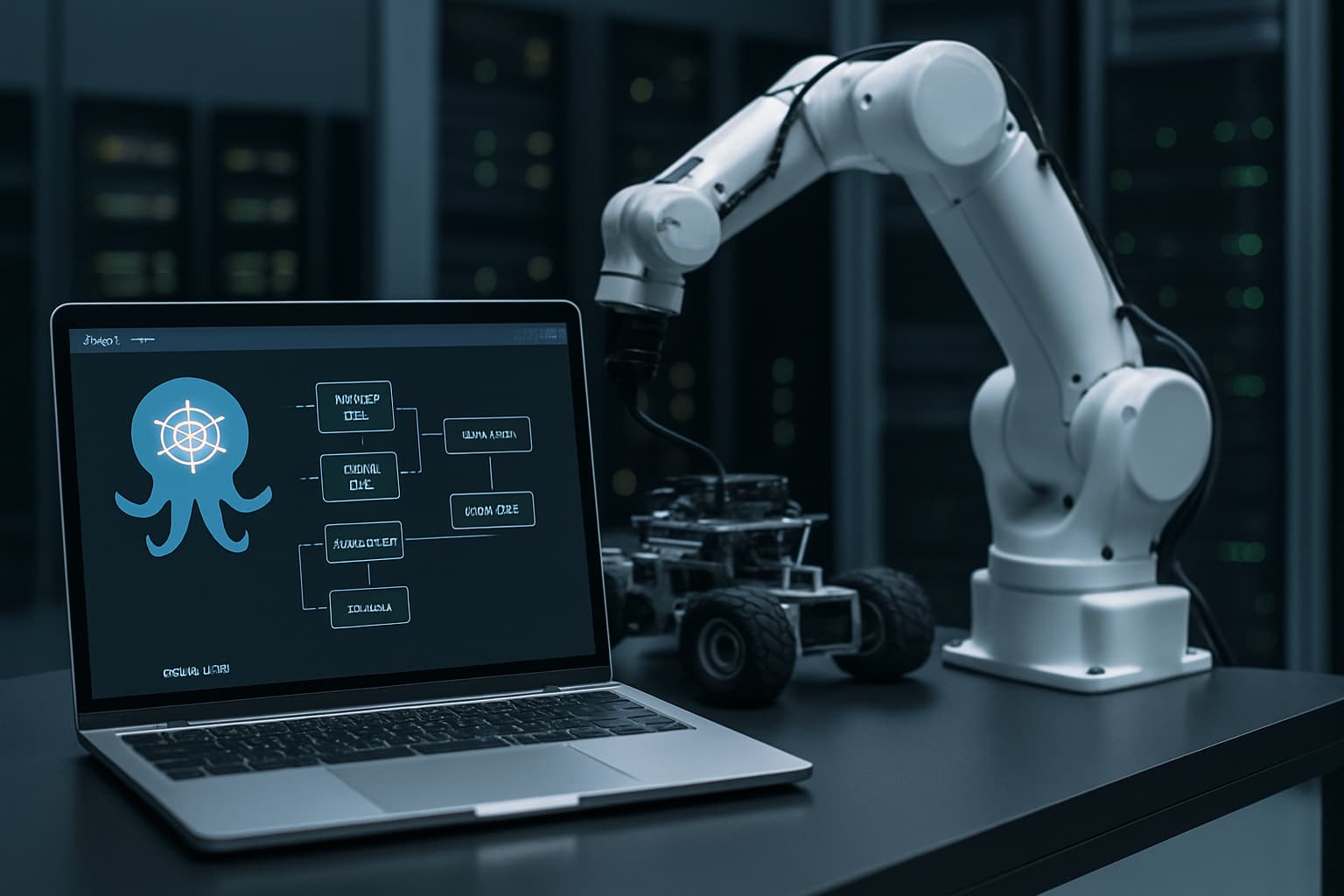



NVIDIA has open-sourced OSMO, a Kubernetes-native workflow orchestrator the company built internally to manage the sprawling compute demands of its robotics AI programs, including Project GR00T, Isaac Lab, and Isaac Sim. The tool lets robotics teams define training, simulation, and hardware-in-the-loop tasks in a single YAML file, then automatically routes those jobs to the right tier of compute, from massive GB200 data center clusters down to compact Jetson AGX Thor edge devices. The release, part of an unusually active week for developer infrastructure open-sourcing, arrives alongside Cloudflare's Forge code-generation pipeline and new agent frameworks from AWS, Microsoft, WSO2, and OpenAI. For an industry racing to build physical AI systems, OSMO addresses a problem that has quietly throttled progress: orchestrating workloads across wildly different hardware without writing custom infrastructure code for every project.
***
The release lands at a moment when robotics and physical AI have become one of the most capital-intensive and infrastructure-hungry corners of the technology industry, with humanoid robots moving from demo stages to factory floors and simulation increasingly standing in for scarce real-world training data. NVIDIA's decision to give away a tool it built for its own flagship robotics projects signals a strategic bet: the company would rather set the orchestration standard that the rest of the robotics industry builds on top of, extending its dominance from chips and simulation software into the workflow layer that ties everything together. It also reflects a broader pattern this week, in which major infrastructure providers, from Cloudflare to AWS to Microsoft, chose to open-source tooling rather than keep it proprietary, a sign that platform companies increasingly see developer adoption, not licensing fees, as the real prize.
What OSMO Actually Does
At its core, OSMO is a workflow orchestrator built on Kubernetes, the dominant system for managing containerized applications at scale. What sets it apart from generic Kubernetes tooling is its specific focus on the robotics development lifecycle, which typically spans several distinct compute environments: large-scale training on data center GPUs, physics simulation on dedicated clusters, and final validation on the actual embedded hardware that will ship inside a robot.
Historically, moving a job between these environments required robotics engineers to write custom infrastructure code tailored to each compute tier, a process NVIDIA says consumed significant engineering time that could otherwise go toward the actual AI models. OSMO collapses that complexity into a single YAML configuration file, letting a developer describe a training job, a simulation run, or a hardware-in-the-loop test once and have the orchestrator figure out where and how to run it, whether that destination is a GB200 cluster in a data center or a Jetson AGX Thor module embedded in a robot.
NVIDIA has used OSMO internally across three of its most prominent robotics initiatives: Project GR00T, its foundation model effort for humanoid robots; Isaac Lab, its reinforcement learning framework; and Isaac Sim, its simulation platform built on Omniverse. The fact that NVIDIA trusted OSMO to manage workflows across all three suggests the tool has already been stress-tested against the kind of production complexity that smaller robotics startups are only now beginning to encounter.
Why NVIDIA Is Giving This Away
Open-sourcing an internal orchestration tool is a calculated move rather than a charitable one. By releasing OSMO publicly, NVIDIA positions itself as the default infrastructure layer for an entire generation of robotics companies that are building on its GPUs, its Isaac simulation tools, and now, potentially, its workflow orchestration as well. Every robotics team that adopts OSMO becomes more deeply embedded in NVIDIA's ecosystem, reinforcing the company's position at nearly every layer of the physical AI stack, from silicon to software.
This mirrors a strategy NVIDIA has used before with tools like Isaac Sim and its broader Omniverse platform: give away the software that makes its hardware more valuable. As robotics compute power has scaled dramatically in recent years, with some estimates putting the increase at roughly a thousandfold over eight years, the bottleneck for many teams has shifted from raw compute availability to the software complexity of actually using that compute efficiently across heterogeneous environments. OSMO is NVIDIA's answer to that shift.
The timing also aligns with a broader industry narrative in which humanoid robots and physical AI systems are moving out of controlled demonstrations and into real production environments, including factory floors. Companies deploying robots at scale need infrastructure that can reliably move a model from simulation to hardware testing to field deployment without introducing new bugs or delays at each transition, and NVIDIA is betting that OSMO becomes the tool that makes those transitions routine rather than exceptional.
A Week Stacked With Open-Source Infrastructure Bets
OSMO's release did not happen in isolation. Cloudflare simultaneously open-sourced Forge, a code generation pipeline designed to automatically produce SDKs, CLIs, and documentation, a tool aimed squarely at reducing the manual maintenance burden that platform companies face as their APIs multiply. AWS, for its part, released Strands Harness on September 21, an open-source agent framework capable of running locally or across any cloud environment, explicitly designed to avoid locking developers into AWS infrastructure alone.
Microsoft shipped version 1.19.0 of its Agent Framework on September 18, stabilizing Python AG-UI hosting and adding workflow recovery capabilities, while WSO2 reached general availability for Agent Manager on September 15, an open-source control plane for governing AI agents across different frameworks, models, and deployment targets. OpenAI rounded out the month by launching its Agents API in public beta on September 10, exposing the orchestration infrastructure that powers its own Codex product to outside developers.
Taken together, these releases describe an industry-wide shift in strategy. Rather than compete purely on proprietary platforms, major infrastructure providers are racing to open-source the control planes, orchestrators, and frameworks that sit underneath AI applications, essentially competing to become the substrate that everyone else builds on. For robotics specifically, OSMO's arrival suggests that the chaotic, bespoke infrastructure practices that have characterized early robotics AI development may be consolidating around a small number of standardized, NVIDIA-adjacent tools.
Robotics teams were writing the same orchestration glue code over and over, just to move a job from a simulation cluster to a physical robot. OSMO was built to make that boundary disappear.
What It Means for Robotics Developers
For engineering teams building robotics products, OSMO's open-source release lowers a real barrier to entry. Smaller robotics startups, which often lack the dedicated infrastructure engineering teams that a company like NVIDIA can deploy, have historically struggled to build the orchestration layer needed to move seamlessly between simulation and physical testing. A freely available, battle-tested tool addresses that gap directly, potentially accelerating the pace at which smaller players can iterate on humanoid robots, industrial automation systems, and other physical AI products.
Sources
- https://monday.com/blog/rnd/software-development-tools/
- https://www.g2.com/best-software-companies/top-development
- https://fullscale.io/blog/software-development-tools/
- https://www.designrush.com/agency/software-development/trends/best-software-development-tools
- https://thectoclub.com/tools/best-software-development-tools/
- https://www.spaceotechnologies.com/blog/software-development-tools/
- https://www.softwaretestinghelp.com/software-development-tools/
- https://worldmetrics.org/best/software-developer-software/
- https://riseuplabs.com/software-development-tools-to-use/
- https://keploy.io/blog/community/software-development-tools
- https://www.cloudzero.com/blog/software-development-tools/
Leave a Comment