





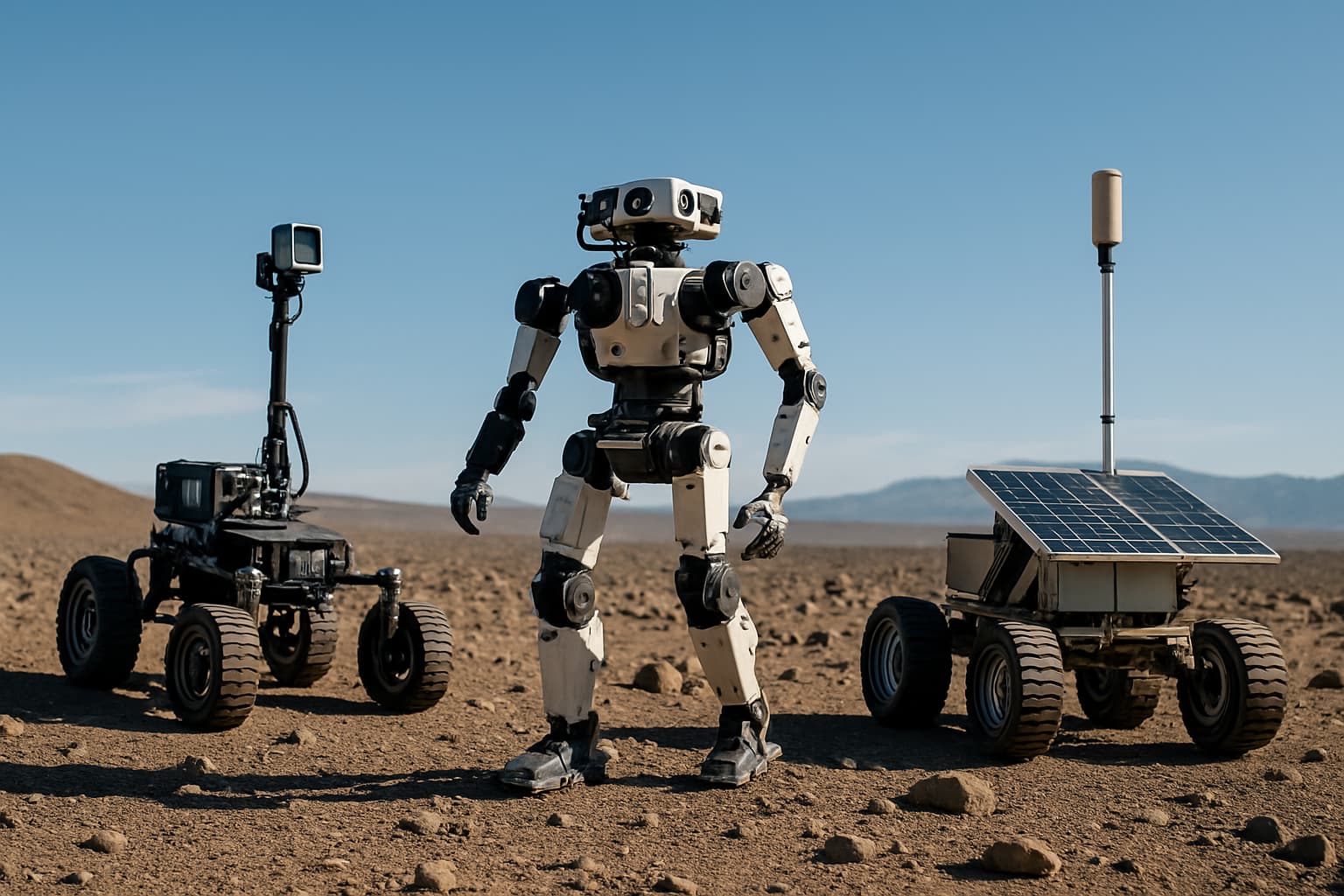



NASA has quietly crossed a threshold that could reshape planetary exploration: three robots tested under the agency's ASTRA project demonstrated the ability to make independent scientific decisions in the field, assessing risks and adjusting their own plans without waiting for instructions from human controllers. The tests mark one of the clearest real-world demonstrations yet of autonomous scientific reasoning outside a lab, a capability NASA says could underpin future robotic missions to the Moon and Mars. Unlike remotely operated rovers that depend on round-trip commands from Earth, these systems were built to react and adapt on their own. The development arrives amid a broader wave of robotics progress, but it stands out for tackling one of the field's hardest problems: autonomy in environments where there is no room for error and no quick way to phone home.
For decades, planetary robots like the Mars rovers have operated on a tight leash, executing pre-scripted commands uploaded from mission control and waiting, sometimes for twenty minutes or more, for a response to any unexpected finding. That latency is a fundamental constraint on deep-space science, and it becomes untenable for missions to more distant or time-sensitive targets. NASA's ASTRA tests suggest a path around that bottleneck, one where robots themselves decide what is worth investigating, what risks are acceptable, and how to replan when conditions change. The timing matters: as NASA and international partners plan a more permanent return to the Moon and eventual human missions to Mars, the agency needs scouts that can conduct real science long before astronauts arrive, and do it without constant supervision.
What ASTRA's Robots Actually Did
The ASTRA project, short for Autonomous Science Target Recognition and Analysis, put three robots through field tests designed to simulate the kinds of unpredictable conditions they would face on another world. Rather than following a fixed itinerary of waypoints and sampling targets dictated in advance by scientists on Earth, the robots were given the latitude to evaluate their surroundings, identify features of scientific interest, and determine for themselves whether a planned action was still the right one given new information.
According to NASA's account of the testing, the robots demonstrated the ability to assess risk on the fly, for example recognizing terrain that might be hazardous or recalculating a path when an obstacle or anomaly appeared, and to adjust their mission plans accordingly without a human operator stepping in. That kind of layered decision-making, blending perception, risk evaluation, and replanning, is precisely what engineers have struggled to make reliable enough for deployment on costly, irreplaceable hardware millions of miles from home.
Why Communication Delay Is the Real Enemy
The core problem ASTRA is built to solve is physics, not software. Radio signals between Earth and Mars take anywhere from about four to twenty-four minutes one way depending on orbital positions, which means a rover that spots something unusual cannot simply ask mission control what to do and get a quick answer. Every round-trip command cycle costs a mission precious operational time, and in fast-changing environments, such as a dust storm rolling in or unstable terrain underfoot, that delay can turn a minor issue into a mission-ending one.
Autonomous decision-making shrinks that gap to zero by letting the robot itself own the call. NASA's framing of the ASTRA results as relevant to future Moon and Mars missions underscores that this is not an academic exercise. The agency is actively planning longer-duration, more scientifically ambitious missions, and robots that can operate independently for extended stretches, prioritizing their own science targets and avoiding hazards without supervision, are treated as a prerequisite rather than a bonus.
Part of a Broader Autonomy Push
NASA's work lands alongside a cluster of other developments suggesting that 2026 is a turning point for robots acting independently in uncontrolled, real-world settings. At MIT, engineers unveiled a new AI control system for a tiny flying robot that gave it insect-like agility, boosting its speed by roughly 450 percent and enabling it to complete ten somersaults in eleven seconds, a dramatic demonstration of how much headroom remains in robotic control software even on hardware that has existed for years. The breakthrough did not come from a redesigned robot body, but from smarter, faster decision-making baked into its flight controller, a parallel to what NASA achieved with ASTRA's ground-based explorers.
Separately, researchers have reported safer robot navigation methods that reduced crash rates by more than 99 percent in testing, though those results remain lab-stage findings rather than field-proven systems. Taken together, these threads point to the same underlying shift: robotics progress in 2026 is increasingly about giving machines the judgment to operate without constant human oversight, whether that machine is a Mars-bound rover, a palm-sized drone, or a warehouse forklift.
These robots are not just executing a checklist anymore. They are weighing options, recognizing when something doesn't match the plan, and deciding what to do next, which is exactly the kind of judgment we need for missions where you can't wait twenty minutes for an answer from Earth.
The Road to Autonomous Planetary Science
None of this means NASA is ready to send a fully independent robot geologist to Mars tomorrow. ASTRA's tests were conducted on Earth under conditions meant to approximate, but not perfectly replicate, the unpredictability of another world, and mission planners will need extensive validation before trusting an autonomous system with irreplaceable hardware on a multibillion-dollar mission. Engineers will also need to resolve thorny questions about how much autonomy to grant a robot before human scientists lose meaningful oversight of what gets explored and why.
Still, the direction of travel is clear. As NASA, commercial partners, and international space agencies plan an expanded cadence of lunar missions this decade and eye crewed Mars exploration in the following one, the agency's own roadmap increasingly treats autonomous scientific judgment as foundational infrastructure, not a future luxury. If ASTRA's approach matures into flight-ready systems, the robots that scout the Moon and Mars in the next decade may spend far less time waiting on Earth and far more time making discoveries on their own terms.
Sources
- https://www.businessinsider.com/category/robotics
- https://www.scmp.com/topics/robotics
- https://techxplore.com/robotics-news/
- https://www.calcalistech.com/tags/Robotics
- https://techcrunch.com/category/robotics/
- https://www.sciencedaily.com/news/computers_math/robotics/
- https://roboticsandautomationnews.com/
- https://newatlas.com/robotics/
- https://www.newsnow.com/us/Tech/Cutting+Edge/Robotics
- https://www.businesswire.com/newsroom/industry/technology/robotics
- https://www.therobotreport.com/robotics-news/
- https://www.automate.org/automation-news-center
- https://www.therobotreport.com/
Leave a Comment