





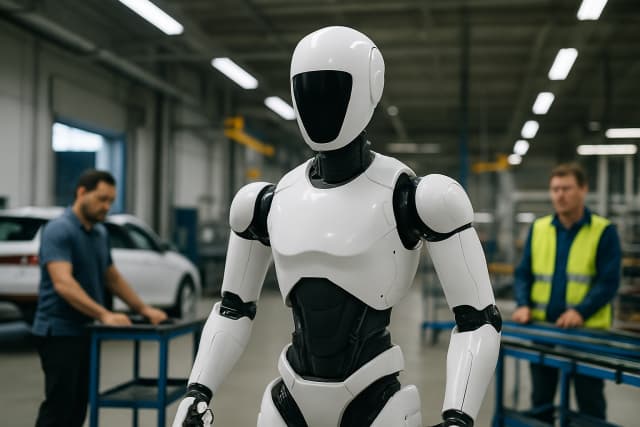
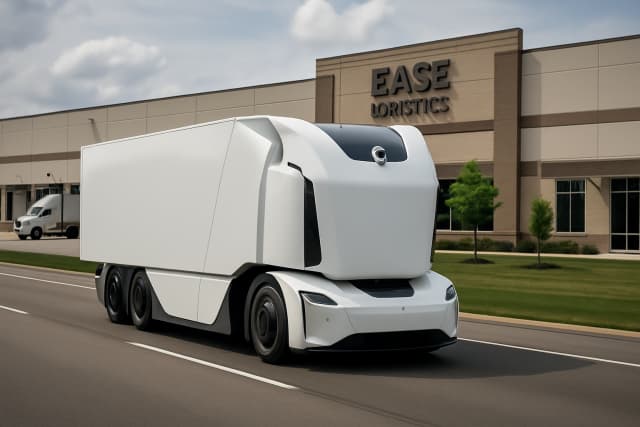
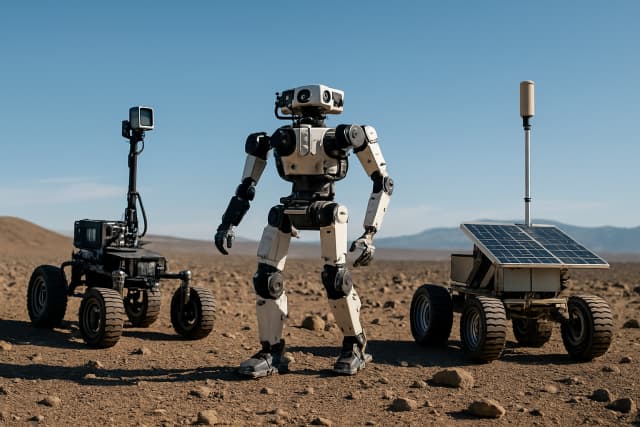
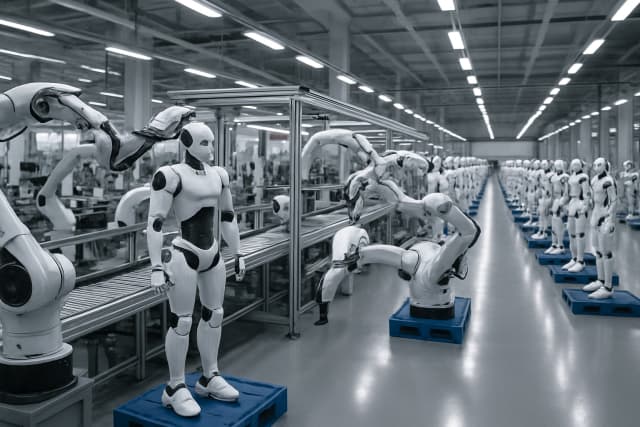







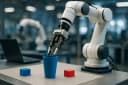




NVIDIA announced major advances in physical AI at its recent GTC conference, unveiling Isaac GR00T open models for natural-language robot task execution, Cosmos world models for generating synthetic training data, and the open-source Newton 1.0 physics engine. The announcements represent a significant leap toward robots that can perceive, reason, and act autonomously in real-world environments. These foundation models are designed to push robotics beyond isolated demonstrations into practical deployment across manufacturing, logistics, and other industries.
The robotics industry is experiencing a fundamental shift as foundation models, improved sensors, and cheaper hardware converge to enable truly autonomous systems. NVIDIA's latest releases address critical bottlenecks that have limited robot deployment at scale, particularly the challenge of training robots to understand natural language commands and operate reliably in unstructured environments. This represents part of a broader transformation where robotics is moving from research labs into commercial applications.
Isaac GR00T Enables Natural Language Robot Control
The Isaac GR00T open models represent a breakthrough in making robots more accessible to non-technical users by enabling natural language task execution. Rather than requiring complex programming or specialized interfaces, robots equipped with GR00T can understand and execute commands given in plain English. This capability addresses one of the biggest barriers to widespread robot adoption in industries where workers need to quickly adapt robot behavior without extensive technical training.
The open-source nature of Isaac GR00T is particularly significant for the robotics ecosystem, as it allows developers and manufacturers to build upon NVIDIA's foundation models without licensing restrictions. This approach mirrors the success of open AI models in other domains and could accelerate innovation across the robotics industry. Companies can customize and fine-tune the models for specific applications while benefiting from NVIDIA's substantial investment in foundational research and development.
Cosmos World Models Solve Training Data Bottleneck
NVIDIA's Cosmos world models address a critical challenge in robot development: the scarcity of high-quality training data for real-world scenarios. Traditional robot training requires extensive data collection in physical environments, which is time-consuming, expensive, and often impractical for edge cases or dangerous situations. Cosmos generates synthetic training data that can simulate diverse scenarios, weather conditions, lighting variations, and unexpected obstacles that robots might encounter.
The synthetic data approach enables robots to be trained on millions of scenarios before ever encountering them in the real world, significantly improving their robustness and reliability. This capability is especially valuable for applications like autonomous manufacturing and logistics, where robots must handle unpredictable variations in their environment. By reducing dependence on real-world data collection, Cosmos could dramatically accelerate robot development cycles and reduce deployment costs.
Newton Physics Engine Advances Dexterous Manipulation
The open-source Newton 1.0 physics engine represents NVIDIA's effort to solve one of robotics' most complex challenges: dexterous manipulation in realistic simulations. Accurate physics simulation is crucial for training robots to handle delicate objects, perform precise assembly tasks, and navigate complex physical interactions. Newton 1.0 provides stable simulation capabilities that better mirror real-world physics, enabling more effective training for manipulation tasks.
By making Newton 1.0 open-source, NVIDIA is democratizing access to advanced physics simulation tools that were previously available only to well-funded research institutions and large corporations. This move could accelerate innovation in areas like surgical robotics, precision manufacturing, and service robotics where dexterous manipulation is essential. The engine's focus on stability addresses long-standing issues with physics simulation that have hindered the transfer of skills from simulated to real-world environments.
Industry Momentum Building Toward Commercial Deployment
NVIDIA's announcements come as the broader robotics industry shows strong momentum toward commercial deployment. Amazon recently reported operating its one millionth robot and achieving 10% travel time reductions through its Deep Fleet AI orchestration system, demonstrating that large-scale robot deployment is already delivering measurable benefits. Meanwhile, venture funding reached $6.1 billion in 2024, up 19% year over year, indicating continued investor confidence in the sector's commercial potential.
The convergence of NVIDIA's foundation models with advances across the industry suggests that 2026 could mark an inflection point for robotics adoption. Companies are moving beyond pilot projects toward multi-robot deployments in manufacturing, logistics, and energy applications. However, challenges remain around hardware maturity, manufacturing complexity, and the need for proven return on investment before widespread adoption occurs.
Foundation models, better sensors, cheaper hardware, and simulation are pushing autonomous systems from demos into deployment, with physical AI leading the charge in real-world applications.
Path Forward for Physical AI Systems
The release of Isaac GR00T, Cosmos, and Newton 1.0 positions NVIDIA as a central enabler of the shift toward general-purpose autonomous systems. Rather than building robots for single, specific tasks, the industry is moving toward platforms that can adapt to multiple applications and environments. This approach mirrors the evolution of computing from specialized machines to general-purpose computers that can run diverse software applications.
Looking ahead, the success of these foundation models will likely depend on how quickly the robotics ecosystem adopts and builds upon NVIDIA's open-source tools. Early indicators suggest strong industry interest, particularly in manufacturing and logistics where the combination of labor shortages and operational pressures creates compelling use cases for autonomous systems. The next 12-18 months will be crucial for demonstrating whether these technological advances can translate into reliable, cost-effective robot deployments at commercial scale.
Sources
- https://www.globalxetfs.com/articles/robotics-breakthroughs-in-automation/
- https://www.youtube.com/watch?v=JHg7jn_uRY0
- https://www.massrobotics.org/flexxbotics-publishes-new-white-paper-on-autonomous-process-control-apc-using-robotics-and-automated-inspection-in-manufacturing/
- https://blogs.nvidia.com/blog/national-robotics-week-2026/
- https://www.bvp.com/atlas/50-startups-transforming-industries-with-physical-ai
- https://cset.georgetown.edu/publication/physical-ai/
- https://www.therobotreport.com
- https://www.techuk.org/accelerating-innovation/robotics.html
- https://www.fictiv.com/articles/humanoid-robotics-manufacturing-impact
- https://ifactory.jrsinnovation.com/blog/humanoid-robots-manufacturing-industrial-automation-future
- https://www.slsbearings.com/sg-en/blog/humanoid-robots-in-manufacturing-the-future-of-factory-automation
Leave a Comment