





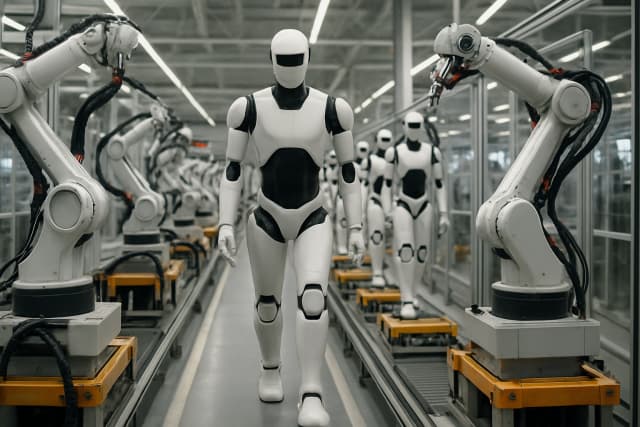





Amazon has deployed its one millionth production robot across its global fulfillment network, marking a watershed moment for warehouse automation at unprecedented scale. The e-commerce giant is now using a new generative AI foundation model called Deep Fleet to coordinate robot movement across more than 300 global facilities, representing the largest coordinated robot deployment in commercial history. This milestone comes as the broader robotics industry shifts from narrow demonstrations to operational deployments that are reshaping how goods move through the global supply chain.
The achievement underscores how artificial intelligence and robotics are converging to solve logistics challenges that were unthinkable just a decade ago. While other tech giants focus on humanoid robots and factory automation, Amazon's approach demonstrates the power of scaling proven robotic systems with advanced AI coordination, potentially setting the template for how autonomous systems will manage complex industrial operations across industries.
Deep Fleet AI Orchestrates Massive Robot Network
Amazon's Deep Fleet represents a breakthrough in multi-robot coordination, using generative AI foundation models to manage robot movements across hundreds of facilities simultaneously. Unlike traditional warehouse management systems that rely on pre-programmed routes and schedules, Deep Fleet can adapt in real-time to changing conditions, peak demand periods, and facility-specific constraints. The system represents a fundamental shift from managing individual robots to orchestrating entire robotic ecosystems.
The scale of coordination required is staggering: with one million robots now operational, Amazon must manage millions of individual movements, pickups, and deliveries every hour across its global network. Deep Fleet's generative AI approach allows the system to predict optimal robot behavior patterns and adapt to unforeseen circumstances without human intervention. This level of autonomous coordination was previously impossible with conventional warehouse management software.
One Million Robot Milestone Signals Industry Maturation
The one millionth robot deployment represents more than just a numerical milestone—it demonstrates that warehouse robotics has moved beyond pilot programs to become core infrastructure for modern commerce. Amazon's robot fleet now includes a diverse array of systems handling everything from inventory movement to package sorting, with each robot contributing to a coordinated workflow that processes billions of items annually. This scale gives Amazon unprecedented data on robot performance and optimization opportunities.
Industry analysts note that Amazon's achievement comes as robotics deployments are accelerating across multiple sectors, driven by breakthrough AI foundation models, lower hardware costs, and persistent labor shortages. The milestone positions Amazon significantly ahead of competitors in terms of both robot deployment scale and operational experience. Other logistics companies are now racing to catch up, but Amazon's head start in both robot deployment and AI coordination gives it substantial competitive advantages.
Beyond Amazon: Industry-Wide Automation Surge
Amazon's milestone comes amid broader industry momentum in warehouse automation and robot coordination. MIT researchers are developing AI systems for warehouse traffic control that learn which robots should get right of way in real-time to reduce congestion and increase throughput. Meanwhile, companies like Festo have launched GripperAI software that lets robots handle mixed, unfamiliar, and randomly positioned products without extensive programming—addressing one of the key flexibility challenges in warehouse operations.
The convergence of these technologies suggests that warehouse automation is entering a new phase where robots can handle increasingly complex and varied tasks. Multiple robotics startups are reporting deployment milestones, including AgiBot's real-world reinforcement learning systems and partnerships between delivery companies and autonomous robot providers. This wave of innovation is being driven by the same AI foundation models that power language systems, but adapted for physical world applications.
The sector is moving from labs to factory floors and households, though robotics has not yet reached a true ChatGPT moment
Implications for Labor and Supply Chain Resilience
Amazon's robot deployment scale raises important questions about the future of warehouse work, but the company has consistently argued that robots augment rather than replace human workers by handling repetitive and physically demanding tasks. The Deep Fleet system is designed to optimize human-robot collaboration, routing robots to support workers rather than compete with them. However, the sheer scale of automation inevitably changes the nature of warehouse work and the skills required for logistics careers.
From a supply chain perspective, Amazon's million-robot network provides unprecedented resilience and adaptability. The Deep Fleet AI system can rapidly reconfigure operations during peak demand periods, supply disruptions, or facility outages by redistributing workloads across the robot network. This capability proved crucial during pandemic-driven demand spikes and will become increasingly valuable as global supply chains face continued uncertainty. The success of Amazon's approach is likely to accelerate adoption of similar systems across retail, manufacturing, and logistics industries worldwide.
Sources
- https://www.youtube.com/watch?v=JHg7jn_uRY0
- https://novushitech.com/robotics-advancements-and-automation/
- https://www.ecpi.edu/blog/7-latest-innovations-in-robotics
- https://roboticsandautomationnews.com
- https://www.bvp.com/atlas/50-startups-transforming-industries-with-physical-ai
- https://news.mit.edu/topic/robotics
- https://www.therobotreport.com
- https://neura-robotics.com
- https://www.techuk.org/accelerating-innovation/robotics.html
- https://www.fictiv.com/articles/humanoid-robotics-manufacturing-impact
- https://www.slsbearings.com/sg-en/blog/humanoid-robots-in-manufacturing-the-future-of-factory-automation
- https://www.youtube.com/watch?v=fxdttSshmRg
Leave a Comment