






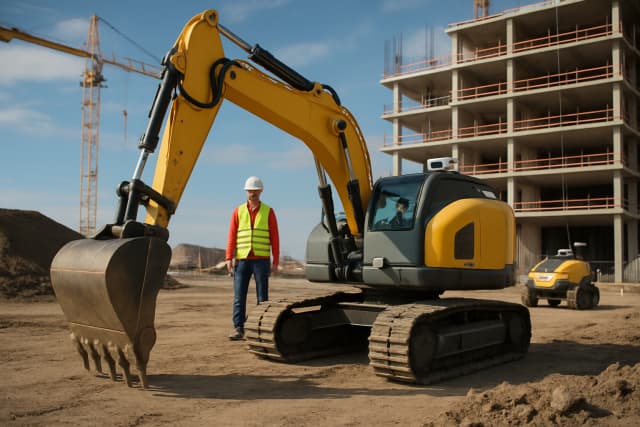










The robotics industry has reached a pivotal inflection point, with compute power improving by approximately 1,000 times over the past eight years—far outpacing traditional Moore's Law expectations. This dramatic acceleration in processing capability is enabling autonomous robots to move beyond limited pilot projects into scaled industrial deployment across warehouses, factories, and logistics operations worldwide. The breakthrough represents a fundamental shift from hardware-driven innovation to software-led advances powered by AI, simulation, and dramatically cheaper computing resources.
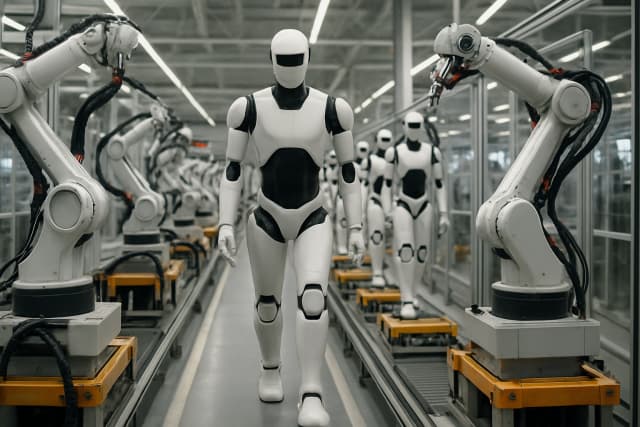
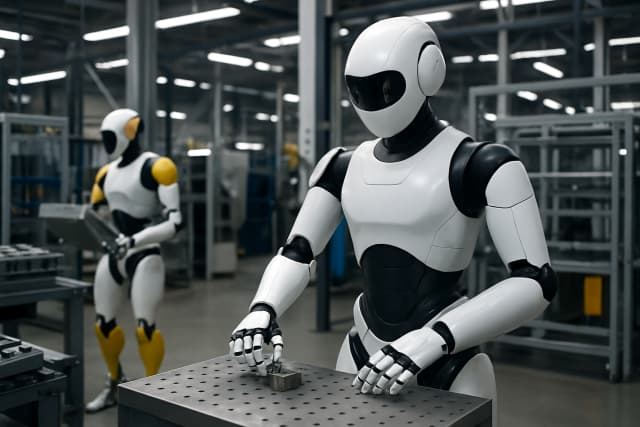
According to the World Economic Forum, autonomous robots are now operating at scale in ports, warehouses, and factories, marking the transition from experimental technology to essential industrial infrastructure. The convergence of accelerated computing, advanced AI models, and narrowing simulation-to-reality gaps has created what industry experts describe as the first true wave of practical robotics deployment at enterprise scale.
Computing Revolution Drives Robotics Transformation
The 1,000-fold increase in robotics compute power over eight years represents one of the most dramatic technology accelerations in recent industrial history. This improvement has fundamentally changed what robots can accomplish in real-time, enabling complex decision-making, advanced perception, and adaptive behavior that were previously impossible outside research laboratories. The computing breakthrough has made it economically viable for companies to deploy sophisticated autonomous systems at scale.
Unlike traditional hardware-focused robotics development, today's breakthroughs are primarily software-led, driven by advances in AI models, training infrastructure, and simulation pipelines. This shift explains why multiple robot categories—from humanoids to warehouse systems to autonomous trucks—are all advancing simultaneously rather than in isolation. The common thread is the shared foundation of dramatically improved computational capability that enables sophisticated AI-driven decision-making across all robotic platforms.
Simulation-to-Reality Gap Closes Through Digital Twins
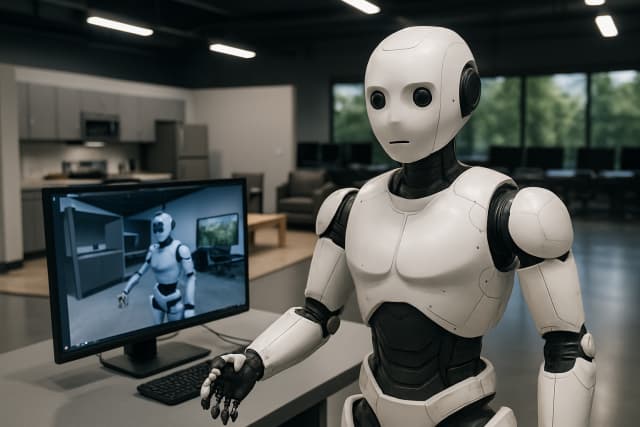
The narrowing simulation-to-reality gap has emerged as a critical enabler of scaled robotics deployment, with robots now trained extensively in virtual environments using digital twins and synthetic data before real-world deployment. This approach dramatically reduces the time and cost required to develop and test robotic systems, while enabling safer experimentation with complex scenarios that would be difficult or dangerous to recreate in physical environments. Companies can now simulate thousands of operational hours in compressed timeframes, accelerating development cycles.
Digital twin technology has matured to the point where virtual training environments can accurately predict real-world performance across diverse industrial applications. This capability has proven especially valuable in warehouse and factory settings, where robots must navigate complex, dynamic environments while interacting safely with human workers and handling varied inventory or production tasks.
Vision-Language-Action Models Enable Complex Operations
Advanced Vision-Language-Action models are revolutionizing how robots interpret commands and handle unfamiliar situations, moving beyond rigid programming to more flexible, adaptive behavior. These AI systems allow robots to understand complex verbal instructions, interpret visual environments, and execute appropriate physical actions—capabilities that were previously limited to carefully scripted scenarios. The technology enables robots to work effectively in dynamic environments where conditions and requirements frequently change.
The integration of agentic AI represents the next frontier, combining analytical AI for decision-making with generative AI for adaptability in messy real-world settings. This hybrid approach allows robots to not only follow programmed routines but also adapt their behavior based on environmental feedback and changing operational requirements, making them far more valuable in practical industrial applications.
Major Industry Players Drive Deployment Scale
Significant industry developments are accelerating the transition to scaled deployment, with companies like Nvidia launching the Isaac GR00T Reference Humanoid Robot platform and Festo introducing GripperAI for flexible handling applications. Standard Bots recently secured $200 million in Series C funding, demonstrating strong investor confidence in the commercial viability of advanced robotics systems. These developments reflect a broader industry shift toward production-ready solutions rather than experimental prototypes.
The Robot Report highlights growing deployment momentum across autonomy-heavy use cases, including robot deliveries, robotaxis, and Level 4 autonomous trucks. This diverse application range demonstrates that the underlying compute and AI advances are enabling breakthroughs across multiple robotics categories simultaneously, rather than being limited to specific use cases or environments.
AI-enabled robotics, autonomous mobile systems, and human-robot collaboration are accelerating innovation, with generative AI shifting robotics from rule-based automation toward more self-evolving systems.
Economic Drivers and Future Implications
The combination of falling hardware costs and improving capabilities has created favorable economic conditions for companies to test and deploy autonomous systems at scale. This cost reduction, coupled with the dramatic improvements in compute power and AI capabilities, has reached a tipping point where robotics deployments can deliver clear return on investment across a wide range of industrial applications. The economic case for robotics has shifted from experimental investment to operational necessity in many sectors.
As the International Federation of Robotics notes, the shift from rule-based automation toward self-evolving systems powered by generative AI represents a fundamental change in how industrial automation will develop. This evolution suggests that current deployments are just the beginning of a broader transformation that will see robots become increasingly autonomous and capable of handling complex, unpredictable tasks that have traditionally required human intelligence and adaptability.
Sources
- https://www.weforum.org/stories/2026/03/advances-in-autonomous-robotics-what-comes-next/
- https://ifr.org/news
- https://novushitech.com/robotics-advancements-and-automation/
- https://www.youtube.com/watch?v=EJ1oakzzfn0
- https://www.ecpi.edu/blog/7-latest-innovations-in-robotics
- https://roboticsandautomationnews.com
- https://www.automate.org/robotics/industry-insights
- https://news.mit.edu/topic/robotics
- https://www.youtube.com/watch?v=1K6UyaQlNtA
- https://www.therobotreport.com
- https://www.fictiv.com/articles/humanoid-robotics-manufacturing-impact
- https://www.slsbearings.com/sg-en/blog/humanoid-robots-in-manufacturing-the-future-of-factory-automation
Leave a Comment