










Amazon has deployed its one millionth robot, marking a historic milestone in industrial automation as the e-commerce giant launches a new AI foundation model to power its unprecedented robotic fleet. The achievement represents the largest coordinated deployment of autonomous robots in commercial history, with the new AI system enhancing predictive maintenance, autonomous navigation, and precision tasks with minimal human intervention. The milestone comes as experts at the World Economic Forum's 56th Annual Meeting in Davos declared that the "hardest advances in robotics are behind us," with the industry now focused on scaling proven technologies across real-world applications.
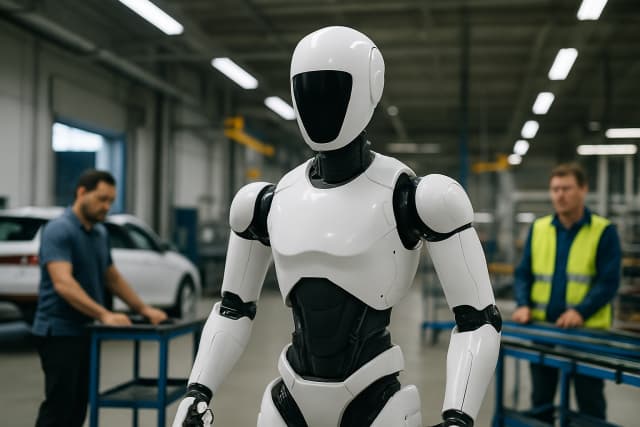
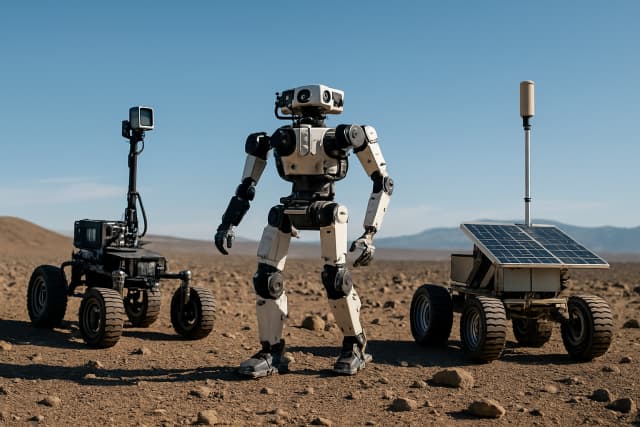
The deployment underscores a pivotal shift in autonomous robotics from isolated industrial applications to widespread real-world integration across manufacturing, healthcare, logistics, and domestic environments. This transformation has been fueled by a 1,000x surge in compute power over the past decade, narrowed simulation-to-reality gaps via digital twins, and Vision-Language-Action models enabling robots to process complex commands, positioning 2026 as the year robotics moves from laboratory curiosities to essential infrastructure.
AI Foundation Model Powers Massive Fleet Coordination
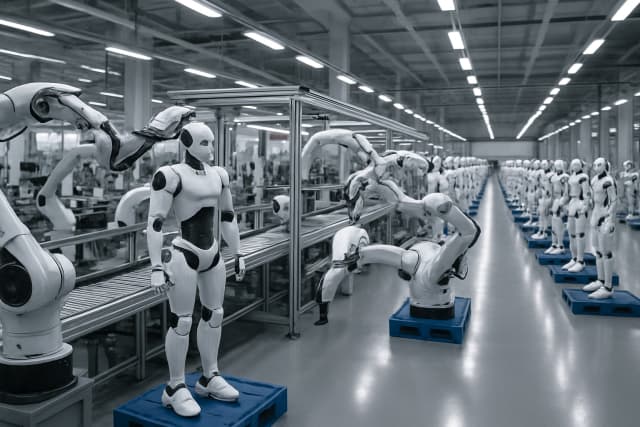
Amazon's new AI foundation model represents a breakthrough in large-scale robotic coordination, enabling seamless communication and task allocation across its million-robot fleet. The system leverages advanced machine learning algorithms to optimize warehouse operations in real-time, adjusting robot behavior based on inventory patterns, seasonal demand fluctuations, and operational constraints. This centralized intelligence allows individual robots to make autonomous decisions while contributing to overall fleet efficiency.
The foundation model's predictive maintenance capabilities mark a significant advancement in operational reliability, using sensor data and performance metrics to anticipate equipment failures before they occur. By analyzing patterns across hundreds of thousands of robots simultaneously, the AI system can identify potential issues and schedule maintenance during optimal windows, minimizing downtime and maximizing productivity. This proactive approach represents a shift from reactive maintenance to intelligent fleet management.
Industry-Wide Automation Surge Follows Amazon's Lead
Amazon's milestone coincides with unprecedented growth across the warehouse automation sector, as competitors race to deploy their own robotic solutions. Locus Robotics has unveiled its Locus Array system, promising 2-3x throughput gains through fully autonomous end-to-end fulfillment, while ABB Robotics launched its OmniVance Collaborative Surface Finishing Cell and award-winning Flexley Mover P603 AMR for high-mix manufacturing environments. These developments signal that the industry has moved beyond proof-of-concept demonstrations to scalable commercial deployments.
The competitive landscape has intensified as companies recognize the strategic importance of automation in addressing labor shortages and rising operational costs. Brain Corp's successful deployment of AI-powered shelf-scanning robots in Czech retailer Albert's stores demonstrates how robotics applications are expanding beyond traditional warehouse environments into retail operations. The technology's ability to scan thousands of SKUs daily without downtime has improved inventory accuracy while reducing human labor requirements.
Technical Breakthroughs Enable Mass Deployment
The surge in robotic deployments has been made possible by foundational technical advances achieved over the past decade, including compute power improvements that outpace Moore's Law by 25x. These computational gains have enabled real-time processing of complex sensor data, allowing robots to navigate dynamic environments and adapt to unexpected situations with human-like flexibility. Vision-Language-Action models now allow robots to understand and execute complex natural language commands, bridging the gap between human intent and machine execution.
Digital twin technology and synthetic data generation have dramatically reduced the simulation-to-reality gap that previously hindered robot deployment in unstructured environments. Companies can now train robotic systems in virtual environments that accurately represent real-world conditions, accelerating development cycles and reducing the risk associated with deploying autonomous systems in operational environments. This technological foundation has enabled the rapid scaling from laboratory demonstrations to million-unit deployments.
The hardest advances in robotics are behind us, with focus now on manipulation, risk assessment, and human collaboration.
Market Transformation Accelerates Toward 2030
Industry analysts project the robotics market will reach $210 billion by 2030, driven by the proven commercial viability demonstrated by deployments like Amazon's million-robot fleet. The success of these large-scale implementations has reduced investor skepticism and accelerated funding for robotics companies, with recent examples including XTEND's $70 million Series B funding round and A&K Robotics' $8 million Series A for autonomous mobility technology. This capital influx is enabling rapid expansion across multiple industry verticals.
Survey data indicates growing confidence in workplace robotics, with 77% of global tech leaders expressing trust in robotic systems for operational environments. Gartner predicts that by 2030, one in twenty supply chain managers will oversee more robots than human workers, representing a fundamental shift in how companies structure their operations. The transition from human-centric to robot-assisted workflows is accelerating across manufacturing, healthcare, logistics, agriculture, and retail sectors, with Amazon's milestone serving as a proof point for the technology's maturity and scalability.
Sources
- https://www.weforum.org/stories/2026/03/advances-in-autonomous-robotics-what-comes-next/
- https://novushitech.com/robotics-advancements-and-automation-2025/
- https://www.therobotreport.com
- https://roboticsandautomationnews.com
- https://www.robotics247.com/topic/category/autonomy
- https://news.mit.edu/topic/robotics
- https://www.slsbearings.com/sg-en/blog/humanoid-robots-in-manufacturing-the-future-of-factory-automation
- https://amdmachines.com/blog/the-future-of-humanoid-robots-in-manufacturing/
- https://roboticsandautomationnews.com/2026/04/15/pia-automation-launches-embodied-ai-and-humanoid-robotics-division-targeting-industrial-applications/100592/
- https://humanoidroboticstechnology.com/articles/top-12-humanoid-robots-of-2026/
- https://technologymagazine.com/news/automation-the-humanoid-robots-inside-siemens-factory
Leave a Comment