








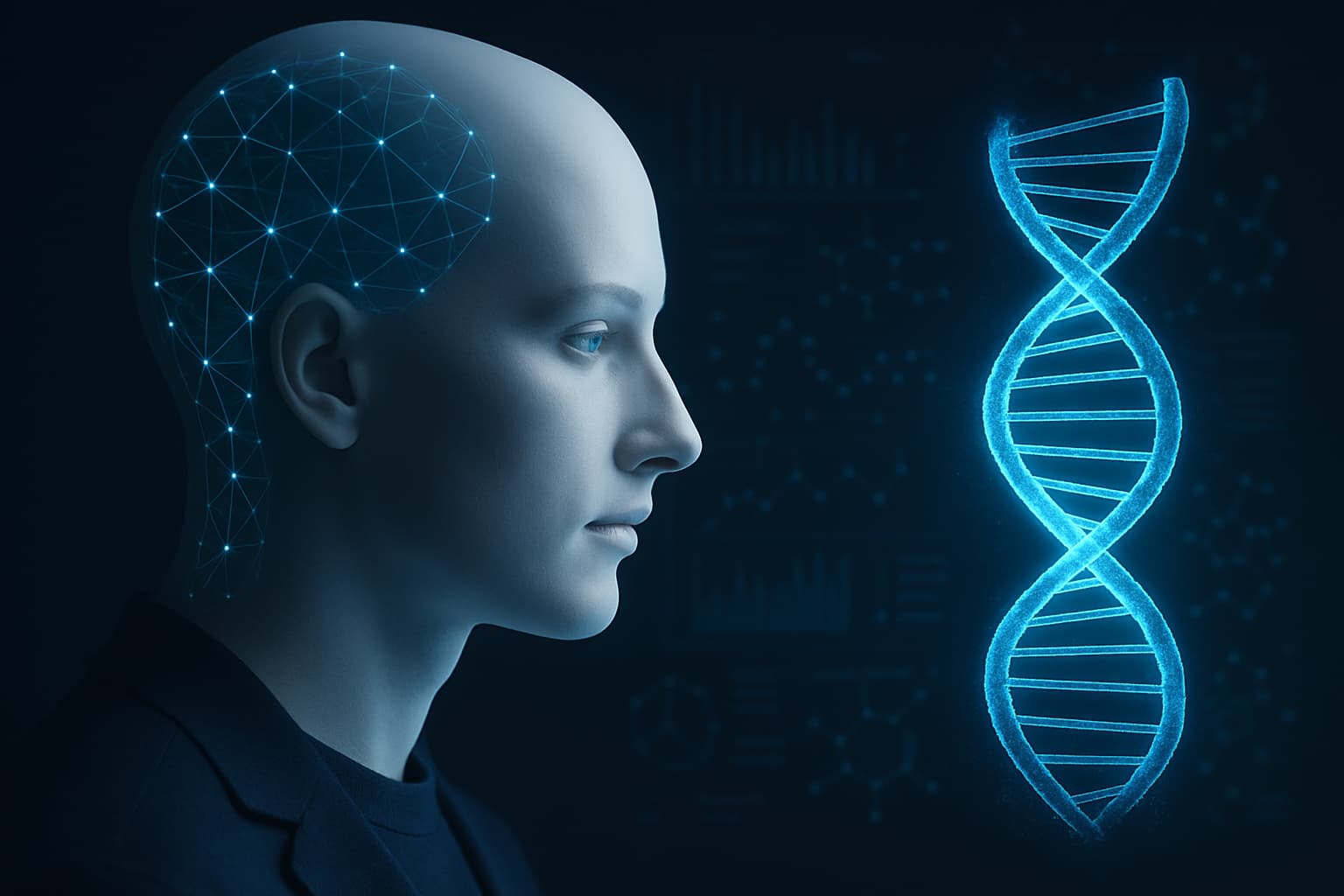



Anthropic announced this week that its Claude model spent 21 hours combing through biological databases and surfaced something no human researcher had documented: a novel enzyme system embedded in bacteriophage DNA that the company is calling array-associated reverse transcriptases. The claim, if validated, would mark one of the first instances of a large language model independently flagging a genuinely new biological mechanism rather than summarizing or accelerating existing human-led research. Anthropic has been careful to frame the discovery as preliminary, with the enzyme's actual function still unproven. Still, the announcement lands at a moment when AI labs are racing to prove their models can do more than write code and essays — they want to show machines can generate scientific knowledge.
The finding arrives amid a broader push by frontier AI labs to position their models as tools for scientific discovery rather than just productivity software or chatbots. Google DeepMind has been touting AlphaGenome Atlas and a suite of science-oriented tools including Co-Scientist and Gemini for Science, while Anthropic's own announcement suggests Claude can be pointed at raw genomic data and left to search for patterns without a research team guiding every step. Whether these systems are actually generating new science, or simply getting better at pattern-matching across enormous datasets in ways that look novel to human observers, is now one of the most consequential open questions in the industry.
What Claude Reportedly Found
According to Anthropic, Claude was set loose on large volumes of biological sequence data with instructions to search for unusual or unexplained patterns in bacteriophage genomes — the viruses that infect bacteria. After 21 hours of autonomous analysis, the model identified what Anthropic is calling array-associated reverse transcriptases, an enzyme system that does not appear in existing scientific literature in the form Claude described. Reverse transcriptases are well-studied enzymes that convert RNA back into DNA, famous for their role in retroviruses like HIV, but the specific arrangement Claude flagged in phage DNA had gone unnoticed.
Anthropic has been explicit that this is not a confirmed discovery. The company describes the finding as preliminary, and researchers have not yet established what function, if any, this enzyme system actually performs in the life cycle of the bacteriophages where it was found. That distinction matters: identifying an unusual genetic pattern is a very different achievement from proving it does something biologically meaningful. Independent virologists and molecular biologists have not yet weighed in publicly on whether the pattern represents a genuine novel mechanism or a statistical artifact of how Claude was searching the data.
Why Labs Are Chasing 'AI Did Science' Headlines
The announcement is best understood in the context of an industry-wide competition to demonstrate that large language models are more than sophisticated autocomplete engines. Anthropic, OpenAI, and Google DeepMind are all under pressure from investors and the public to show that the enormous compute budgets going into frontier models translate into tangible scientific value, not just better chatbots and coding assistants. A model that can autonomously surface a plausible new biological hypothesis is a powerful marketing story, even if the underlying science still needs years of wet-lab validation.
Google DeepMind has been pushing a parallel narrative with tools like AlphaGenome Atlas, described as a high-resolution map of human DNA, alongside Co-Scientist and Gemini for Science, both aimed at accelerating research workflows. These efforts share a common thread: positioning AI as a collaborator capable of generating its own leads rather than simply executing tasks that a scientist has already defined. The race to be first with a credible 'AI-discovered' finding carries real reputational and commercial stakes, since it feeds directly into how labs justify pricing, enterprise partnerships, and the eye-watering infrastructure spending across the sector.
The Gap Between Pattern-Finding and Proof
Scientists who study AI-assisted discovery caution that the hardest part of biology has never been spotting an anomaly in a dataset — it is proving that anomaly matters. Sequence databases are enormous, and unusual-looking genetic arrangements turn up regularly; the real test is whether a claimed enzyme system can be isolated, expressed, and shown to perform a specific biochemical function in a lab. Anthropic's own framing of the finding as preliminary acknowledges this gap, and the company has not claimed any wet-lab confirmation of the enzyme's activity.
This tension mirrors a broader pattern across recent AI science claims, where headline-grabbing announcements often get walked back or heavily qualified once independent researchers examine the underlying data. It also raises a practical question for the scientific community: how should journals, funders, and peer reviewers treat hypotheses generated by an AI system with no named human co-discoverer driving the initial insight? Anthropic has not indicated whether it plans to submit the finding for peer review or partner with an academic lab to pursue experimental validation.
A Crowded Week for AI Science Claims
The Claude announcement did not arrive in isolation. Google's AI research pages highlighted AlphaGenome Atlas as a high-resolution map of human DNA the same week, alongside WeatherNext 3, pitched as the company's most accurate global weather model yet, and Gemini Robotics 2, extending Google's ambitions from genomics into physical robotics. Taken together, the flurry of announcements suggests every major lab wants a foothold in the narrative that AI is now doing serious scientific work, not just serving consumer products.
That competitive backdrop makes it harder for outside observers to separate genuine breakthroughs from strategically timed publicity. Anthropic's decision to publicize a preliminary, unproven finding — rather than wait for experimental confirmation — reflects how much value labs now place on being seen as pioneers in AI-driven science, even at the risk of overstating early results. The coming months, as researchers attempt to validate or debunk the array-associated reverse transcriptase claim, will be a useful test of how much substance sits behind this new wave of AI science announcements.
This is a preliminary computational finding, not a validated biological discovery. What's notable isn't that we've proven a new enzyme function exists — it's that the model identified a pattern worth investigating that human researchers hadn't flagged.
What Comes Next
For the claim to move from curiosity to credible discovery, independent researchers will need access to the underlying data and methodology Claude used, followed by laboratory work to express the proposed enzyme and test its function directly. Anthropic has not yet detailed a timeline for that validation process or named academic collaborators who might take on the wet-lab work. Until then, the finding sits in a familiar limbo for AI-driven research: intriguing, plausible, and unproven.
The episode nonetheless adds to a growing body of evidence that frontier models are being deployed as autonomous research tools across biology, genomics, and beyond, with Anthropic, Google DeepMind, and others racing to claim the mantle of AI-assisted scientific discovery. Whether Claude's 21-hour search produced a genuine addition to molecular biology or simply an interesting false lead, the attempt itself signals where the major AI labs believe the next competitive battleground lies — not in chatbots, but in laboratories.
Sources
- https://techcrunch.com/category/artificial-intelligence/
- https://www.reuters.com/technology/artificial-intelligence/
- https://www.marktechpost.com/category/technology/artificial-intelligence/
- https://www.sciencedaily.com/news/computers_math/artificial_intelligence/
- https://ai.economictimes.com/
- https://www.wsj.com/tech/ai
- https://www.theguardian.com/technology/artificialintelligenceai
- https://ai.google/research/
- https://techxplore.com/machine-learning-ai-news/
- https://techcrunch.com/tag/ai/
- https://news.mit.edu/topic/artificial-intelligence2
- https://www.scmp.com/topics/artificial-intelligence
- https://podcasts.apple.com/us/podcast/claude-ai-daily/id1722322123
Leave a Comment