







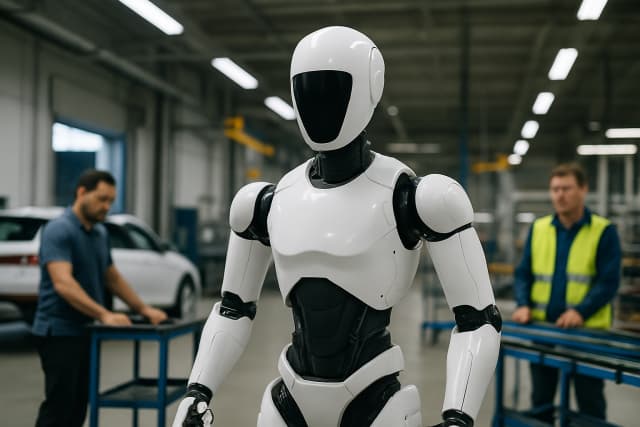



Hyundai and Boston Dynamics are preparing to put more than 25,000 Atlas humanoid robots to work across the automaker's plants, with annual production targeted at roughly 30,000 units by 2028. The plan, which also calls for U.S. facilities to churn out over 300,000 actuators per year, represents one of the largest commitments to humanoid labor announced by any manufacturer to date. It arrives alongside Goldman Sachs Research data showing humanoid manufacturing costs fell approximately 40% in a single year, far outpacing the firm's earlier forecast of a 15-20% annual decline. Together, the numbers suggest the economics of humanoid robotics are shifting faster than most industry projections anticipated.
The announcement lands amid a broader wave of humanoid deployments across the auto industry, from Figure AI's work at BMW's Spartanburg plant to Tesla's newly started Optimus production line in Fremont, California. Yet IDC data cited in recent industry coverage shows manufacturers shipped nearly 25,000 humanoid robots worldwide in just the first half of 2026, a 432% jump year over year, indicating Hyundai's plan is not an outlier but part of an accelerating industrial pattern. Still, Gartner expects fewer than 20 companies to successfully scale humanoids into live production by 2028, underscoring the gap between ambitious announcements and operational reality.
A Production Target With Real Scale
Hyundai's commitment stands apart from the demonstration-heavy announcements that have characterized much of the humanoid robotics sector over the past two years. Deploying more than 25,000 Atlas units across its plants, alongside a 2028 target of roughly 30,000 units produced annually, moves the conversation from pilot programs to industrial-scale procurement. The addition of a U.S. actuator supply chain capable of producing over 300,000 units per year signals that Hyundai, which owns Boston Dynamics, is building vertically integrated manufacturing capacity rather than relying solely on external suppliers.
This kind of scale matters because humanoid robotics has historically struggled to move beyond proof-of-concept trials. Gartner's own forecast suggests fewer than 100 companies will progress past initial trials through 2028, with fewer than 20 reaching true production-line integration. Hyundai's plan, if executed on schedule, would place it firmly among that small group of companies capable of operationalizing humanoids rather than merely testing them.
The Cost Curve Bends Faster Than Expected
Goldman Sachs Research's finding that humanoid manufacturing costs dropped about 40% in a single year is arguably the more consequential data point buried inside Hyundai's announcement. The bank had previously projected a more gradual 15-20% annual decline, a figure already considered aggressive relative to typical industrial hardware cost curves. A cost drop more than double that forecast suggests component sourcing, actuator manufacturing, and software standardization are compounding faster than analysts modeled, potentially pulling forward the timeline for broader industrial adoption.
Current humanoid prototypes still cost an estimated $150,000 to $500,000 per unit, a price point that keeps most deployments confined to structured, high-value tasks like parts sequencing, material handling, and inspection. But if cost declines continue at even half the pace Goldman observed, the per-unit economics could shift meaningfully within a few budget cycles, making fleet-scale deployment viable for a wider range of manufacturers beyond well-capitalized automakers.
Competitors Are Moving in Parallel
Hyundai's announcement does not exist in isolation. Figure AI's third-generation Figure 03 robot has already demonstrated sequencing work at BMW's Plant Spartanburg, following an earlier 11-month deployment of Figure 02 units that loaded more than 90,000 sheet-metal parts during production of over 30,000 BMW X3 vehicles. Figure reported producing more than 350 Figure 03 units by April 2026, with manufacturing demonstrations reaching approximately one robot per hour, suggesting the company is also racing toward production-scale output.
Tesla, meanwhile, began manufacturing its Optimus humanoid on an actual production line at its Fremont facility in the third quarter of 2026, though the company reportedly expects at least a year to reach a target of 20,000 robots per week. BMW has separately begun testing Hexagon Robotics' AEON humanoid in Leipzig, Germany, diversifying its supplier base beyond Figure. The pattern across the industry is one of parallel, competing bets on humanoid labor, with automakers increasingly unwilling to commit to a single vendor or platform.
Why Automakers Are the Proving Ground
Automotive manufacturing has emerged as the preferred testing ground for humanoid robotics largely because its workflows are semi-structured and repetitive enough to be automated without requiring full general-purpose intelligence. Parts sequencing, container retrieval, and sheet-metal handling are tasks with predictable geometries and known failure modes, making them far more tractable for current-generation humanoids than open-ended domestic or retail environments. Mitsubishi Electric's recent system linking general-purpose humanoids directly to CNC machine tools, allowing natural-language task allocation between robot and machine, reflects the same logic applied to precision manufacturing.
Schaeffler's October opening of a 7,500-square-meter humanoid facility in Taicang, China, where six robots sort, assemble, and inspect components used in other humanoid robots, illustrates an emerging feedback loop: robots increasingly participate in building the supply chain for more robots. South Korea's Neuromeka, testing humanoids at a Hyundai Motor partner site in the Daegu region, is targeting mass production as early as 2027, reinforcing that Hyundai's bet reflects an industry-wide conviction that humanoid labor in manufacturing has crossed from speculative technology into a near-term operational requirement.
The cost curve on humanoid manufacturing is bending faster than almost anyone modeled a year ago. That changes the calculus for how quickly automakers can justify fleet-scale deployment rather than isolated pilots.
The Gap Between Ambition and Reliability
Despite the scale of Hyundai's ambitions, the fundamental technical barriers that have slowed humanoid adoption elsewhere have not disappeared. Reliability, safety certification, integration costs, and the difficulty of handling variable parts at full production speed remain unresolved challenges even for well-funded programs. Research from Apple on humanoid control systems, published this month, specifically flagged tactile sensing and contact-dependent tasks as persistent weaknesses, noting that vision-only systems remain unreliable when objects are occluded.
The near-term reality, even for a deployment as ambitious as Hyundai's, is likely to be human-supervised automation within tightly constrained workflows rather than fully autonomous factories operating without oversight. Whether Hyundai hits its 2028 production target of 30,000 units annually will serve as an important industry benchmark, testing whether the cost declines Goldman Sachs documented can translate into the operational reliability that mass deployment actually requires.
Sources
- https://nvidianews.nvidia.com/news/nvidia-advances-isaac-platform-for-general-purpose-robotics-with-new-reference-humanoid-frameworks-simulation-pipelines-and-data/
- https://roboticsbusinessnews.com/category/research-ans-development/breakthrough-technologies
- https://www.robotics247.com/topic/category/Autonomy
- https://www.businesswire.com/newsroom/industry/technology/robotics
- https://www.technologyreview.com/2026/10/08/1145923/ai-breakthroughs-in-robotics-wont-change-your-life-any-time-soon/
- https://news.mit.edu/topic/robotics
- https://www.robotics247.com/podcast/october-2026-robotics-recap
- https://news.futunn.com/en/post/1003827602/apple-discloses-halo-autonomous-control-system-for-humanoid-robots-physical
- https://cms.xpr.media/stories/28288317-9f7c-40ed-9101-40385509e261
- https://www.automate.org/robotics/news
Leave a Comment