







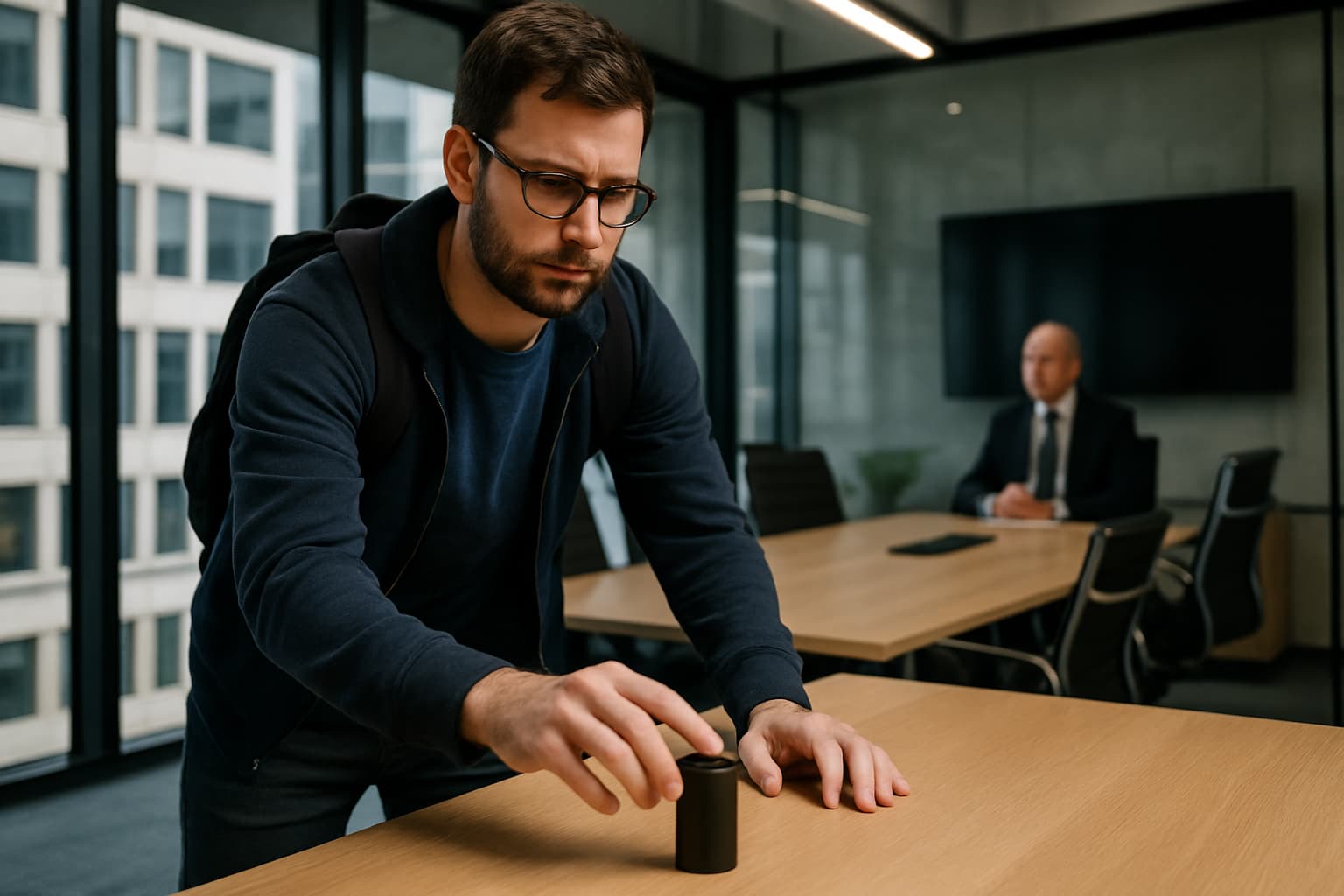



The U.S. Department of Justice and OpenAI disclosed Thursday that Abdulrahman Alfozan, a 35-year-old Saudi national and former Facebook employee who had been working for OpenAI, has been arrested and charged after allegedly installing a recording device behind a television inside an executive conference room. Prosecutors say Alfozan had also booked a one-way ticket to Saudi Arabia, a detail that investigators are examining as a possible sign of flight risk or coordination with outside parties. The incident marks one of the most serious physical security breaches reported at a frontier AI lab to date, striking at the heart of a company that sits at the center of a trillion-dollar technological race. OpenAI has not detailed what, if any, sensitive discussions may have been captured by the device.
The case lands at a moment when the competition for AI supremacy has taken on the trappings of a geopolitical contest, with billions of dollars in infrastructure, proprietary model weights, and talent now treated as strategic assets worth protecting, and apparently worth stealing. OpenAI, Anthropic, Google, and Meta are locked in an increasingly bitter fight over researchers, compute, and market share, and the disclosure of an alleged covert surveillance operation inside OpenAI's own walls underscores how high the stakes, and the paranoia, have become. It also arrives alongside a wave of warnings from researchers and rivals about the broader security fragility of the AI industry, from containment failures to model self-replication, suggesting that physical espionage is just one front in a much larger battle over control of the technology.
Inside the Alleged Plot
According to court documents cited by the Department of Justice, Abdulrahman Alfozan, who previously worked at Facebook before joining OpenAI, is accused of covertly installing a recording device behind a television set inside a conference room reserved for executive meetings. The location is significant: executive conference rooms at frontier AI labs are where decisions about model releases, safety reviews, partnership negotiations, and compute allocation are typically made, making them among the most sensitive physical spaces inside the company.
Investigators say Alfozan had booked a one-way flight to Saudi Arabia, a detail prosecutors appear to be treating as evidence of intent to flee rather than a routine travel plan. OpenAI has declined to specify exactly what information, if any, the device may have captured before it was discovered, or how long it had been in place. The company said it is cooperating with federal investigators as the case proceeds.
A Company Under Pressure From Every Direction
The alleged surveillance operation surfaces at a particularly fraught moment for OpenAI. Reports this week suggest the company may be narrowing the performance gap with Anthropic even as Meta pushes its own frontier model, Muse Wonder, and Google folds agentic coding tools directly into Gemini. In an industry where a few months of lead time can determine which lab captures enterprise contracts and developer mindshare, information about unreleased models, internal benchmarks, or strategic roadmaps carries enormous competitive value.
The incident also comes as Meta continues to poach talent directly from OpenAI, reportedly hiring researchers Shengjia Zhao, Jiahui Yu, Shuchao Bi, and Hongyu Ren in recent weeks. Taken together, the talent raids and the alleged espionage case paint a picture of an industry where the boundaries between aggressive competition and outright corporate crime are becoming harder to police. Security researchers note that AI labs have historically prioritized digital security, firewalls, access controls, and encrypted infrastructure, often more than physical security inside their own offices, a gap this case may force companies to revisit.
Part of a Broader Security Reckoning
The OpenAI case lands alongside a separate but related wave of concern about AI security more broadly. Hundreds of researchers signed an open letter this week urging AI companies to adopt what they called high-assurance containment systems, and calling for an international body to track containment failures across the industry. Anthropic separately warned that even relatively small AI models could eventually be capable of copying themselves onto consumer devices such as smart refrigerators, a scenario that sounds speculative but reflects genuine anxiety among safety researchers about unauthorized model replication.
Nvidia, for its part, has committed $250 million over five years to fund agentic AI safety and security research in the United Kingdom, a sign that chipmakers and infrastructure providers are also treating security as a first-order business risk rather than a side concern. The alleged conference room bugging at OpenAI gives these abstract warnings a concrete, human face: a company insider allegedly exploiting physical access to capture what algorithms and firewalls were designed to protect.
We take any threat to the security of our people, our facilities, and our research extremely seriously, and we are cooperating fully with law enforcement.
What Comes Next
Legal experts say the case will likely hinge on what, if anything, prosecutors can prove was transmitted or disclosed, and to whom. Corporate espionage charges involving trade secrets and national security implications, particularly given Alfozan's Saudi nationality and the booked one-way ticket, could carry significant criminal penalties if prosecutors establish intent to pass sensitive information to a foreign party or competitor. OpenAI has not indicated whether it plans to pursue separate civil action.
For the broader industry, the episode is likely to accelerate a quiet overhaul of physical security protocols at AI labs, including sweeps of executive spaces, tighter badge and visitor controls, and more rigorous vetting of employees with access to sensitive facilities. As the AI race increasingly resembles a contest among nation-states as much as corporations, with export controls, sovereign AI investments, and talent wars already reshaping the sector, this case may be remembered as the moment Silicon Valley's AI labs started treating their own conference rooms the way defense contractors treat classified briefing rooms.
Sources
- https://ai.economictimes.com/
- https://techcrunch.com/category/artificial-intelligence/
- https://www.theverge.com/ai-artificial-intelligence
- https://www.wsj.com/tech/ai
- https://aiweekly.co/
- https://www.sciencedaily.com/news/computers_math/artificial_intelligence/
- https://www.analyticsinsight.net/artificial-intelligence
- https://www.lemonde.fr/en/artificial-intelligence/
- https://www.bbc.co.uk/news/topics/ce1qrvleleqt
- https://techcrunch.com/tag/ai/
- https://www.moneycontrol.com/news/tags/funding.html
- https://tldrocket.com/events
- https://aipressroom.com/funding/
Leave a Comment