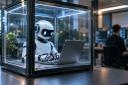













Boston Dynamics confirmed that its Atlas humanoid will begin testing inside GlobalFoundries semiconductor facilities in early 2027, focusing first on autonomous inspection and asset management rather than production-line work. The announcement arrives alongside a wave of similar milestones: Figure AI's Figure 02 just wrapped an 11-month trial at BMW's Spartanburg plant after handling more than 90,000 sheet-metal components, Agility Robotics' Digit has moved over 100,000 totes for GXO Logistics, and Tesla has begun early, if uneven, production of its Optimus robot. Together, these developments mark a turning point: humanoid robotics is shifting from choreographed demos to paid, measurable industrial pilots.
***
For years, humanoid robots have been synonymous with viral videos of backflips and warehouse cameos staged for investors. That era is giving way to something less flashy but more consequential—contracts, uptime metrics, and production-line integration. JPMorgan now forecasts U.S. humanoid production could hit 300,000 to 400,000 units annually by 2030, climbing toward 1.5 million by 2035, with robots potentially saving customers roughly $100,000 per year in suitable applications. Yet the research is equally clear that this transition is narrow and uneven, concentrated in material handling, inspection, and logistics rather than the general-purpose factory labor long promised by the industry.
From Demo Stage to Factory Floor
The GlobalFoundries deal is notable less for its scope than for its caution. Boston Dynamics has explicitly framed the early 2027 deployment as a test of autonomous inspection, asset management, and facility integration requirements—not a replacement for existing production staff. Semiconductor fabs are exceptionally sensitive environments, with cleanroom standards and tight tolerances that make them a demanding proving ground for any physical robot, let alone a bipedal one still refining its balance and dexterity.
That cautious framing echoes across the industry. Figure AI's 11-month run at BMW's Spartanburg, South Carolina plant produced concrete numbers: more than 90,000 sheet-metal components handled, supporting production of over 30,000 BMW X3 vehicles. BMW has since moved on to testing Hexagon Robotics' AEON humanoid at its Leipzig facility, suggesting the automaker is treating humanoid robotics as an ongoing evaluation process rather than a one-off pilot. Agility Robotics, meanwhile, has converted early experiments into commercial traction, reporting more than $300 million in committed multi-year orders from customers including Amazon, GXO, Schaeffler, and Toyota Motor Manufacturing Canada.
Tesla and XPeng Push Toward Mass Production
Tesla has begun early production of Optimus on a former vehicle-assembly line in Fremont, California, though Elon Musk has publicly described the ramp as shallow and somewhat bumpy, with ongoing revisions to the robot's hands, structural design, and onboard AI. Tesla has indicated it may need to build 10,000 to 20,000 Optimus units simply to generate enough real-world data to train the robot's control systems—an acknowledgment that humanoid intelligence, unlike software, cannot be scaled through simulation alone.
XPeng is pursuing a parallel but distinct strategy. The company commissioned dedicated humanoid-robot production lines in September 2026 and says its IRON robot has completed a full manufacturing cycle on a facility that is more than 80% automated in its core processes. Separately, XPeng is targeting commercial deliveries of Iron in the second quarter of 2027. Topstar, a Guangdong-based manufacturer, has taken a more modest approach with its 172-centimeter, 72-kilogram Star robot, aimed squarely at material handling and sorting tasks, alongside its wheeled Xiaotuo robot already being tested for electronics-manufacturing logistics.
Why Factories, and Why Now
The industrial focus is deliberate. Humanoids are being pitched as ideal for so-called brownfield factories—older facilities built around human-scale aisles, tools, and workstations—because a bipedal, human-shaped robot can use that existing infrastructure without costly retrofits. Tasks like moving totes and bins, loading and unloading production equipment, inspecting assets, sorting varied parts, and supplying materials to human coworkers top the list of near-term use cases, precisely because they are repetitive, physically taxing, or hazardous without requiring the speed and precision of dedicated industrial machinery.
That said, fixed robotic arms and specialized automation remain faster, cheaper, and more reliable for high-speed, high-tolerance repetitive work. Humanoids are not being positioned to outcompete those systems but to fill gaps where flexibility matters more than raw throughput—variable product mixes, irregular part shapes, and environments originally designed for human workers. This positioning explains why automotive and logistics companies, rather than high-precision electronics assemblers, are currently leading deployment.
We're not replacing assembly lines. We're proving these machines can operate reliably in our facilities before we even think about scaling them into production workflows.
The Scaling Problem Nobody Has Solved
Despite the momentum, the research underscores a sobering reality: this remains an early, fragile market. Gartner projects that fewer than 100 companies worldwide will move humanoid trials beyond the experimental stage by 2028, and fewer than 20 will reach genuine production use in supply-chain or manufacturing settings. That is a strikingly small number given the billions of dollars flowing into humanoid startups and the ambitious unit forecasts from banks like JPMorgan.
The core constraints are consistent across every company in the research—data scarcity, unresolved hardware reliability, uncertain maintenance economics, and the basic challenge of proving humanoids can match the uptime of specialized machines. Tesla's acknowledgment that it may need tens of thousands of robots just to collect adequate training data illustrates how far the industry remains from the kind of foundation-model generalization now emerging in robotic manipulation research at institutions like UC Berkeley. For now, the honest story of 2026 is not humanoid robots replacing human labor at scale, but a handful of blue-chip manufacturers—BMW, GlobalFoundries, Amazon, Toyota—running real, paid pilots to find out whether these machines can earn their keep.
Sources
- https://techxplore.com/robotics-news/
- https://emergent.sh/news/ai-advances-create-paradigm-shift-robotics
- https://www.businesswire.com/newsroom/industry/technology/robotics
- https://www.mobilityengineeringtech.com/topia/adt/robotics_automation_control/automation
- https://www.unite.ai/series/robotics/
- https://www.sciencedaily.com/news/computers_math/robotics/
- https://roboticsandautomationnews.com/
- https://kr-asia.com/industry/robotics
- https://techcrunch.com/category/artificial-intelligence/robotics/
- https://spectrum.ieee.org/topic/robotics/
- https://interestingengineering.com/ai-robotics/atlas-humanoid-semiconductor-manufacturing
- https://www.openpr.com/news/4694358/humanoid-robot-market-gains-momentum-as-humanoid-secures-usd-152
Leave a Comment