




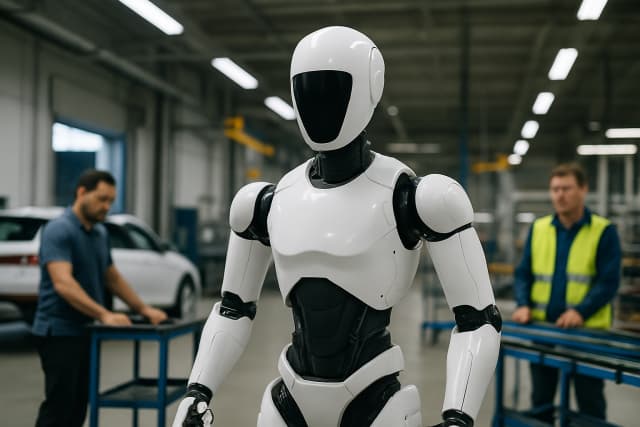
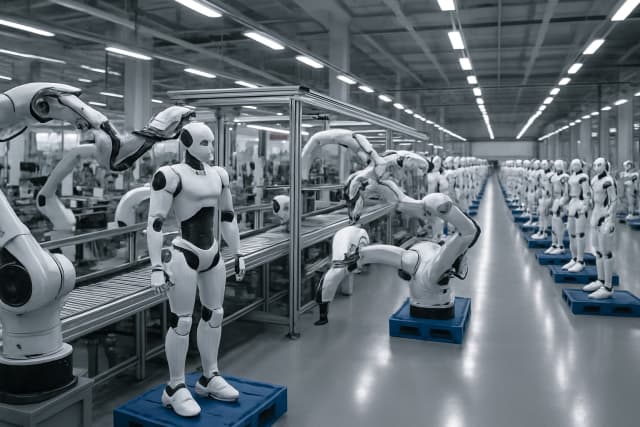



Schaeffler on October 26, 2026 opened a humanoid-robot "lighthouse factory" in Taicang, China, a roughly 7,500-square-meter facility where robots will help assemble the actuators and joint modules that go into later generations of humanoids. The plant combines an intelligent assembly line, robot-skill testing infrastructure, physical-AI data acquisition systems, digital twins, and an on-site data center. It is among the clearest commercial examples yet of what engineers have started calling "humanoids making humanoids" — a recursive manufacturing loop in which robotic labor builds the next wave of robotic hardware.
The opening lands amid a broader industry pivot from humanoid demonstrations to narrowly scoped factory deployments, with parallel announcements this month from UBTECH, Agility Robotics, Boston Dynamics, Audi, and Bosch. But Schaeffler's facility stands out because it closes the loop between robot production and robot use: rather than deploying humanoids to assemble cars or sort warehouse totes, the company is using them to manufacture the precision components — actuators, joints, and motion systems — that other humanoids depend on. That makes Taicang less a pilot program than a bet on vertical integration, positioning Schaeffler, a century-old German bearings and motion-technology supplier, as a critical hardware supplier to the entire humanoid industry rather than merely a customer of it.
Inside the Taicang Lighthouse Factory
Schaeffler's new site in Taicang, roughly an hour outside Shanghai, spans approximately 7,500 square meters and was designed from the outset as an integrated physical-AI production environment rather than a conventional assembly plant retrofitted with robots. The facility houses an intelligent assembly line alongside dedicated space for testing robot skills under real production conditions, letting engineers validate manipulation, force control, and sequencing tasks before they are deployed at scale. A digital-twin layer mirrors the physical line in simulation, while an on-site data center captures sensor and motion data generated by the robots themselves.
That data pipeline is central to the plant's purpose. Every cycle of assembly performed by a humanoid on the line generates physical-AI training data — torque curves, grip pressures, failure cases — that can be fed back into model training and simulation, tightening the loop between real-world performance and software improvement. Schaeffler has framed the factory explicitly as a testbed for its own joint modules and actuators, the mechanical components that determine how precisely a humanoid can walk, grasp, or balance.
The components being assembled are not generic industrial parts. Actuators and joint modules are among the most technically demanding subsystems in any humanoid platform, requiring tight tolerances, durability under repeated motion, and integration with sensors and control electronics. By having robots assemble these parts for future robot generations, Schaeffler is testing whether humanoid labor can meet the precision standards its own supply chain already demands of human technicians and fixed automation.
Humanoids Making Humanoids
The phrase "humanoids making humanoids" captures a structural shift that distinguishes Taicang from most other humanoid deployments announced in 2026. Facilities such as UBTECH's 14,000-square-meter plant in Liuzhou, which pairs humanoids with automated guided vehicles and robotic arms to produce more than 10,000 units annually, are focused on manufacturing throughput — building robots faster and cheaper. Schaeffler's plant instead targets the supply chain beneath that throughput, producing the specialized mechanical components that determine how capable those finished robots can ultimately be.
This vertical approach mirrors a pattern familiar from the semiconductor and automotive industries, where companies that control critical sub-component manufacturing often capture outsized value relative to final assemblers. Schaeffler, which has spent decades supplying precision bearings and motion systems to automakers and industrial manufacturers, is applying that same logic to humanoid robotics: rather than competing to build whole humanoids, it is positioning itself as an indispensable supplier of the joints and actuators every humanoid platform needs.
The approach also creates a feedback advantage. Because Schaeffler's own robots are using its own components under real production loads, the company gains direct insight into component wear, failure modes, and performance limits that external suppliers would only learn about secondhand. That data can feed directly into the design of next-generation actuators, potentially giving Schaeffler a faster iteration cycle than competitors relying solely on bench testing or customer feedback.
Part of a Broader Industrial Wave
Schaeffler's announcement arrives during an unusually concentrated stretch of humanoid manufacturing news. Days earlier, Audi, Agile Robots, Dassault Systèmes, and NVIDIA unveiled a proof of concept at Audi's Ingolstadt plant that will use mobile humanoids for parts sequencing. Agility Robotics and AGCO separately announced a 2027 U.S. manufacturing pilot in which Agility's Digit robot will handle parts sorting, stacking, and tote placement at AGCO's Hesston, Kansas facility. Boston Dynamics, meanwhile, is training its Atlas robot for parts preparation at Hyundai's Metaplant America, with a roadmap extending to component assembly by 2030.
Schaeffler itself is also a partner in a separate near-term deployment: the company's Herzogenaurach and Schweinfurt sites in Germany are scheduled to begin testing Humanoid's HMND 01 platform, manufactured under contract by Bosch, between December 2026 and June 2027. That timeline places Schaeffler in the unusual position of both deploying humanoids built by a partner company and manufacturing humanoid components itself in China — giving it visibility across nearly the entire value chain, from component production to end-use deployment.
Underpinning much of this activity is NVIDIA's expanded Isaac robotics platform, unveiled at GTC Berlin on October 21, which bundles Isaac OS, Isaac Lab 3.0, new simulation pipelines, and an open-source workflow combining ChatGPT Astra, Isaac, and Cosmos. NVIDIA has said companies including ABB Robotics, KUKA, Universal Robots, and NEURA Robotics are building on the platform, and Toyota Material Handling Europe reported that combining Omniverse with Isaac Sim cut deployment time for autonomous material-handling systems by up to 50 percent — evidence that simulation and physical-AI tooling are becoming as important to this wave of robotics as the hardware itself.
We are not just building robots in this factory, we are building the components that will define how precisely and reliably the next generation of humanoids can move.
The Economics of Scaling Humanoid Hardware
Despite the flurry of announcements, the economics of humanoid deployment remain daunting. A 2026 industry assessment citing Gartner projects that fewer than 100 companies will move beyond humanoid proof-of-concept projects through 2028, and fewer than 20 will scale the technology into live manufacturing or supply-chain production. Reported prototype costs range from roughly $150,000 to $500,000 per unit, before accounting for maintenance, integration, safety validation, and workforce retraining — a cost structure that still favors narrowly defined, high-repetition tasks over broad labor replacement.
Sources
- https://nvidianews.nvidia.com/news/nvidia-advances-isaac-platform-for-general-purpose-robotics-with-new-reference-humanoid-frameworks-simulation-pipelines-and-data/?ref=aiposthub.com
- https://www.businesswire.com/newsroom/industry/technology/robotics
- https://podcasts.apple.com/ug/podcast/robotics-industry-insider-ai-automation-news/id1784757046
- https://roboticsandautomationnews.com/tag/enterprise-robotics/
- https://techxplore.com/robotics-news/
- https://www.robotics247.com/search/results/search&category=&keywords=robots%20automation/P420
- https://www.automate.org/robotics/news
- https://eecs.engin.umich.edu/ranews/_ra_robotics-and-autonomous-systems
- https://www.openpr.com/news/4666762/brandon-torres-declet-says-the-next-physical-ai-breakthrough-may
- https://roboticsandautomationnews.com/page/959/?iframe=true&mode=grid
Leave a Comment