





Foundry Robotics closed an oversubscribed $100 million Series A round on October 31, betting that fully autonomous factories for complex assembly can be built faster than the industry's existing humanoid-robot timelines suggest. The round, among the largest recent raises in industrial robotics, arrives alongside a wave of deployments that together signal a broader shift: physical-AI systems capable of perceiving their surroundings, planning tasks, and operating with minimal human oversight are moving out of pilot programs and into daily operations across factories, warehouses, construction sites, and defense platforms.
***
The funding lands at a pivotal moment for industrial automation. For decades, factory robots were fixed, single-purpose machines bolted to assembly lines and fenced off from human workers. Foundry Robotics and a cluster of competitors are now chasing something different: robotic cells paired with AI software and human specialists that can be reconfigured for complex, variable assembly work, with the company specifically targeting a reduction in full humanoid-robot deployment time to one hour or less. That ambition mirrors a pattern playing out across the robotics sector this fall, from Walmart's expanded warehouse automation deal with Symbotic to Aurora Innovation's push toward driverless trucking fleets, all pointing toward the same underlying technology stack of foundation models, edge computing, and advanced sensing converging into machines that can act, not just sense.
A Record Round for Autonomous Assembly
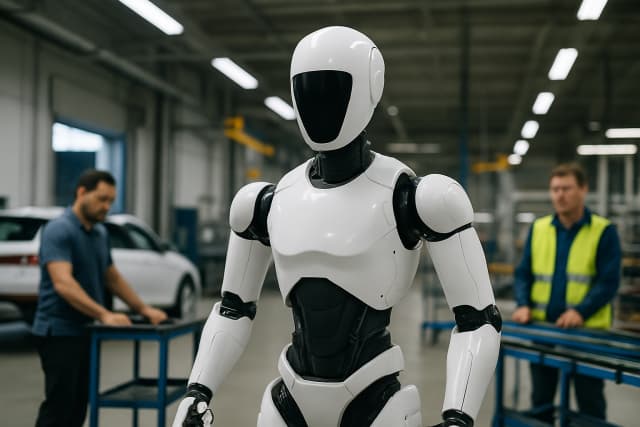
Foundry Robotics' $100 million Series A, announced October 31, was oversubscribed, reflecting investor appetite for companies that combine robotic hardware with software capable of managing complex, non-repetitive assembly tasks. Rather than selling robots as standalone products, Foundry operates what it describes as autonomous factories, pairing AI-enabled robotic cells with manufacturing specialists who oversee and refine the work. The model positions the company as an operator of automated manufacturing capacity rather than simply a vendor of robotic arms or humanoids.
Central to Foundry's pitch is speed of deployment. The company says it plans to scale its software so that a full humanoid-robot deployment, from installation to productive operation, can take an hour or less. That timeline stands in sharp contrast to current industry norms, where integrating new robotic systems into existing manufacturing-execution systems and safety protocols typically takes weeks or months. If achieved at scale, such rapid deployment could meaningfully lower the barrier for manufacturers currently unwilling to commit to lengthy automation retrofits.
The raise comes as Gartner has cautioned that fewer than 100 companies worldwide are likely to move humanoid robot trials beyond the experimental stage through 2028, with fewer than 20 reaching actual production use in manufacturing or supply-chain settings. Foundry's bet is that building the operating layer, the software and process expertise around deployment, rather than the robot hardware itself, is the more defensible and scalable business in that constrained landscape.
Warehouses and Highways Join the Shift
Foundry's raise is not an isolated event. Symbotic and Walmart expanded their warehouse automation partnership to 25 U.S. regional distribution centers, extending Symbotic's AI-driven supply-chain robotics with the possibility of additional rollouts across Walmart's global network. The expansion underscores how thoroughly autonomous material handling has moved from pilot status into core logistics infrastructure for one of the world's largest retailers.
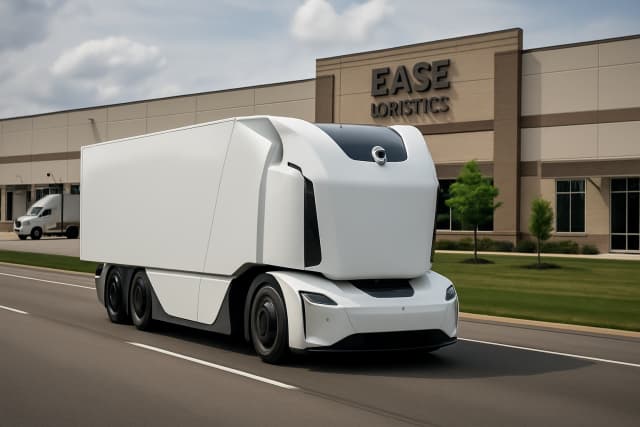
In transportation, Aurora Innovation set a public target of more than 30,000 driverless trucks operating by 2030, a figure that signals growing commercial confidence in autonomous trucking even though the company has not yet demonstrated operations at that scale. Similarly, CEVA Logistics has begun deploying Sereact's AI-powered dual-arm robots for Zalando returns processing at facilities in Germany and Poland, a concrete example of vision-guided manipulation handling the kind of variable, unpredictable tasks that have historically resisted automation.
Taken together, these moves illustrate a consistent theme: companies are no longer satisfied with robots that perform a single fixed motion. The economic case for autonomy is strongest where labor costs, safety risks, and throughput demands intersect, and warehouses, distribution centers, and long-haul freight corridors currently offer the clearest return on investment.
The Technology Stack Behind the Shift
Underpinning these commercial deployments is a rapidly maturing technology stack. Amazon's newly launched Physical AI Toolchain on AWS aims to give developers the tools to build machines that interpret their surroundings and act within them, joining efforts from Intel and SAP, which demonstrated physical AI applications in autonomous warehousing, and Aetina, which is building edge infrastructure specifically for AI-driven robotic action. Dyna Robotics' new DYNA-2 model, pretrained on more than one million hours of egocentric human video, reflects a parallel push to transfer knowledge from human behavior directly into general-purpose robotic control systems.
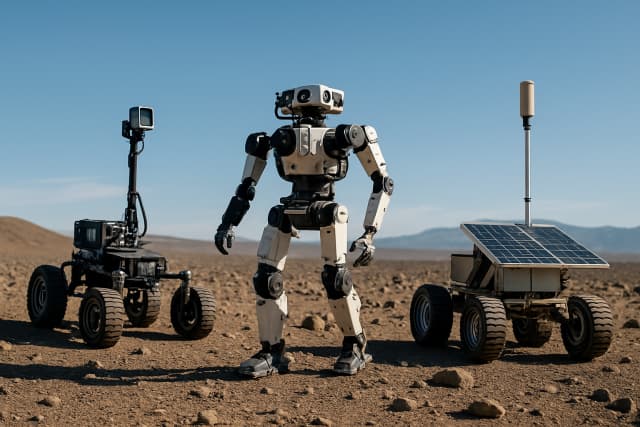
Sensing hardware is advancing in tandem. Luxonis introduced the OAK 4 FFC, a modular board-level vision computer designed for humanoids and drones that cannot accommodate conventional camera housings, while MicroVision and FieldAI expanded their collaboration on autonomous ground vehicles and drones, demonstrating a system that combines the Robinson Unmanned Spirit drone with MicroVision's MOVIA Air Plus sensor for real-time, colorized 3D mapping integrated into military ATAK systems.
ANYbotics, meanwhile, introduced an operational engine called Shift intended to scale autonomous inspection robots beyond one-off deployments into persistent industrial monitoring. Each of these developments addresses a different link in the same chain: perception, computation, and fleet-level software that together allow robots to operate with less hand-holding across increasingly unstructured environments.
Defense and Aerospace Accelerate in Parallel
The physical-AI shift extends well beyond commercial industry. AEVEX Aerospace received $41.6 million in U.S. defense contracts covering production, fielding, and operations of its SightGlass and Fisher mine-countermeasure systems, part of the broader push to expand the U.S. military's robotic and autonomous-systems fleet. NASA, for its part, awarded AstraQua a $1,274,990 Phase II contract to advance AstraSense, a physical-AI system designed to provide predictive health monitoring for electric and hybrid-electric aircraft, including advanced air mobility vehicles.
These defense and aerospace investments share the same underlying logic as their industrial counterparts: autonomous systems that can monitor their own condition, map unfamiliar terrain, and detect hazards reduce both operational risk and the need for constant human supervision. MicroVision's long-range IRIS lidar, now under evaluation by FieldAI for autonomous ground vehicles, exemplifies how sensing technology originally developed for commercial applications is migrating into military use cases involving navigation, obstacle detection, and mission execution.
We're not trying to replace every worker on a line. We're trying to build factories that can be stood up and reconfigured in days instead of years, with autonomy handling the parts of assembly that are too variable for traditional fixed automation.
What Still Stands Between Pilots and Scale
Despite the momentum, significant barriers remain before physical-AI systems achieve widespread, reliable deployment. Industry analysts point to deployment reliability, rigorous safety validation, and integration with legacy industrial software as the primary obstacles separating impressive demonstrations from dependable, continuous operation. Robots that perform flawlessly in a controlled trial often struggle when confronted with the full variability of a real production floor or an uncontrolled outdoor environment.
Cost remains another constraint. Current humanoid and autonomous-system hardware is frequently estimated in the range of $150,000 to $500,000 per unit, with battery endurance typically limited to two to four hours, figures that will likely need to fall substantially, alongside major gains in uptime, before adoption spreads beyond well-funded early movers like Walmart, BMW, and the U.S. Department of Defense.
Still, the breadth of this fall's announcements, spanning venture funding, government contracts, hardware launches, and multi-site commercial rollouts, suggests the industry is coalescing around a shared conviction: the next phase of automation will not be defined by robots that simply repeat a fixed motion, but by systems that can perceive, reason, and adapt. Foundry Robotics' $100 million round is less a singular bet than a signal of where investors believe that convergence is heading next.
Sources
- https://www.newswire.com/news/microvision-expands-collaboration-with-fieldai-across-government-and-2902107
- https://www.robotics247.com/podcast/october-2026-robotics-recap
- https://roboticsandautomationnews.com/category/news/
- https://roboticsbusinessnews.com/category/research-ans-development/breakthrough-technologies
- https://www.businesswire.com/newsroom/industry/technology/robotics
- https://www.automate.org/robotics/news
- https://www.robotics247.com/topic/category/industries/P40
- https://www.robotics247.com/topic/tag/Autonomy
- https://www.globenewswire.com/news-release/2026/10/15/3381856/0/en/the-autonomous-revolution-ai-is-creating-new-billion-dollar-opportunities-across-industries.html
- https://roboticsandautomationnews.com/tag/autonomous-robotics/
- https://af.net/realtime/humanoid-robots-transition-from-laboratory-demos-to-factory-floors-as-industrial-deployments-expand/
Leave a Comment