






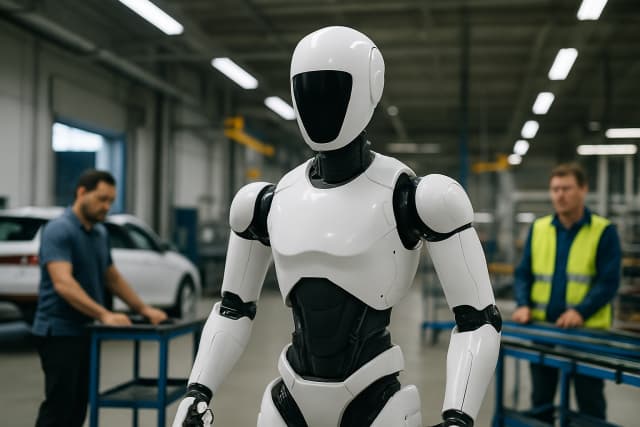
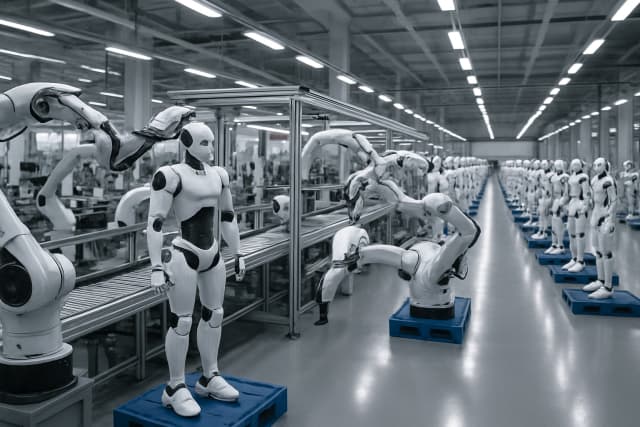



Humanoid robots have crossed the threshold from laboratory curiosities to production-line workers, with Chinese electronics factories achieving 99.99% success rates and 16-hour daily operations using advanced humanoids. Genie G2 robots at a Nanchang electronics facility are now performing quality control checks alongside human workers, exceeding design targets by processing over 320 units per minute compared to the original goal of 285. Meanwhile, Boston Dynamics' all-electric Atlas has entered its first paid commercial deployment at Hyundai's RMAC facility, while Tesla continues scaling thousands of Optimus units across its manufacturing operations.
***
The breakthrough deployments mark a pivotal moment for the robotics industry, as Global X ETFs projects cumulative humanoid robot sales will reach 100 million units by 2036, unlocking a staggering $4.8 trillion market by 2035. With manufacturing costs expected to drop 40% and Goldman Sachs forecasting the humanoid market will hit $38 billion by 2035 with 1.4 million unit shipments, major industrial players are racing to integrate these versatile machines into existing factory infrastructure without requiring massive overhauls.
Chinese Factories Lead Real-World Integration
China has emerged as the global leader in practical humanoid robot deployment, driven by acute labor shortages and aggressive automation initiatives. At a Nanchang electronics factory, Genie G2 humanoids have achieved remarkable operational metrics, maintaining a 99.99% success rate while operating 16 hours daily across two worker shifts. The robots consistently process over 320 units per minute, significantly exceeding the original design target of 285 units.
The facility plans to expand from its current deployment to 100 robots in the short term, with ambitious scaling plans reaching 500+ units across multiple workstations. Beyond quality control, the operation is expanding into tablets and phones testing, as well as semiconductor packaging applications. This real-world success demonstrates that humanoid robots can seamlessly integrate into existing production environments while delivering measurable performance improvements in productivity, quality, and operational consistency.
Western Giants Enter Commercial Phase
Boston Dynamics has achieved a major milestone with its all-electric Atlas humanoid entering its first paid commercial deployment at Hyundai's RMAC facility in 2026. The company unveiled enterprise-grade fleets at CES 2026, with initial production runs fully allocated between Hyundai RMAC and Google DeepMind, and additional deployments planned for 2027. Atlas will focus on parts sequencing by 2028 and advance to full assembly operations by 2030, marking a significant evolution from research prototype to production workhorse.
Tesla continues to scale its Optimus program aggressively, with Elon Musk expecting thousands of units operational across Tesla factories by the end of 2025, with continued expansion into 2026. The Optimus Gen 2 features enhanced joint articulation designed for both industrial and domestic applications, learning from extensive real-world operational data. Meanwhile, Figure Robots has secured paying customers following successful trials at BMW's Spartanburg facility, where humanoids demonstrated their capability by inserting sheet metal components for 30,000 vehicles during weeks-long pilot programs.
Massive Investment Wave Fuels Industry Growth
The humanoid robotics sector is experiencing unprecedented capital influx, with Asian developer Galbot recently securing $300 million in funding at a $3 billion valuation to fuel scaled production and R&D for industrial and service applications. This investment represents surging confidence among institutional investors who view humanoids as the next major technological disruption. Norwegian firm 1X has opened consumer preorders for its NEO humanoid robot, targeting home tasks and human interaction through advanced embodied AI systems.
PIA Automation's launch of its Embodied AI & Humanoid Robotics division in April 2026 exemplifies the industry's rapid commercialization. Through its partnership with Agibot via joint venture Joybot Manufacture, PIA is developing the I-Bot mobile humanoid for smart factories, capable of data collection, precision manufacturing, and navigation in complex industrial environments. The company plans to establish European manufacturing capacities for localized, large-scale production to accelerate market penetration across the region.
Technical Breakthroughs Enable Mass Deployment
The current wave of humanoid deployments has been enabled by convergent breakthroughs in Vision-Language-Action AI, allowing robots to learn tasks through natural language instruction rather than complex programming. AgiBot's real-world reinforcement learning system represents a particular advancement, enabling robots to acquire new skills in minutes rather than weeks or months of traditional training. These systems excel in multi-task flexibility, heavy lifting, material handling, and 24/7 operations within existing factory infrastructure.
Goldman Sachs attributes the market's rapid expansion to a projected 40% drop in manufacturing costs, driven by improvements in AI algorithms, efficient chip designs, advanced sensors, and precision actuators. Early 2026 deployments emphasize ergonomic tasks unsuitable for fixed-arm robots, with humanoids augmenting human workers for oversight rather than complete replacement. The robots are particularly effective at consistent speeds, reduced cycle times, enhanced precision, hazard removal, and operational flexibility that traditional automation cannot match.
Integrating embodied AI and humanoid robotics into industrial applications opens up entirely new production possibilities... enabling new forms of human-robot collaboration.
Market Tipping Point Approaches
Industry analysts identify 2030 as the expected 'tipping point' when humanoid robots will achieve widespread adoption across industries and consumer applications. Global X ETFs projects the market will unlock $4.8 trillion in value by 2035, supported by cumulative sales reaching 100 million units by 2036. This projection reflects not just manufacturing applications, but expansion into logistics, healthcare, hospitality, and residential markets as costs decline and capabilities improve.
The convergence of post-COVID labor shortages, advancing AI capabilities, and proven real-world performance metrics is creating ideal conditions for accelerated adoption. With major deployments now demonstrating measurable ROI and operational reliability, the humanoid robotics industry appears positioned for the exponential growth phase that industry observers have long anticipated. As more companies achieve successful deployments and costs continue declining, the transition from experimental technology to standard industrial equipment seems increasingly inevitable.
Sources
- https://www.globalxetfs.com/articles/robotics-breakthroughs-in-automation/
- https://www.youtube.com/watch?v=kH4LtrxD8Sc
- https://www.therobotreport.com/robotics-news/
- https://www.youtube.com/watch?v=eJNSvKYKvtw
- https://www.therobotreport.com
- https://www.businesswire.com/newsroom/industry/technology/robotics
- https://www.youtube.com/watch?v=JI4hlf2bq6E
- https://thesiliconreview.com/robotics
- https://www.robotics247.com/press-releases
- https://roboticsandautomationnews.com/2026/04/15/pia-automation-launches-embodied-ai-and-humanoid-robotics-division-targeting-industrial-applications/100592/
- https://sedonatec.com/feeds/blog/robots-factory
- https://www.youtube.com/watch?v=4l1wfW4_ETM
Leave a Comment