






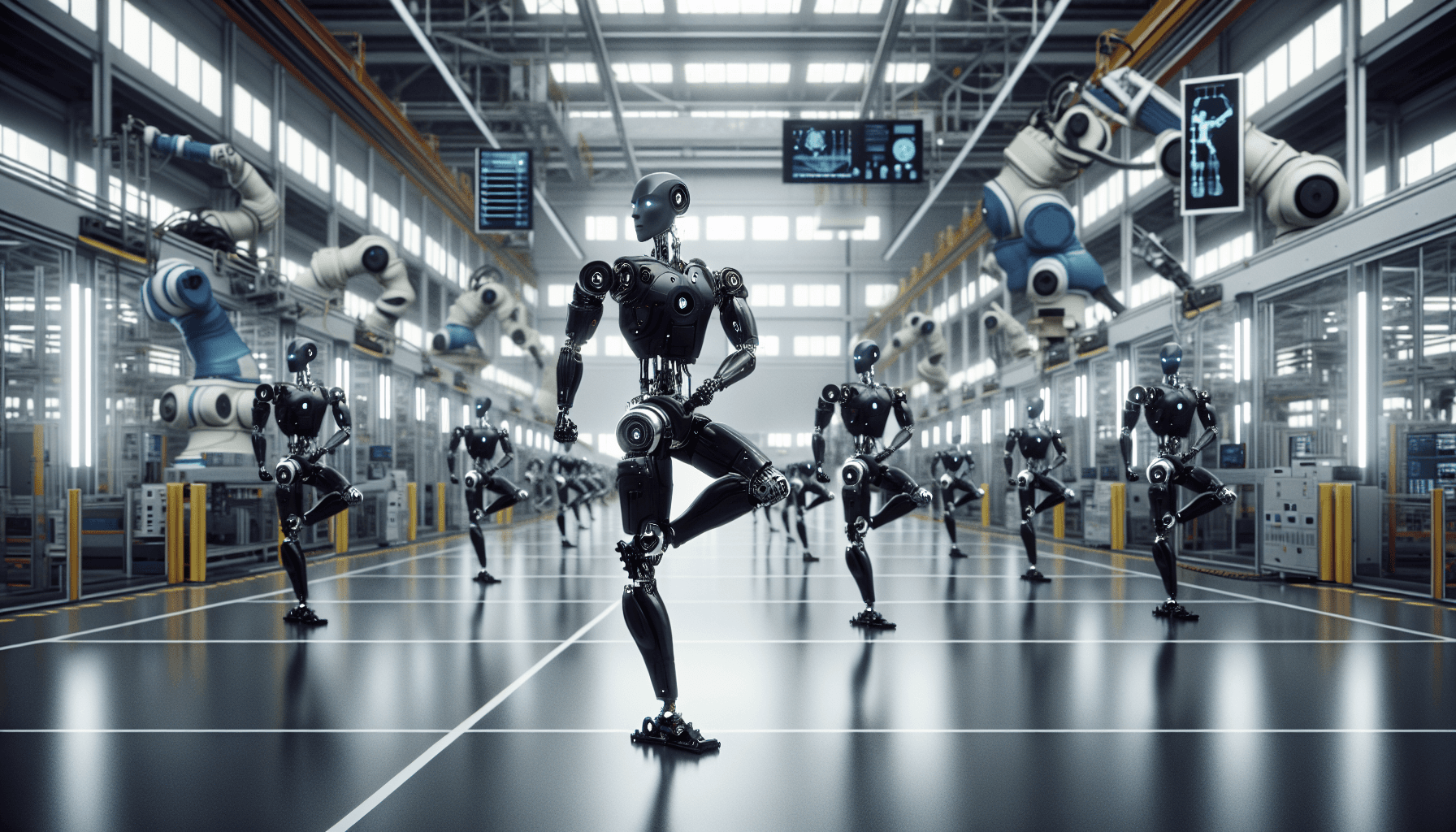
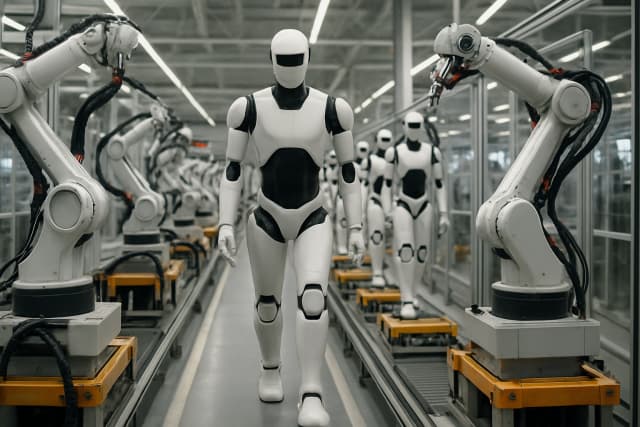
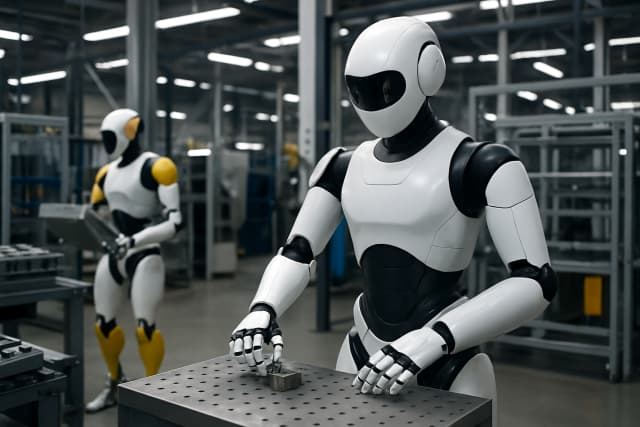
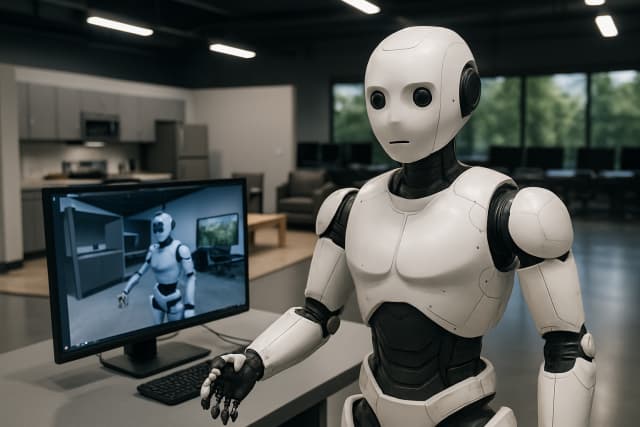



A breakthrough in autonomous robotics has emerged with the successful demonstration of humanoid robot fleets that can power on, stand up, and self-organize without human intervention. The February 2026 unveiling by Outright Systems showcased robots processing environmental data in real-time while communicating as a coordinated team, marking a pivotal shift from isolated robotic units to scalable ecosystems. Simultaneously, Unitary Robotics revealed its G1 humanoid robot "martial arts swarm" in Beijing, displaying extreme precision, balance, and synchronized performance that experts say signals the dawn of true robotic coordination.
***
These developments come as the World Economic Forum declared the "hardest technical advances" in autonomous robotics complete at its January 2026 Davos meeting, citing a 1,000x compute acceleration over eight years that outpaces Moore's Law by 25 times. With narrowed simulation-to-reality gaps through digital twins and synthetic data, robots can now train virtually and transfer skills directly to factories, warehouses, and logistics operations, enabling the coordinated fleet deployments that were demonstrated in February.
Autonomous Fleets Demonstrate Real-World Coordination
The February 20, 2026 demonstrations represented a quantum leap in robotics capabilities, with Outright Systems showcasing humanoid robots that could autonomously activate and coordinate without any human programming or intervention. Each unit in the fleet processed environmental data independently while maintaining real-time communication with other robots, creating a self-organizing network optimized for industrial applications. The robots demonstrated the ability to navigate together, assign tasks among themselves, and adapt to changing conditions in their environment.
Unitary Robotics' parallel demonstration in Beijing took coordination to another level with their G1 humanoid robots performing synchronized martial arts routines that required split-second timing and spatial awareness. The precision displayed in these movements translated directly to industrial applications, where such coordination could enable robots to work in close proximity on complex assembly tasks or navigate crowded factory floors without collision. Industry analysts noted that the martial arts demonstration served as a powerful proof-of-concept for the fine motor control and predictive capabilities needed in modern manufacturing.
From Lab Breakthroughs to Industrial Reality
The February demonstrations built upon months of foundational work, including Agibot's deployment of Real-World Reinforcement Learning (RWRL) systems that enable robots to learn and adapt in dynamic environments. This technology allows robots to continuously improve their performance based on real-world feedback, rather than relying solely on pre-programmed responses. Agibot's new generation of embodied AI robots represents what industry experts are calling a "shift toward physical AI," where artificial intelligence is deeply integrated with mechanical systems.
The timing of these breakthroughs aligns perfectly with industry needs, as global industrial robot installations hit 4.3 million units in 2023 with 10% year-over-year growth. Manufacturing companies facing labor shortages and reshoring trends are increasingly looking to coordinated robot teams to handle complex, multi-step processes that previously required human workers. The ability of robots to work together autonomously addresses one of the biggest limitations of traditional industrial automation, which typically involved isolated machines performing single tasks.
Technical Foundations Enable Breakthrough Performance
The dramatic improvement in robotic coordination stems from advances in simulation technology and digital twins that allow robots to train in virtual environments before deployment. This approach has dramatically reduced the time and cost required to develop new robotic capabilities, while also improving the reliability of robot behavior in unpredictable real-world conditions. Companies like Antioch, which raised $8.5 million for its cloud-based robotics simulation platform, are providing the infrastructure that makes rapid development and testing of coordinated robot behaviors possible.
The 1,000x compute acceleration cited by the World Economic Forum has been crucial in enabling real-time processing of the massive amounts of data required for fleet coordination. Each robot must simultaneously track its own position and status, monitor the locations and activities of other robots in the fleet, process environmental data, and execute complex motor functions. The computational requirements for this level of coordination would have been prohibitive just a few years ago, but advances in AI chips and edge computing have made it feasible for industrial deployment.
Industrial Applications Drive Market Transformation
The coordinated robot fleets are being designed specifically for applications where flexibility and adaptability are crucial, such as disaster response, warehouse operations, and flexible manufacturing systems. In factories, coordinated robots can work together on assembly lines, automatically redistributing tasks when one unit requires maintenance or when production demands change. This represents a significant advantage over traditional industrial robots, which typically require extensive reprogramming and reconfiguration when production requirements change.
German robotics firm RobCo demonstrated this industrial focus at Hannover Messe in April 2026 with the launch of "Autonomous Alfie," a humanoid robot designed for flexible manufacturing that integrates AI for autonomous task-handling. Similarly, Path Robotics introduced Rove, which combines AI with quadruped mobility for welding applications in manufacturing environments. These developments show how the coordination technologies demonstrated in February are being rapidly commercialized for specific industrial use cases.
These breakthroughs signal the dawn of coordinated robot ecosystems, shifting focus from isolated units to scalable teams optimized for factories, warehouses, and disaster response.
Market Projections Signal Explosive Growth Ahead
Industry analysts are projecting that humanoid robots will reach 100 million cumulative sales by 2036, with coordinated fleets representing a significant portion of that market. The ability to deploy teams of robots rather than individual units opens up new applications and increases the return on investment for companies implementing robotic systems. Kuka's "Automation 2.0" initiative and SVT Robotics' "Softbot Intelligence" platform both focus on AI-driven systems that can manage and optimize multiple robots simultaneously.
The funding landscape reflects this optimism, with significant investments flowing into companies developing coordination technologies. Starship Technologies' Series C round for autonomous deliveries, Augmentus funding for high-mix software, and Nauticus Robotics' $250 million round for deep-sea mining applications all demonstrate investor confidence in coordinated autonomous systems. The success of the February demonstrations has provided concrete proof that the technical challenges have been solved, paving the way for widespread commercial deployment throughout 2026 and beyond.
Sources
- https://www.youtube.com/watch?v=lf9BdOJ-VcY
- https://www.weforum.org/stories/2026/03/advances-in-autonomous-robotics-what-comes-next/
- https://www.globalxetfs.com/articles/robotics-breakthroughs-in-automation/
- https://novushitech.com/robotics-advancements-and-automation-2025/
- https://www.therobotreport.com
- https://roboticsandautomationnews.com
- https://setr.stanford.edu/technology/robotics/2023
- https://news.mit.edu/topic/robotics
- https://sedonatec.com/feeds/blog/robots-factory
- https://www.slsbearings.com/sg-en/blog/humanoid-robots-in-manufacturing-the-future-of-factory-automation
- https://amdmachines.com/blog/the-future-of-humanoid-robots-in-manufacturing/
- https://roboticsandautomationnews.com/2026/04/15/pia-automation-launches-embodied-ai-and-humanoid-robotics-division-targeting-industrial-applications/100592/
Leave a Comment