







The robotics industry reached a pivotal milestone in 2026 as multiple breakthrough systems demonstrated that core technical challenges preventing widespread autonomous robot deployment have been largely resolved. From self-organizing humanoid fleets that coordinate without human input to AI-powered welding robots navigating factory floors independently, the technological barriers that have constrained robotics for decades are rapidly falling away. Industry experts point to a convergence of factors including 1,000x compute acceleration over eight years, advanced vision-language-action models, and digital twins that have narrowed the simulation-reality gap to enable truly autonomous operation.
***
This represents a fundamental shift from the experimental robotics of previous years to practical, scalable systems ready for widespread industrial and commercial deployment. With 4.3 million industrial robots installed globally in 2023 marking 10% year-over-year growth, and humanoid robot sales projected to reach 100 million units cumulatively by 2036, the industry is transitioning from research curiosity to essential infrastructure across manufacturing, logistics, healthcare, and consumer applications.
Autonomous Fleet Coordination Achieves Human-Free Operation
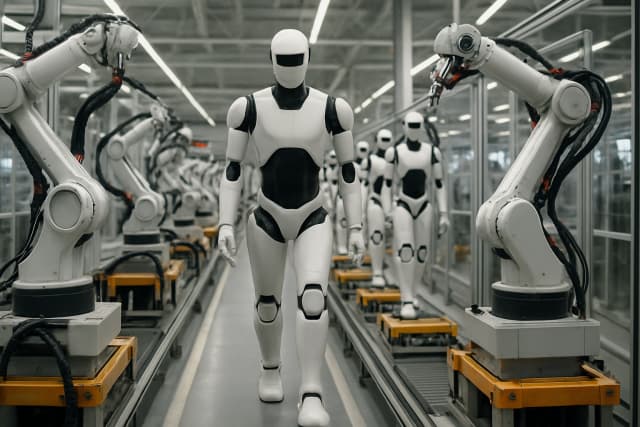
The most significant breakthrough came with autonomous humanoid robot fleets that can power on, self-organize, stand, and move coordinately without any human intervention. These systems use real-time environmental awareness and inter-robot communication to coordinate complex tasks across factories, warehouses, and disaster response scenarios. The technology represents a quantum leap from previous robotics systems that required extensive human oversight and programming for each operation.
Unitary Robotics demonstrated the precision possible with these coordinated systems through their G1 martial arts swarm, revealed in Beijing, which showcased extreme precision, balance, and synchronized performance among multiple humanoid robots. This demonstration highlighted how far robot coordination has advanced, with machines now capable of executing complex, precise movements in perfect synchronization while adapting to real-time environmental changes.
The implications extend far beyond manufacturing into critical applications like disaster response, where coordinated robot fleets could operate in dangerous environments without risking human lives. Early deployments in factories and warehouses are already showing significant efficiency gains, with robots able to reorganize themselves dynamically based on changing operational requirements without human reprogramming.
AI Integration Transforms Industrial Applications
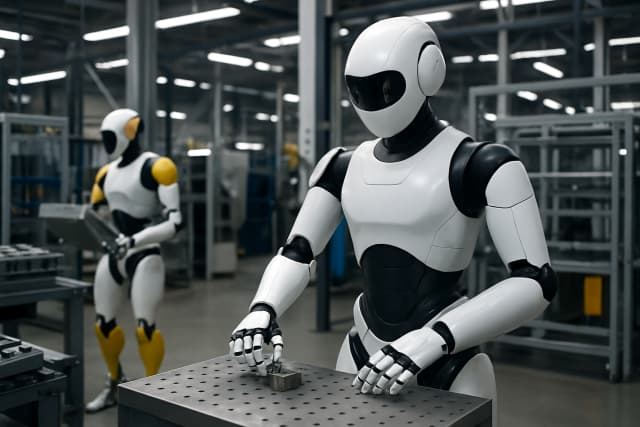
Companies across the robotics ecosystem are launching AI-integrated systems that blur the line between traditional automation and intelligent robotics. Agibot unveiled a new generation of robots and foundation models specifically designed for large-scale industrial deployment, focusing on what they term 'physical AI' - robots that can learn and adapt through real-world interaction rather than just programmed responses. Meanwhile, RobCo's Autonomous Alfie humanoid robot for industrial automation debuted at Hannover Messe, demonstrating how quickly humanoid robotics is moving from concept to commercial reality.
Path Robotics introduced Rove, which combines their Obsidian physical AI model with quadruped mobility for manufacturing applications, enabling mobile AI welding that can navigate complex factory environments. This represents a significant advancement in specialized industrial robotics, where AI enables robots to adapt welding techniques in real-time based on material conditions and environmental factors. Kuka's announcement of Automation 2.0 integrates AI directly with industrial robotics platforms, while SVT Robotics launched Softbot Intelligence for real-time data leveraging across robotic operations.
These AI-integrated systems are addressing critical labor shortages while enabling manufacturing reshoring by providing the flexibility and intelligence previously available only through human workers. The robots can now interpret complex commands through vision-language-action models, allowing factory workers to communicate with machines using natural language rather than specialized programming interfaces.
Compute and Hardware Advances Enable Real-World Performance
The technical foundation enabling these breakthroughs stems from dramatic improvements in computing power and hardware capabilities. The industry has achieved 1,000x compute acceleration over eight years, exceeding Moore's Law by 25 times, while simultaneously developing digital twins that have significantly narrowed the simulation-reality gap. This computational power enables vision-language-action models that can interpret and execute complex commands in real-time, a capability that was computationally impossible just a few years ago.
Hardware improvements have made robotics more accessible and reliable, with cheaper components enabling broader deployment while maintaining higher performance standards. The combination of improved sensors, more efficient actuators, and advanced processing capabilities has created robots that can operate reliably in unstructured environments - a key requirement for real-world applications beyond controlled factory settings.
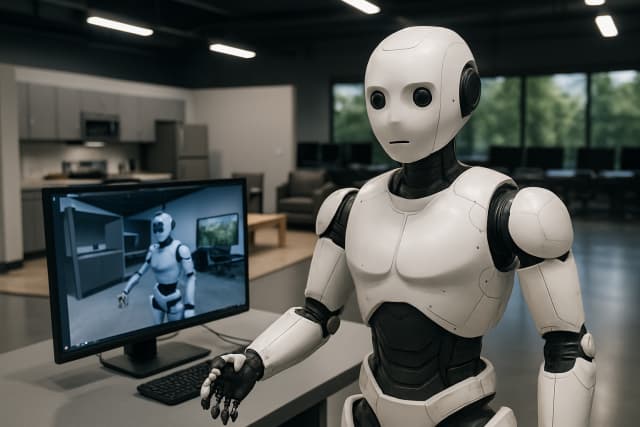
Digital twin technology has been particularly crucial in bridging the gap between simulation and reality, allowing robots to be trained in virtual environments that accurately predict real-world performance. This has dramatically reduced the time and cost required to deploy new robotic systems, as much of the learning and optimization can occur in simulation before physical deployment.
Market Expansion Across Multiple Sectors
The solved technical challenges are enabling rapid market expansion across diverse sectors beyond traditional manufacturing. Autonomous robots are now scaling successfully in ports, warehouses, factories, and healthcare applications, with surgical robots achieving unprecedented precision levels. The technology is transitioning from industrial applications to domestic use, with companies preparing consumer-oriented robotic systems based on the same underlying technologies that have proven successful in industrial deployments.
Recent examples demonstrate the breadth of applications now possible. Waymo has expanded robotaxis to Las Vegas, San Diego, and Detroit, while Bedrock Robotics raised $80M specifically for autonomous construction machinery. These deployments across transportation and construction show how the core breakthroughs in robotics are enabling automation in sectors previously considered too complex or unpredictable for robotic systems.
The market growth reflects this technical maturity, with Goldman Sachs projecting the humanoid robot market alone will reach $38 billion by 2035, with 1.4 million unit shipments. This represents not just incremental improvement but a fundamental shift toward robotics as critical infrastructure across the economy, addressing labor shortages while enabling new capabilities that exceed human performance in precision, endurance, and safety.
The compute acceleration we've achieved - exceeding Moore's Law by 25x - combined with digital twins and vision-language-action models has finally closed the gap between what robots can understand and what they need to do in the real world.
Industry Outlook and Future Deployments
With core technical challenges largely resolved, industry focus is shifting from proving capability to scaling deployment and integration. The enablers that drove 2025-2026 breakthroughs - AI/ML integration, digital twins, and advanced simulation - are now enabling self-learning robots that perform predictive maintenance and dynamic adaptation with minimal human intervention. Companies like Novus Hi-Tech are leading autonomous mobile robots (AMRs) and AI inspection systems that exemplify this new generation of truly autonomous systems.
The convergence of solved technical challenges, market demand driven by labor shortages, and proven real-world performance is creating conditions for rapid scaling across industries. Robots are no longer experimental tools but practical solutions for immediate deployment, with the industry having demonstrated that autonomous coordination, environmental adaptation, and complex task execution are now reliable capabilities rather than aspirational goals.
Sources
- https://www.youtube.com/watch?v=lf9BdOJ-VcY
- https://www.weforum.org/stories/2026/03/advances-in-autonomous-robotics-what-comes-next/
- https://www.globalxetfs.com/articles/robotics-breakthroughs-in-automation/
- https://novushitech.com/robotics-advancements-and-automation-2025/
- https://roboticsandautomationnews.com
- https://www.therobotreport.com
- https://www.automate.org/robotics/industry-insights
- https://news.mit.edu/topic/robotics
- https://sedonatec.com/feeds/blog/robots-factory
- https://www.slsbearings.com/sg-en/blog/humanoid-robots-in-manufacturing-the-future-of-factory-automation
- https://www.youtube.com/watch?v=4l1wfW4_ETM
- https://amdmachines.com/blog/the-future-of-humanoid-robots-in-manufacturing/
Leave a Comment