





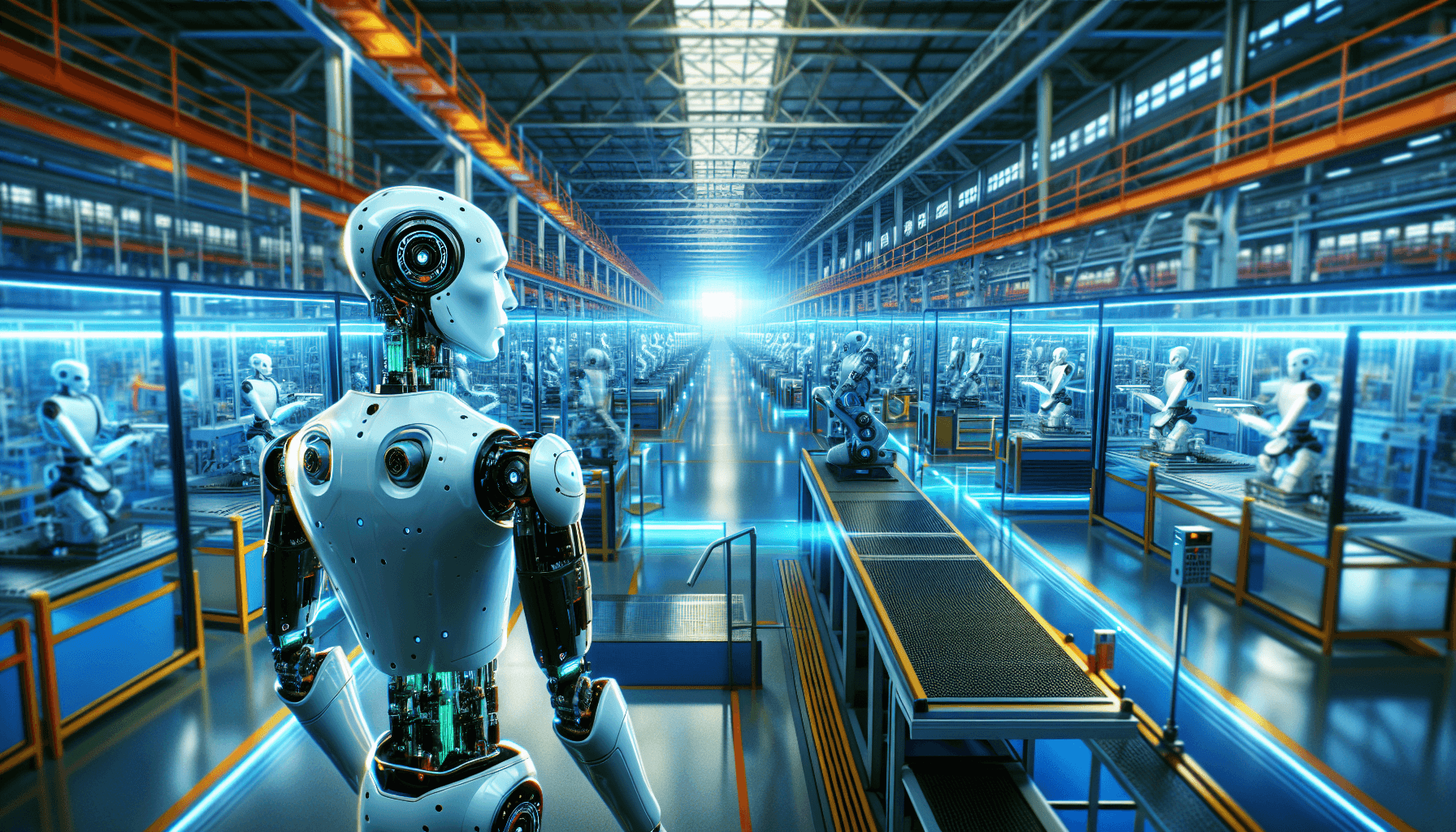



Humanoid robots have officially moved beyond demonstration videos into real-world factory floors, with Chinese electronics manufacturers, Hyundai, and other major companies launching pilot programs to address critical labor shortages. As of early 2026, these robots are handling material transport, quality inspections, and machine tending at production facilities, marking the first commercial deployments of bipedal automation in manufacturing environments. The push comes as U.S. manufacturers face 433,000 unfilled positions and a 1.4% monthly worker quit rate, creating urgent pressure to find alternative workforce solutions.
While these early deployments operate at slower speeds than traditional industrial robots and remain limited to a handful of sites, they represent a fundamental shift toward flexible automation that can work in human-designed spaces without costly facility retrofits. Goldman Sachs forecasts the humanoid robotics market will reach $38 billion by 2035 with 1.4 million unit shipments, driven by 40% reductions in manufacturing costs and the ability to fill an estimated 1.9 million projected U.S. job vacancies through 2033.
Live Factory Deployments Across Global Manufacturers
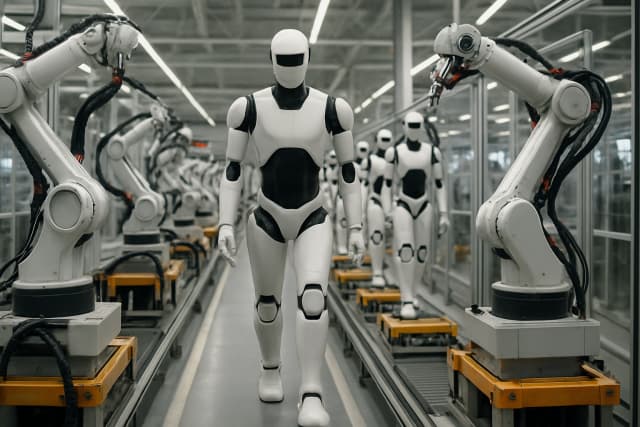
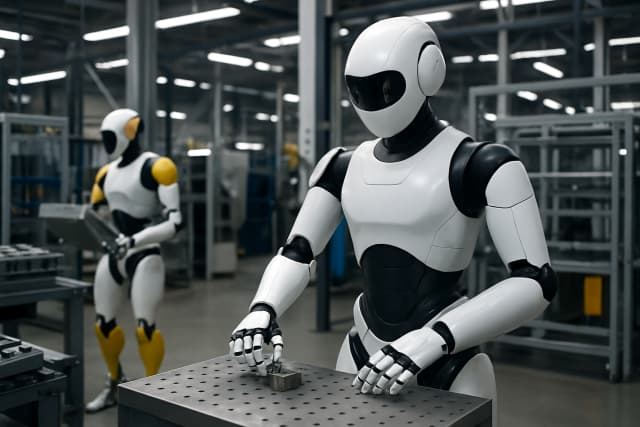
Chinese manufacturers are leading the charge with AgiBot and other companies deploying AI-powered humanoid robots for assembly, quality control, and object handling at scale. Xinhua reported robots performing quality checks at a Nanchang electronics factory, with YouTube footage showing the systems operating autonomously alongside human workers. These deployments focus on tasks like autonomous material handling, bin picking, simple assembly, heavy lifting, and machine tending including loading and unloading CNC machines.
Hyundai has partnered with Boston Dynamics to deploy Atlas robots for hazardous heavy lifting and ergonomic tasks that prove difficult for traditional fixed automation systems. Tesla is reportedly ending Model S and Model X production to repurpose factory space for Optimus robot manufacturing and robotaxi development, according to eWeek. Other automotive and electronics manufacturers are conducting early tests, with Chinese firms demonstrating the most rapid progress in real-world implementations.
Leading Platforms Enter Commercial Testing Phase
Figure AI is conducting autonomous material handling pilots while Agility Robotics deploys its Digit robot for bin picking and factory floor operations. Tesla's Optimus Gen 2 focuses on repetitive manufacturing tasks, and Unitree's H1 and G1 models are demonstrating material handling capabilities. Apptronik's Apollo robot targets heavy-duty precision work in complex manufacturing processes.
Despite these advances, none of the current humanoid platforms match the speed of traditional automotive production lines, where conventional robots continue to dominate high-volume welding, stamping, and body-in-white operations. The International Federation of Robotics reports hundreds of thousands of traditional industrial robots are still installed annually, with global manufacturers adding 4.3 million industrial robots in 2023 alone, representing 10% year-over-year growth.
Technical Limitations and Deployment Challenges
Current humanoid robots operate with slower cycle times than traditional automation and have unproven mean time to failure rates, lacking the ISO 10218 safety certification required for widespread industrial deployment. These systems excel in flexibility and can work in existing infrastructure without facility modifications, but they cannot match the precision and speed required for volume production work. Supply chain constraints and reliability concerns continue to hinder large-scale deployment.
The robots are best suited for tasks requiring adaptability in human-designed spaces rather than precision-critical, high-volume operations. Their advantage lies in 24/7 operation capability, safety in hazardous environments, and the ability to perform varied tasks without extensive reprogramming. Vision-Language-Action AI models enable these robots to learn new tasks through natural language instructions, significantly boosting their adaptability compared to traditional programmed automation.
Labor Crisis Drives Adoption Timeline
The urgency of deployment stems from severe manufacturing labor shortages, with 433,000 open U.S. factory positions as of December 2025 Bureau of Labor Statistics data and 184,000 workers quitting monthly at a 1.4% rate. Deloitte projects 1.9 million manufacturing job vacancies will remain unfilled through 2033, creating economic pressure for alternative workforce solutions. Companies are viewing humanoid robots as a strategic response to sustained labor market tightness rather than a replacement for human workers.
New ventures like PIA Automation's Embodied AI & Humanoid Robotics unit and Accenture pilot programs are integrating robots with humans and existing automation systems to enhance operational visibility. Assembly Magazine reported in 2026 that this represents a fundamental shift toward integrated robotic workforces, where humanoid robots complement rather than replace traditional automation and human workers in manufacturing environments.
We're seeing robots performing quality checks in electronics factories and handling heavy lifting tasks that are difficult for fixed automation systems. This marks a shift to integrated robotic workforces from traditional fixed automation.
Market Projections and Industry Transformation
Analysts predict limited production deployments will expand in logistics and light manufacturing between 2027-2030 if technical challenges are resolved, including achieving production-level mean time to failure rates, costs rivaling collaborative robots with payback periods under two years, and obtaining necessary safety approvals. Goldman Sachs projects the market will grow to $38 billion by 2035 with 1.4 million unit shipments, fueled by 40% manufacturing cost reductions and improved reliability.
The transition represents a move toward what Chinese factory reports describe as integrated robotic workforces, departing from the fixed automation model that has dominated manufacturing for decades. However, widespread adoption depends on overcoming current technical hurdles including cycle time improvements, reliability enhancements, and safety certification processes. Early benefits include continuous operation, improved safety in dangerous roles, and the potential to address the projected workforce gap through 2033.
Sources
- https://www.youtube.com/watch?v=lf9BdOJ-VcY
- https://www.weforum.org/stories/2026/03/advances-in-autonomous-robotics-what-comes-next/
- https://www.globalxetfs.com/articles/robotics-breakthroughs-in-automation/
- https://novushitech.com/robotics-advancements-and-automation-2025/
- https://roboticsandautomationnews.com
- https://www.therobotreport.com
- https://www.automate.org/robotics/industry-insights
- https://news.mit.edu/topic/robotics
- https://www.evsint.com/humanoid-robots-industrial-manufacturing-2026/
- https://www.slsbearings.com/sg-en/blog/humanoid-robots-in-manufacturing-the-future-of-factory-automation
- https://sedonatec.com/feeds/blog/robots-factory
- https://www.youtube.com/watch?v=4l1wfW4_ETM
Leave a Comment