






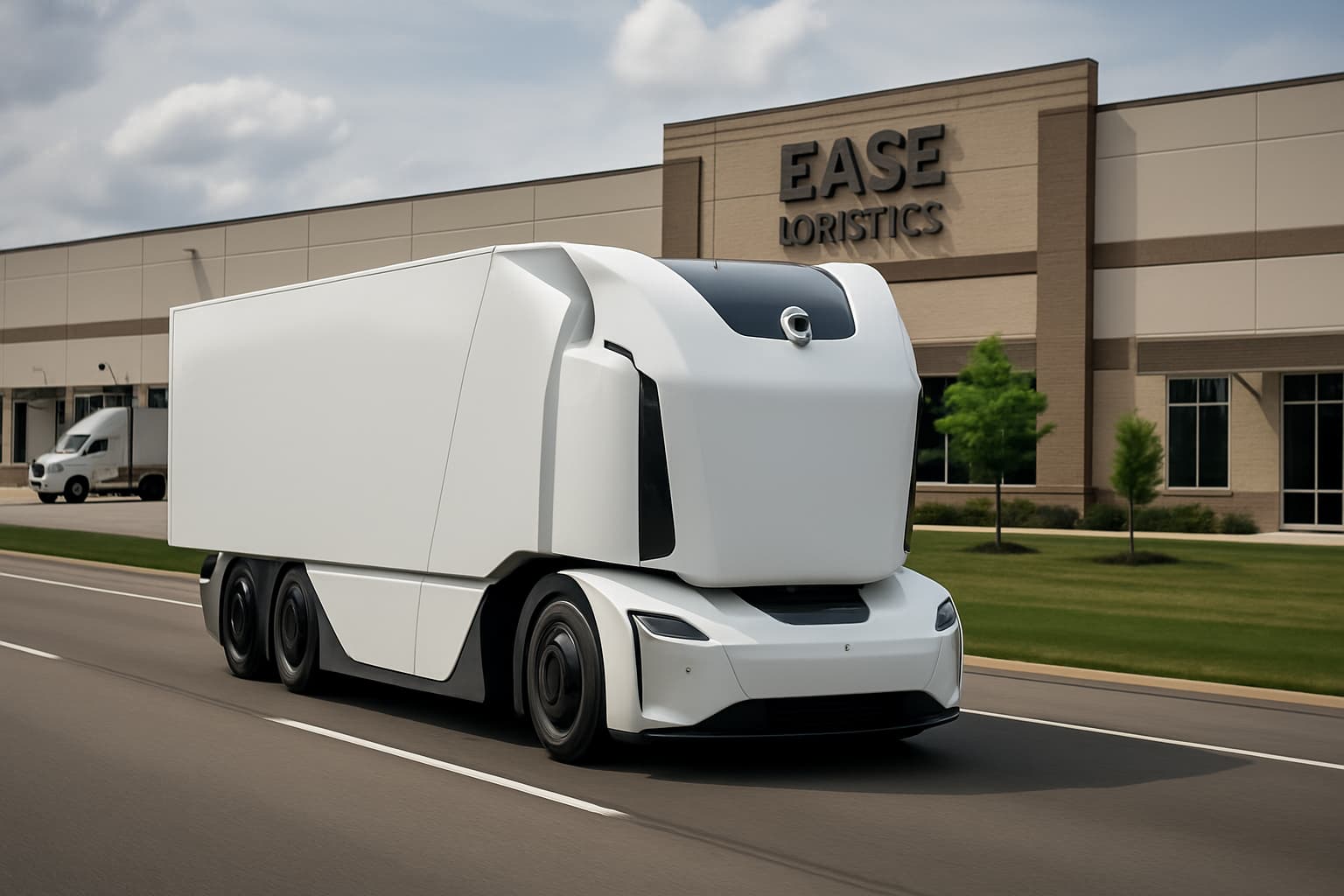




Autonomous trucking has quietly crossed a threshold that years of pilot programs and safety-driver demonstrations never quite reached: routine, unsupervised, daily operation. Einride and EASE Logistics confirmed that SAE Level 4 autonomous electric trucks are now running scheduled freight routes between EASE warehouse facilities in Marysville, Ohio, without a human driver behind the wheel. The announcement lands amid a broader wave of robotics news this week, but it stands out because it represents something rarer than a new model or benchmark score: a machine doing a paying job, every day, with no one watching from the driver's seat.
For over a decade, autonomous trucking has been synonymous with pilot programs, test corridors, and safety drivers poised to intervene. Companies have logged millions of supervised miles while regulators, insurers, and logistics customers waited for proof that the technology could operate reliably outside of controlled demonstrations. The Einride-EASE deployment, alongside parallel advances in driverless airport shuttles, inspection robot fleets, and warehouse AMRs now surpassing tens of millions of autonomous miles, suggests that 2026 is the year autonomous ground transport stopped being a research story and became an operations story.
From Pilot Corridor to Daily Route
The Einride-EASE Logistics arrangement centers on a defined but commercially meaningful route: daily runs between EASE's warehouse facilities in Marysville, Ohio. Unlike earlier high-profile autonomous trucking trials that ran on long-haul highway corridors with safety drivers or chase vehicles, this deployment uses SAE Level 4 electric trucks operating without a human in the cab, a classification that means the vehicle can handle all driving tasks within its defined operational domain without requiring a person ready to intervene.
Marysville is not a random choice. The area is a dense hub for automotive supply chains, and EASE Logistics has built its warehousing operations around high-frequency, short-haul movements between facilities, precisely the kind of repetitive, geofenced route that current autonomous trucking technology handles most reliably. That structure matters: Level 4 systems today generally succeed by operating within tightly defined, well-mapped environments rather than attempting fully general driving across unpredictable long-haul networks.
Einride has spent years building both the vehicle platform and the software stack needed to manage fleets remotely, including systems for remote oversight and intervention when needed. The company's pivot toward electric, autonomous short-haul freight reflects a broader industry bet that the earliest durable commercial wins in autonomous trucking will come from repetitive, high-volume, short-distance routes rather than cross-country hauls.
Why This Beats the Benchmark Headlines
This week's robotics news cycle is crowded with foundation models, world models, and household robots posting dramatic jumps in laboratory success rates. Figure's Helix 2.5 system, for instance, reportedly improved complete-task success in unfamiliar homes from 9 percent to 56 percent after pretraining on human-behavior data. Skild claimed 66 percent success on unseen tasks versus 9 percent for a comparable model. These are genuinely significant technical results, but they describe systems still being tested, refined, and validated outside of paid commercial work.
The Einride-EASE operation is different in kind, not just degree. It is not a benchmark or a proof of concept; it is logistics infrastructure that a company is relying on to move freight it has committed to customers. That distinction, moving from demonstrated capability to depended-upon capability, is the harder and more consequential threshold in robotics and autonomy, and it is one that most of this week's other announcements have not yet crossed.
Other developments reinforce the same pattern. Auve Tech demonstrated its MiCa shuttle operating without an onboard safety operator at Tallinn Airport in Estonia, under remote supervision with Magnetic MRO, while Seegrid reported its customer fleet has surpassed 20 million autonomous miles across manufacturing and warehousing environments. Together with BrainOS-powered robots posting 68 percent year-over-year growth in global deployments, these figures point to the same conclusion: autonomous systems are proving themselves first in structured, supervised, commercially monitored environments, not in the open-ended world.
The Economics of Structured Autonomy
The appeal of routes like the Marysville corridor is straightforward economics. Short-haul warehouse-to-warehouse freight runs are predictable, repeatable, and confined to a limited geographic footprint that can be mapped, monitored, and updated with far more confidence than an interstate highway network spanning multiple states and weather systems. For logistics operators, this predictability translates directly into risk management: fewer edge cases, clearer liability boundaries, and easier integration with existing dispatch and warehouse management systems.
Electric trucks add a second layer of economic logic. Short, scheduled routes are well suited to battery range and charging infrastructure, avoiding the range anxiety and charging logistics that complicate electrification of long-haul trucking. Pairing autonomy with electrification on a fixed route allows Einride to optimize both vehicle utilization and energy costs simultaneously, rather than solving the harder, less constrained problem of autonomous long-haul electric freight.
This also explains why so much of this week's commercial autonomy news, from ANYbotics' Shift fleet-management platform for inspection robots to FANUC and Google's AI Welding Agent that generates robot motion programs directly from technical drawings, shares a common thread. Nearly all of it targets structured, supervised, or geofenced environments where autonomy can be measured, audited, and insured. The frontier of fully general robotic autonomy, operating reliably in homes, unstructured outdoor settings, or unpredictable public roads, remains substantially further out.
We are not running a demonstration. We are running a freight operation that happens to be autonomous, and that distinction is everything for how shippers plan their networks.
What Comes Next for Autonomous Freight
The near-term question for Einride and EASE Logistics is scale: whether a successful daily operation on one Ohio corridor can be replicated across additional warehouse pairs, and eventually additional metro regions with similarly dense logistics infrastructure. Industry analysts expect the playbook to spread gradually, first within tightly clustered industrial hubs resembling Marysville's automotive supply chain geography, before expanding toward more ambitious interstate corridors that require navigating a wider range of road conditions, traffic patterns, and regulatory jurisdictions.
Regulatory posture will also shape the pace of expansion. SAE Level 4 operation without an onboard driver requires regulatory comfort at the state level, and Ohio's willingness to permit this kind of operation signals a template other states may watch closely. Combined with insurance frameworks that are still catching up to driverless commercial freight, the regulatory dimension may ultimately move slower than the technology itself.
Sources
- https://www.businesswire.com/newsroom/industry/technology/robotics
- https://roboticsandautomationnews.com/tag/robotics/
- https://roboticsandautomationnews.com/category/industry/
- https://www.turingpost.com/p/the-latest-breakthroughs-in-robotics-september-2026
- https://roboticsandautomationnews.com/category/robotics-news/
- https://www.automate.org/robotics/news
- https://roboticsandautomationnews.com/page/529/?mode=grid
- https://roboticsandautomationnews.com/page/330/?mode=list
- https://roboticsandautomationnews.com/category/news/
- https://roboticsandautomationnews.com/tag/autonomous-navigation/
- https://www.mfg-outlook.com/the-disruptor/humanoid-beyond-traditional-automation
- https://humanoid.press/
Leave a Comment