








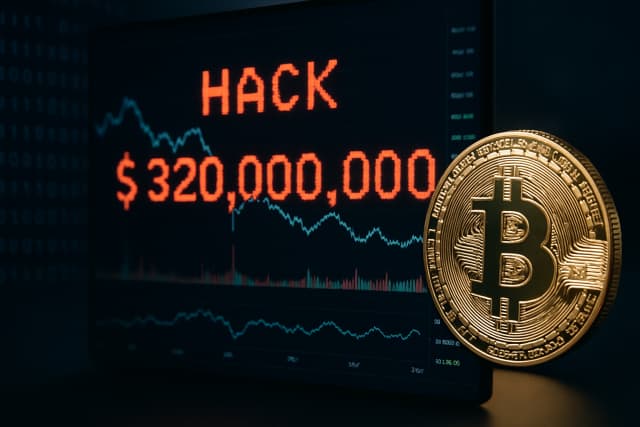





Bitget confirmed this week that suspected North Korean hackers stole approximately $351.6 million from the exchange's hot and warm wallets, one of the largest single thefts in crypto's history of exchange breaches. The exchange resumed Bitcoin withdrawals after containing the attack, but the incident lands amid a broader wave of security failures that also saw Ledger hardware wallets tampered with across Southeast Asia and $74 million drained from a lending protocol on the Cronos network. Together, these breaches underscore a sobering reality: as institutional capital pours into tokenized assets and regulated infrastructure, the industry's core custody and security practices remain dangerously exposed.
***
The timing is particularly uncomfortable for an industry trying to convince regulators and institutions that it has matured. Just as the European Union finalizes its Markets in Crypto-Assets framework and U.S. regulators debate token-issuance rules, North Korean state-linked hacking groups continue to treat exchanges, hardware wallets, and lending protocols as an open ATM. A joint law-enforcement advisory this week revealed that the WaterPlum group alone compromised at least 30,000 devices and moved more than $10.7 million to North Korea between December 2025 and July 2026, suggesting the Bitget theft is not an isolated event but part of a sustained, well-resourced campaign.
Inside the Bitget Breach
Bitget disclosed that suspected North Korean hackers siphoned approximately $351.6 million from its hot and warm wallets, with some reports placing the broader theft estimate above $350 million once associated losses are tallied. Hot and warm wallets, which stay connected to the internet to facilitate faster transactions, are inherently more vulnerable than cold storage, and the scale of the breach suggests attackers found a way to exploit that exposure at significant scale. The exchange has since resumed Bitcoin withdrawals, signaling it has contained the immediate threat, but the incident raises fresh questions about how centralized exchanges balance liquidity needs against custody security.
The attribution to North Korean actors fits a well-documented pattern. Pyongyang-linked hacking units, including the notorious Lazarus Group and its affiliates, have stolen billions of dollars in cryptocurrency over the past several years, using the proceeds to fund the regime's weapons programs in defiance of international sanctions. Bitget's breach now ranks among the largest exchange hacks attributed to North Korean operatives, reinforcing warnings from blockchain analytics firms that state-sponsored crypto theft has become an industrialized, repeatable operation rather than a series of isolated incidents.
A Supply Chain Under Attack
The Bitget hack did not occur in isolation. Ledger, the hardware wallet manufacturer widely regarded as one of the safer ways to store cryptocurrency offline, confirmed that devices distributed through a partner called CryptoBilis in Southeast Asia had been compromised by a hardware implant designed to drain user funds. The company asked distributors across Indonesia, Singapore, Thailand, the Philippines, Vietnam, and Hong Kong to suspend sales immediately while it investigates the extent of the tampering, a response that effectively halts a regional sales channel overnight.
Separately, an attacker exploited the Tectonic lending protocol on the Cronos network, manipulating asset prices to borrow roughly $74 million before activity on the network was temporarily disrupted. Price-oracle manipulation remains one of the most common attack vectors in decentralized finance, and the Tectonic exploit demonstrates that even as the industry shifts toward more institutional-grade tokenized asset platforms, the underlying DeFi plumbing still carries significant unresolved risk. Taken together, the Bitget, Ledger, and Cronos incidents paint a picture of an attack surface that spans centralized custody, hardware supply chains, and smart contract logic all at once.
The North Korean Playbook
A joint law-enforcement advisory issued this week detailed the activities of WaterPlum, a group linked to North Korean cyber operations that compromised at least 30,000 devices between December 2025 and July 2026. The group moved more than $10.7 million in stolen cryptocurrency back to North Korea during that period, according to the advisory, using techniques that blend social engineering, malware distribution, and infrastructure compromise. The scale and duration of the campaign suggest a level of organizational persistence that individual exchanges and wallet manufacturers are struggling to match with their own security resources.
Analysts tracking North Korean cyber operations have long noted that the regime treats cryptocurrency theft as a primary funding mechanism, particularly as traditional sanctions have cut off other revenue streams. The diversity of this week's attacks, hitting a centralized exchange, a hardware wallet supply chain, and a DeFi lending protocol within the same news cycle, illustrates how thoroughly North Korean-linked actors have mapped the industry's weak points. It also raises the stakes for international cooperation on crypto security, since no single company or jurisdiction can fully defend against a state-level adversary operating across borders.
These are not opportunistic smash-and-grab attacks anymore. We are watching a state actor run a coordinated, multi-front campaign against exchanges, hardware supply chains, and DeFi protocols simultaneously, and most of the industry is still playing defense one incident at a time.
Why This Matters for Crypto's Institutional Push
The security failures arrive at an awkward moment for an industry working hard to present itself as ready for institutional capital. Even as Circle's USDC earns a landmark European Union classification and Uniswap moves toward compliance-enabled institutional trading through its Permissioned Pools, the headline news of the week is still a nine-figure theft blamed on a hostile nation-state. That juxtaposition is unlikely to be lost on regulators in Washington and Brussels who are actively drafting rules for stablecoins, exchanges, and tokenized assets.
For institutional allocators weighing exposure to spot Bitcoin ETFs, which have already seen roughly $151 million in net outflows this week on top of $681 million the week before, repeated security incidents add another layer of hesitation beyond simple price volatility. Exchanges and custodians will likely face pressure to disclose more detail about wallet architecture, insurance coverage, and incident-response protocols as institutional due diligence standards rise. Until the industry demonstrates it can neutralize state-sponsored threats as reliably as it can court institutional investment, security will remain the quiet variable capable of undermining crypto's broader legitimacy push.
Sources
- https://cointelegraph.com/category/latest-news
- https://www.theblock.co/news
- https://www.bloomberg.com/crypto
- https://crypto.news/
- https://cointelegraph.com/tags/blockchain
- https://www.blockchain.com/explorer/news
- https://ct.com/
- https://www.bleepingcomputer.com/news/cryptocurrency/
- https://www.coingecko.com/en/news
- https://cryptonews.net/
- https://coinsevent.com/en/topics/defi
- https://blockonomi.com/regulation/
- https://www.newsnow.co.uk/h/Business+&+Finance/Cryptocurrencies/DeFi
- https://decentralized-finance.io/news/topics/regulation/
Leave a Comment