







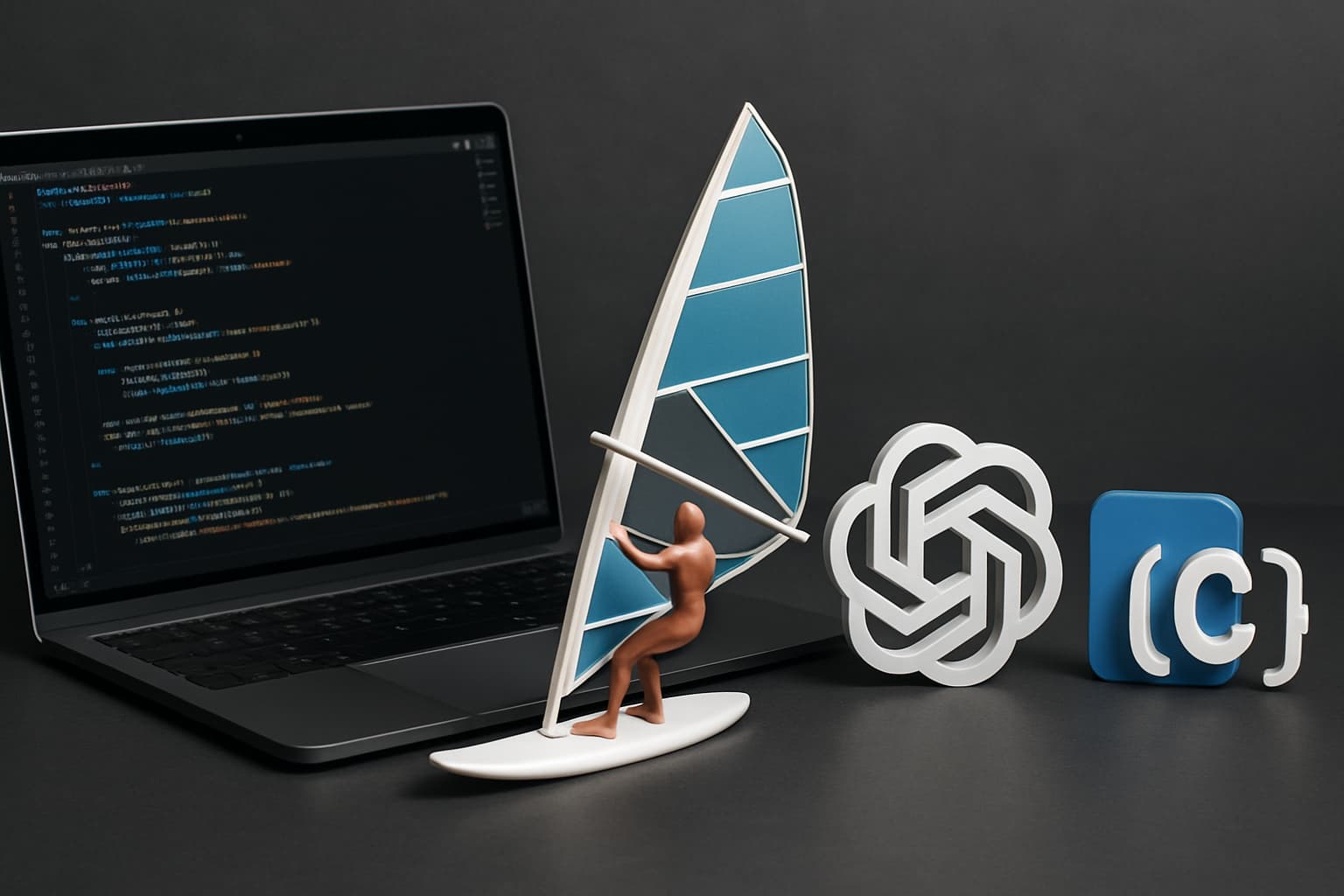



OpenAI has agreed to acquire Windsurf, the AI-native coding assistant formerly known as Codeium, for more than $3 billion, according to market intelligence reviewed this week. The deal marks OpenAI's largest acquisition to date and signals an aggressive push to own not just the models that power AI coding, but the editors and workflows developers use every day. The move lands amid a frenetic stretch for developer tooling, with Microsoft rolling out a GitHub AI agent built on Anthropic's Claude 3.7 Sonnet and Cursor's parent company reaching a $9.9 billion valuation just months earlier.
***
The Windsurf acquisition is more than a single transaction; it is a signal flare for where the entire software industry believes value is migrating. As AI assistants shift from autocomplete novelties to autonomous agents capable of writing, testing, and shipping code, the companies that control the developer's primary workspace stand to capture an outsized share of the coming productivity gains. With Microsoft, Anthropic, OpenAI, and a crowded field of well-funded startups all converging on the same terrain, the fight over AI coding tools has become one of the clearest proxies for the broader AI arms race.
A Record-Setting Bet on Developer Workflows
The reported price tag of more than $3 billion makes the Windsurf deal OpenAI's largest acquisition to date, eclipsing prior investments in infrastructure and smaller tooling startups. Windsurf, which rebranded from Codeium, had built a reputation among developers for its AI-native IDE that blends code generation with contextual understanding of entire codebases rather than isolated snippets. For OpenAI, the acquisition represents a shift from simply licensing its models to third-party tools toward vertically integrating the entire coding experience, from the underlying language model to the editor window itself.
That strategic logic mirrors moves already underway elsewhere in the industry. Microsoft, which owns GitHub and has poured billions into OpenAI, does not have exclusive claim to the best coding models, a fact underscored by its decision to power a new GitHub AI agent with Anthropic's Claude 3.7 Sonnet rather than an OpenAI model. By acquiring Windsurf outright, OpenAI gains a distribution channel and a captive developer audience that does not depend on Microsoft's goodwill or GitHub's platform decisions.
Microsoft Answers With Claude Inside GitHub
Microsoft's newly launched GitHub AI agent, available to Copilot Pro+ and Enterprise customers, is a notable admission that the best model for a given coding task may not come from Microsoft's closest AI partner. By integrating Anthropic's Claude 3.7 Sonnet directly into GitHub's agent framework, Microsoft is betting that developers care more about output quality than brand loyalty. The agent is designed to handle more autonomous tasks than traditional Copilot suggestions, including multi-step reasoning across files and repositories, a capability increasingly central to how vendors differentiate their offerings.
This multi-model approach reflects a broader maturation in the AI coding market. Where early competition centered on who had the single best large language model, the current phase is about orchestration: which platform can seamlessly route tasks to the right model, maintain context across a session, and integrate cleanly with existing CI/CD pipelines, version control, and project management tools like Jira and GitHub Actions. GitHub's scale advantage, with hundreds of millions of repositories and a dominant share of enterprise version control, gives Microsoft leverage regardless of whose model sits underneath the hood.
Cursor's Valuation Signals a Crowded, Well-Funded Field
OpenAI's move into owned tooling does not happen in a vacuum. Cursor, another AI-native code editor, reached a $9.9 billion valuation after raising $900 million in a funding round completed earlier in 2025, a figure that underscores just how much investor capital is chasing the same category Windsurf occupies. Cursor's rapid rise, alongside continued interest in tools like Tabnine and cloud-based development environments such as Gitpod and Replit, illustrates that the AI coding assistant market has moved well past the experimental phase and into serious commercial competition.
The presence of multiple well-capitalized entrants raises the stakes for OpenAI's acquisition. Rather than being the clear technological leader by default, OpenAI now faces direct competition from independent, venture-backed players building comparable products without the constraints of operating inside a larger AI lab's broader business priorities. Absorbing Windsurf gives OpenAI an immediate foothold in that fight, but it also invites scrutiny over whether an OpenAI-owned editor can remain agnostic enough to appeal to developers who may distrust deep integration with a single model provider.
What It Means for Enterprise Developers
For engineering teams already juggling a stable core stack of Visual Studio Code, Git, Docker, Jenkins, and Kubernetes, the consolidation among AI coding vendors introduces both opportunity and uncertainty. Enterprises evaluating AI-assisted development now face a landscape where the underlying model, the editor, and the version control system may all be controlled by overlapping but competing corporate interests. Decisions about which AI coding assistant to standardize on increasingly carry strategic weight, affecting everything from vendor lock-in risk to how easily a company can switch models as pricing and capabilities shift.
There is also a security and governance dimension that enterprise buyers cannot ignore. As AI agents gain more autonomy within developer workflows, ranging from GitHub's new Claude-powered agent to whatever Windsurf becomes under OpenAI's ownership, organizations must reassess code review practices, audit trails, and access controls. The acquisition arrives alongside separate but related developments in the broader ecosystem, including Oracle's Java 27 release with strengthened post-quantum cryptography support, suggesting that even as AI reshapes how code gets written, the underlying platforms are simultaneously being hardened against a new generation of security threats.
The editor is no longer just where you type code, it's becoming the interface for an entire AI-driven development workflow, and whoever owns that interface owns the relationship with millions of developers.
The Road Ahead
Regulatory review of the deal remains a live question given its size and OpenAI's growing footprint across the software stack, from foundation models to now developer tooling itself. Antitrust authorities in both the United States and Europe have grown more attentive to AI industry consolidation, and a $3 billion-plus acquisition by one of the sector's most closely watched companies is likely to draw scrutiny even if it closes without formal objection. How regulators and rivals respond will shape whether this becomes a template for further vertical integration across the AI coding market.
What is already clear is that the boundary between AI model provider and software company is dissolving. OpenAI, Microsoft, and Anthropic are no longer simply competing on model benchmarks; they are competing to own the daily habits of millions of developers. As that competition intensifies, the tools engineers open every morning, and the companies behind them, are being rewritten in real time.
Sources
- https://www.g2.com/best-software-companies/top-development
- https://thectoclub.com/tools/best-software-development-tools/
- https://spacelift.io/blog/software-development-tools
- https://www.tekrevol.com/blogs/software-development-tools/
- https://monday.com/blog/rnd/software-development-tools/
- https://www.softwaretestinghelp.com/software-development-tools/
- https://www.cloudzero.com/blog/software-development-tools/
- https://www.designrush.com/agency/software-development/trends/best-software-development-tools
- https://riseuplabs.com/software-development-tools-to-use/
- https://keploy.io/blog/community/software-development-tools
- https://www.spaceotechnologies.com/blog/software-development-tools/
Leave a Comment