





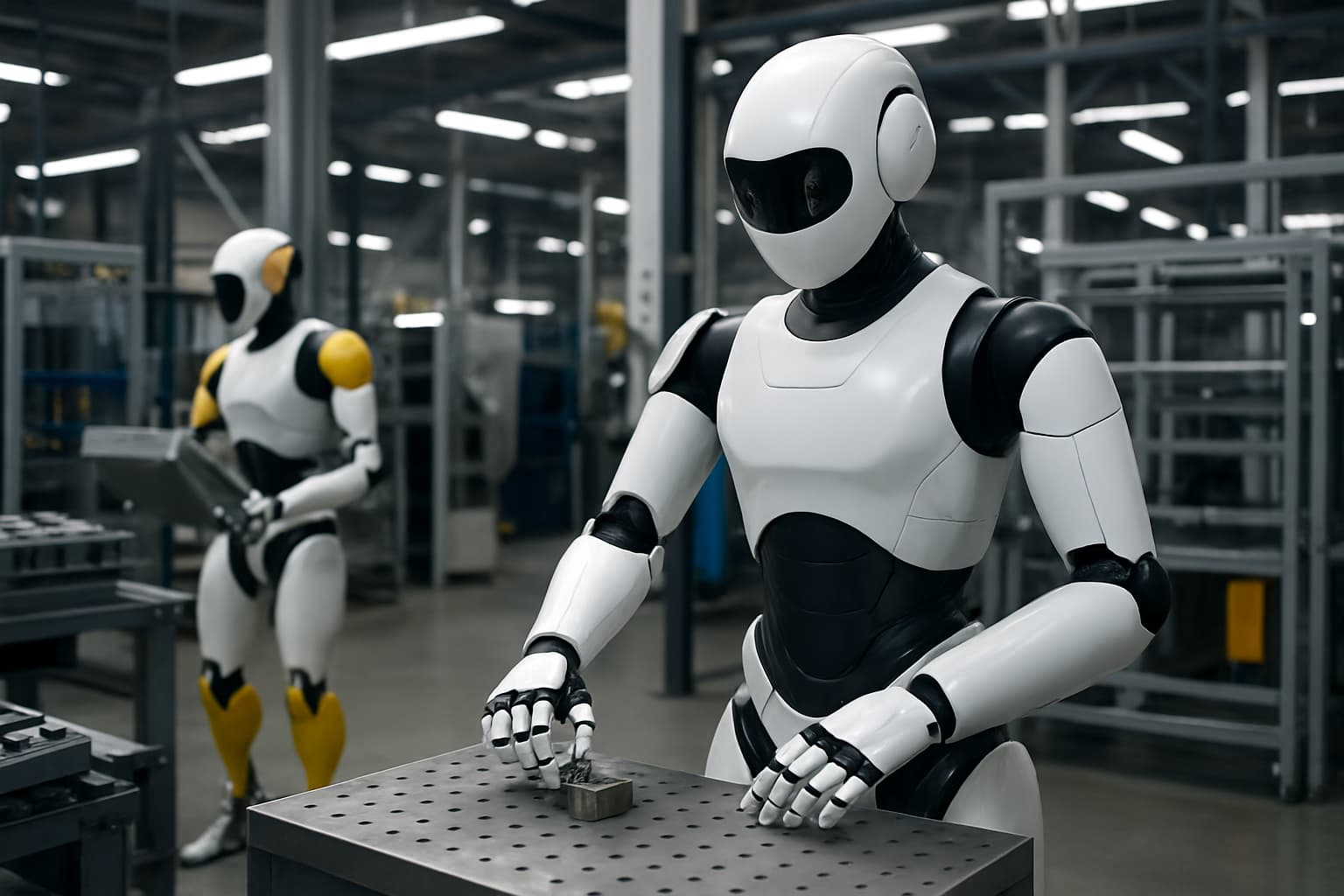
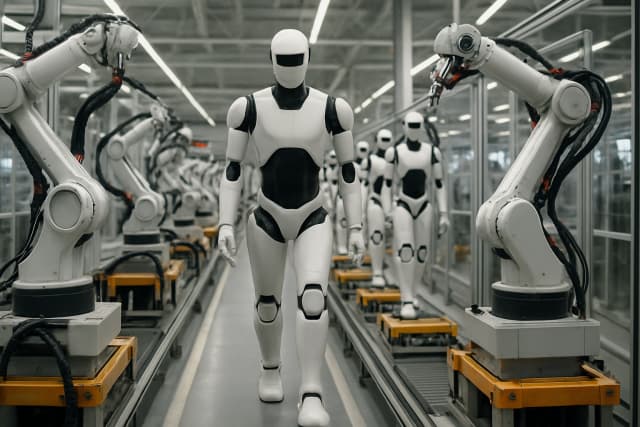
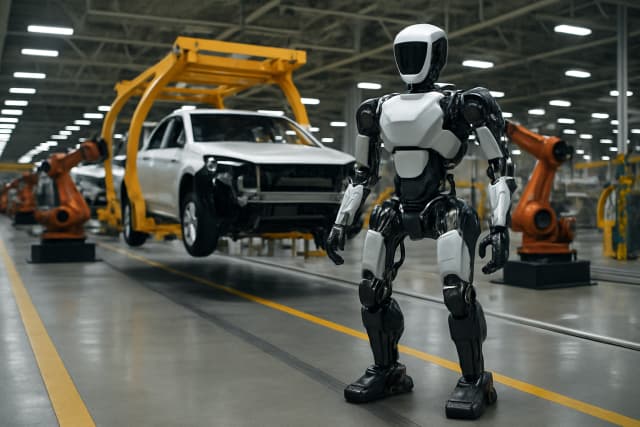



For years, humanoid robots were a trade-show novelty—impressive on stage, absent from the factory floor. That has changed. In 2026, UBTECH's Walker S2 is racking up orders from BYD and Foxconn, Agility Robotics' Digit is hauling 25-pound baskets at a Schaeffler plant in South Carolina, and AGIBOT's G2 is running electronics test stations in Nanchang with a reported 99.9% success rate. The shift is narrow but real: humanoids are no longer just walking and waving, they are working shifts.
***
The transition matters because manufacturing has spent decades building infrastructure around human bodies—conveyor heights, tool grips, walkway widths—that traditional fixed automation and wheeled robots struggle to navigate without expensive retrofits. Humanoids, by design, promise to slot into those brownfield environments with minimal disruption. But the research also carries a caution: most of what's being deployed today is task-specific, not the sweeping factory replacement that headlines sometimes suggest, and separating genuine commercial traction from speculative claims has become its own reporting challenge.
From Pilots to Payroll: Who's Actually Deploying
The clearest signal of momentum comes from UBTECH, whose Walker S2 platform has reportedly secured orders from BYD, Foxconn, and six other manufacturers, with units already running on automotive and electronics production lines. Walker S2's most notable engineering feature may be its autonomous battery-swapping capability, which lets it continue operating across multiple shifts without a human plugging it in—a small detail that speaks to how deployment economics, not just raw capability, are now driving design choices.
Agility Robotics has taken a similarly grounded approach with Digit, which is handling material transfer duties at Schaeffler's South Carolina facility and at Toyota Motor Manufacturing Canada in Woodstock, Ontario. At Schaeffler, Digit is reported to be moving 25-pound baskets between stamping and washing operations—unglamorous, repetitive work that is precisely the kind of job robotics companies believe humanoids can own first. Meanwhile, Apptronik's Apollo is being trialed at Mercedes-Benz and Jabil facilities, aimed at warehouse and factory logistics roles rather than complex assembly.
The Numbers Behind the Hype
Perhaps the most concrete performance datapoint in the current wave comes from AGIBOT's G2 unit at Longcheer Technology in Nanchang, China, where the robot is reportedly performing precision loading and unloading at electronics test stations. The company claims a 99.9% success rate and throughput of 310 units per hour—figures that, if sustained, would represent a meaningful bar for comparing humanoid performance against traditional fixed automation or human labor.
AGIBOT has also disclosed progress on what it calls Real-World Reinforcement Learning, a system that reportedly lets robots learn new skills in minutes on a pilot production line rather than requiring weeks of retraining or reprogramming. If accurate, that capability addresses one of the biggest practical objections to humanoid adoption: that reconfiguring a robot for a new task is often slower and more expensive than just hiring a person. Faster skill acquisition, paired with rising installation volumes—China's robot installations grew 44% according to the International Federation of Robotics—suggests the economics may be tipping in favor of broader adoption sooner than skeptics expected.
Boston Dynamics, Tesla, and the Bigger Bets
Boston Dynamics' Electric Atlas is being positioned squarely for industrial automation and warehouse logistics, with reporting linking the platform to manufacturing pilots and Hyundai-connected factory use. One widely circulated claim suggests Hyundai plans to deploy more than 25,000 Atlas humanoids across Hyundai and Kia plants, with U.S. production scaling by 2028. That figure, however, originates from a blog-style source rather than a primary Hyundai or Boston Dynamics release, and should be treated as an aspirational target rather than a confirmed order book until the companies themselves verify it.
Tesla's Optimus program presents a similar pattern of ambition outpacing verified deployment. The robot is reportedly being used inside Tesla's own facilities for manufacturing-related tasks and, notably, for collecting training data that could improve future versions—but public evidence still points to early-stage internal testing rather than the large-scale rollout Tesla has previously teased. The gap between announced vision and documented deployment is becoming one of the defining tensions of the humanoid robotics narrative in 2026.
Why Brownfield Factories Are the Real Battleground
The strategic logic behind humanoid investment centers on brownfield plants—existing factories built decades ago around human dimensions and workflows, where retrofitting for wheeled robots or fixed robotic arms can cost millions and take production lines offline for months. A humanoid, in theory, can walk the same floors, climb the same stairs, and use the same handheld tools without any facility redesign. That single advantage is why manufacturers are willing to tolerate humanoids that are still slower, more expensive, and less reliable than purpose-built automation for many tasks.
Industry observers caution, however, that this advantage is currently confined to narrow use cases: material handling, parts transfer, bin picking, kitting, machine tending, and simple assembly support. Independent reporting consistently notes that most factory deployments remain pilot-scale, with safety standards, reliability thresholds, and total cost of ownership still limiting how quickly companies scale beyond initial trials. The next twelve months, as more of these pilots mature into repeat orders or quietly wind down, will likely determine whether 2026 is remembered as the year humanoids proved themselves in industry or merely the year they got their first real chance.
The value proposition isn't that a humanoid can do everything a person can do. It's that it can work inside a factory nobody had to redesign.
The Road Ahead
What separates this moment from previous humanoid robotics hype cycles is the presence of hard operational numbers—throughput rates, success percentages, shift durations—rather than choreographed demo videos. Companies like AGIBOT, UBTECH, and Agility Robotics are being judged not on how humanlike their robots look, but on whether they can hit a 310-unit-per-hour quota or survive a full shift without human intervention. That shift in evaluation criteria is itself a sign of the industry maturing.
Still, the sector's own advocates acknowledge the work is far from finished. Full factory replacement remains a distant goal, and the gap between the most-hyped announcements—like Hyundai's rumored 25,000-unit rollout—and independently verified deployments remains wide. For now, the honest headline is more modest than the marketing: humanoid robots have earned a narrow but genuine foothold in manufacturing, and the coming year will show whether that foothold expands into something structural or stays a well-funded experiment.
Sources
- https://www.therobotreport.com/
- https://www.roboticstomorrow.com/stream/news/
- https://roboticsandautomationnews.com/
- https://www.therobotreport.com/robotics-news/
- https://www.robotics247.com/
- https://www.therobotreport.com/category/news/
- https://www.therobotreport.com/category/robots-platforms/industrial-robots/
- https://www.therobotreport.com/top-10-robotic-stories-june-2026/
- https://www.therobotreport.com/top-10-robotics-stories-of-may-2026/
- https://www.turingpost.com/p/roboticsupdates
- https://blogs.nvidia.com/blog/national-robotics-week-2026/
- https://www.sciencedaily.com/news/computers_math/robotics/
Leave a Comment