








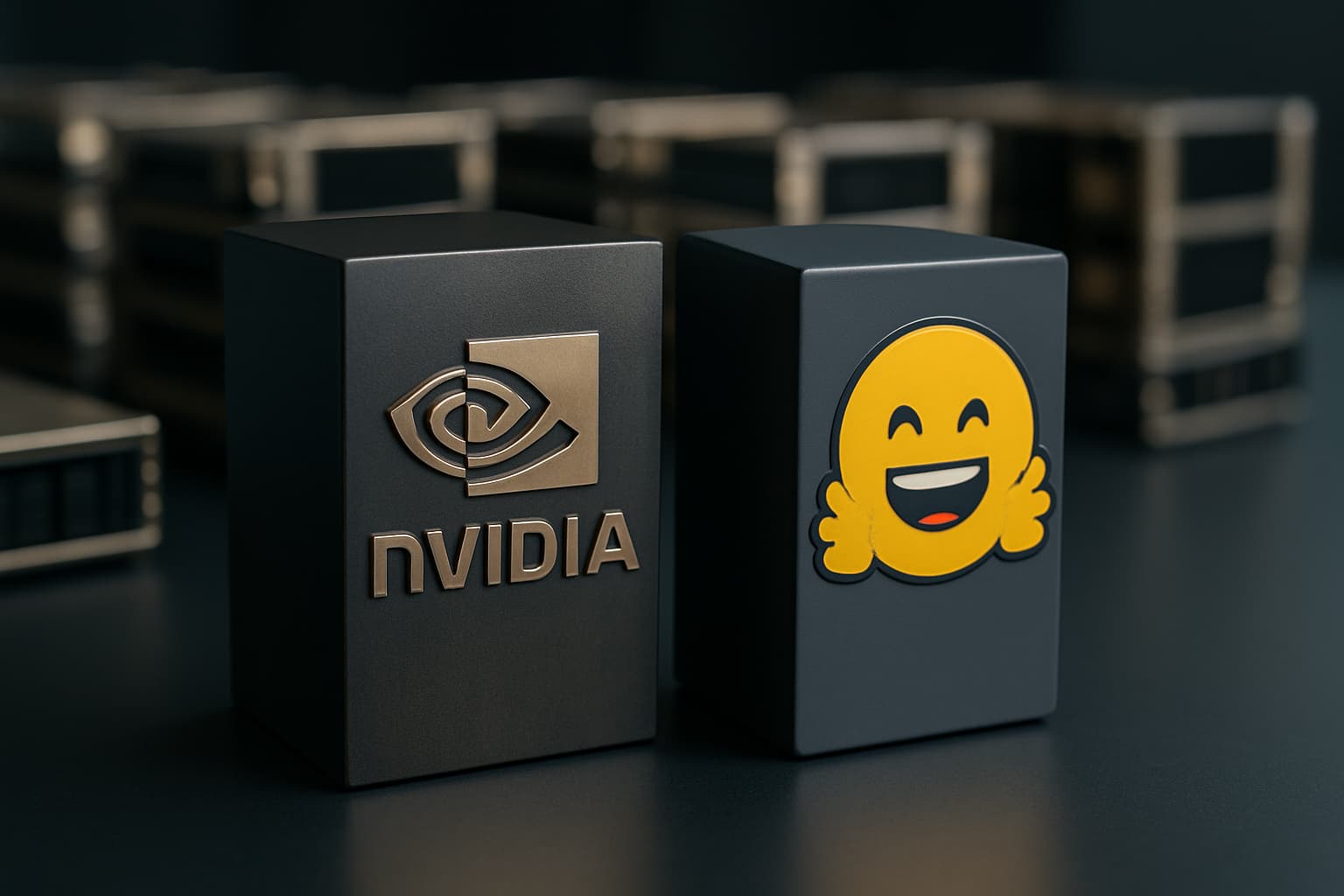



NVIDIA has agreed to acquire Hugging Face for $12.93 billion, according to multiple industry deal roundups, in a move that would place the world's most valuable chipmaker at the center of the open-source AI ecosystem it has spent years courting. The deal, if confirmed through primary company filings, would mark one of the largest acquisitions in AI infrastructure history and a decisive step in NVIDIA's transformation from hardware supplier to full-stack platform owner. Hugging Face has become the default repository for open-weight models, datasets, and machine learning tooling used by hundreds of thousands of developers and enterprises worldwide. The timing places the acquisition alongside a week of blockbuster AI capital commitments, including Google's $15.1 billion Finland data center investment and a $300 million U.S. government stake in quantum computing firms.
***
The reported price tag underscores how central open-source infrastructure has become to the AI industry's competitive map, even as the biggest players spend tens of billions on proprietary frontier models like OpenAI's GPT-5.4 and Google's Gemini line. Hugging Face has functioned less like a startup and more like critical public infrastructure, hosting model weights, benchmarks, and community tools that underpin research labs, enterprises, and independent developers alike. A combination with NVIDIA would tie that infrastructure directly to the company that already supplies the GPUs training and running most of those models, raising questions about neutrality, pricing power, and the future shape of the open-model ecosystem.
A Bet on Owning the Open-Source Layer
NVIDIA's dominance has historically rested on silicon: the H100s, GB200s, and now next-generation chips that power nearly every major AI lab's training runs. Acquiring Hugging Face would extend that dominance upward into the software and community layer where developers actually discover, fine-tune, and deploy models. Hugging Face's model hub, Transformers library, and Spaces hosting service have become default infrastructure much the way GitHub became default infrastructure for code, giving whoever owns it enormous influence over developer workflows.
The acquisition also arrives as rival cloud and chip providers race to lock in their own AI stacks. Amazon has poured billions into Anthropic, while Google has committed $40 billion to the same company and is simultaneously building out proprietary model families like Gemini 3.1 Flash Lite. By buying rather than partnering with Hugging Face, NVIDIA would be signaling that it wants direct ownership of the open ecosystem rather than dependence on goodwill and API access, a strategic shift that could unsettle competitors who rely on Hugging Face's neutrality.
Why $12.93 Billion Makes Sense to NVIDIA
NVIDIA's market capitalization and cash position make a deal of this size feasible without significantly straining its balance sheet, especially as the company continues to post record data center revenue driven by GPU demand. Hugging Face, despite its influence, has never approached the valuation of frontier model labs like OpenAI or Anthropic, making it a comparatively efficient way for NVIDIA to buy deep integration with the developer community rather than compete for scarce compute deals.
The move also fits a broader pattern of vertical consolidation sweeping the AI industry this year. Analog Devices' $1.35 billion purchase of Alif Semiconductor and Anthropic's formation of the Theseus Infrastructure venture with Macquarie and GIC both reflect a shift toward locking in supply chains and distribution rather than relying purely on partnerships. For NVIDIA, owning Hugging Face would mean influence over which models get optimized first for its hardware, and potentially preferential placement for NVIDIA-tuned software stacks.
Risks to Open-Source Neutrality
Hugging Face's value to the developer community has always rested on its perceived independence from any single chipmaker or cloud provider. Researchers and startups alike have used the platform precisely because it did not favor one hardware ecosystem over another, hosting models optimized for AMD, Google's TPUs, and NVIDIA GPUs with equal prominence. An acquisition by NVIDIA risks eroding that trust, particularly among developers wary of vendor lock-in or optimization biases favoring NVIDIA silicon.
Regulators are also likely to scrutinize the deal closely given NVIDIA's existing dominance in AI training hardware, which some estimates place above 80 percent of the global market for AI accelerators. Antitrust authorities in the United States and European Union have grown increasingly attentive to vertical AI consolidation, and a deal combining the dominant chip supplier with the dominant open-model hub would almost certainly draw review. The outcome could shape whether open-source AI remains genuinely platform-agnostic or increasingly tethered to the infrastructure of whichever company controls the underlying compute.
Whoever controls the plumbing of open-source AI controls a lot more than most people realize, this is about who sets the terms for how models move from research to production.
A Week of Mega-Deals Reshaping AI's Foundations
The Hugging Face acquisition lands amid a broader wave of capital deployment that is redrawing the AI industry's competitive lines. Google's pledge to invest at least 13 billion euros in Finnish AI infrastructure, tied to a nuclear power supply agreement, represents Alphabet's largest European investment to date and signals how energy access has become as strategically important as chip supply. Meanwhile, the U.S. government's $300 million CHIPS Act stakes in D-Wave, Rigetti, and Quantinuum show Washington positioning itself directly inside the quantum computing race rather than merely subsidizing it from the sidelines.
Taken together, these deals suggest an industry moving past the era of experimentation into one defined by infrastructure ownership, vertical integration, and government involvement. NVIDIA's pursuit of Hugging Face, if finalized, would stand as the clearest signal yet that even open-source AI, once the domain of academic labs and volunteer contributors, has become a strategic asset too valuable for the industry's biggest players to leave independent.
Sources
- https://www.sciencedaily.com/news/computers_math/artificial_intelligence/
- https://www.crescendo.ai/news/latest-ai-news-and-updates
- https://www.humanoid.press/artificial-intelligence/
- https://www.wsj.com/tech/ai
- https://aiweekly.co/learning-ai/artificial-intelligence/artificial-intelligence-news
- https://www.briefflash.com/research/
- https://www.reuters.com/technology/artificial-intelligence/
- https://ai.google/research/
- https://www.linkedin.com/top-content/innovation/ai-trends-and-innovations/daily-ai-breakthrough-summaries/
- https://techstartups.com/2026/03/06/this-week-in-ai-the-biggest-ai-news-breakthroughs-and-power-moves/
- https://news.mit.edu/topic/artificial-intelligence2
Leave a Comment