




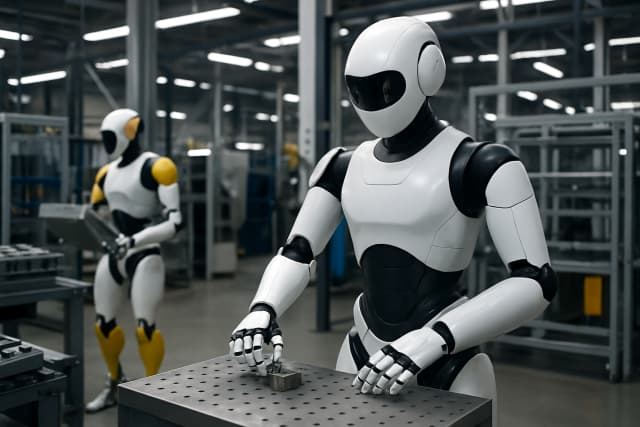
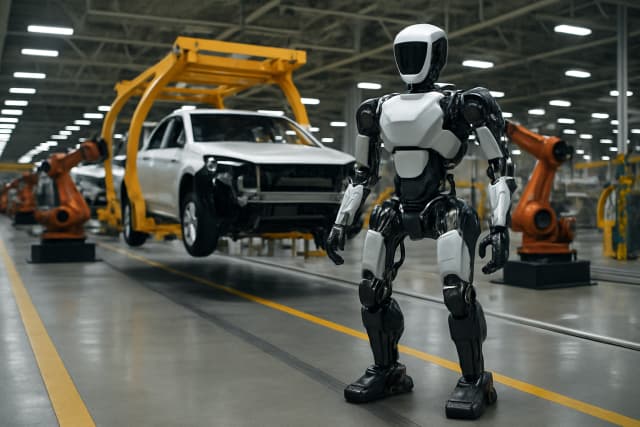

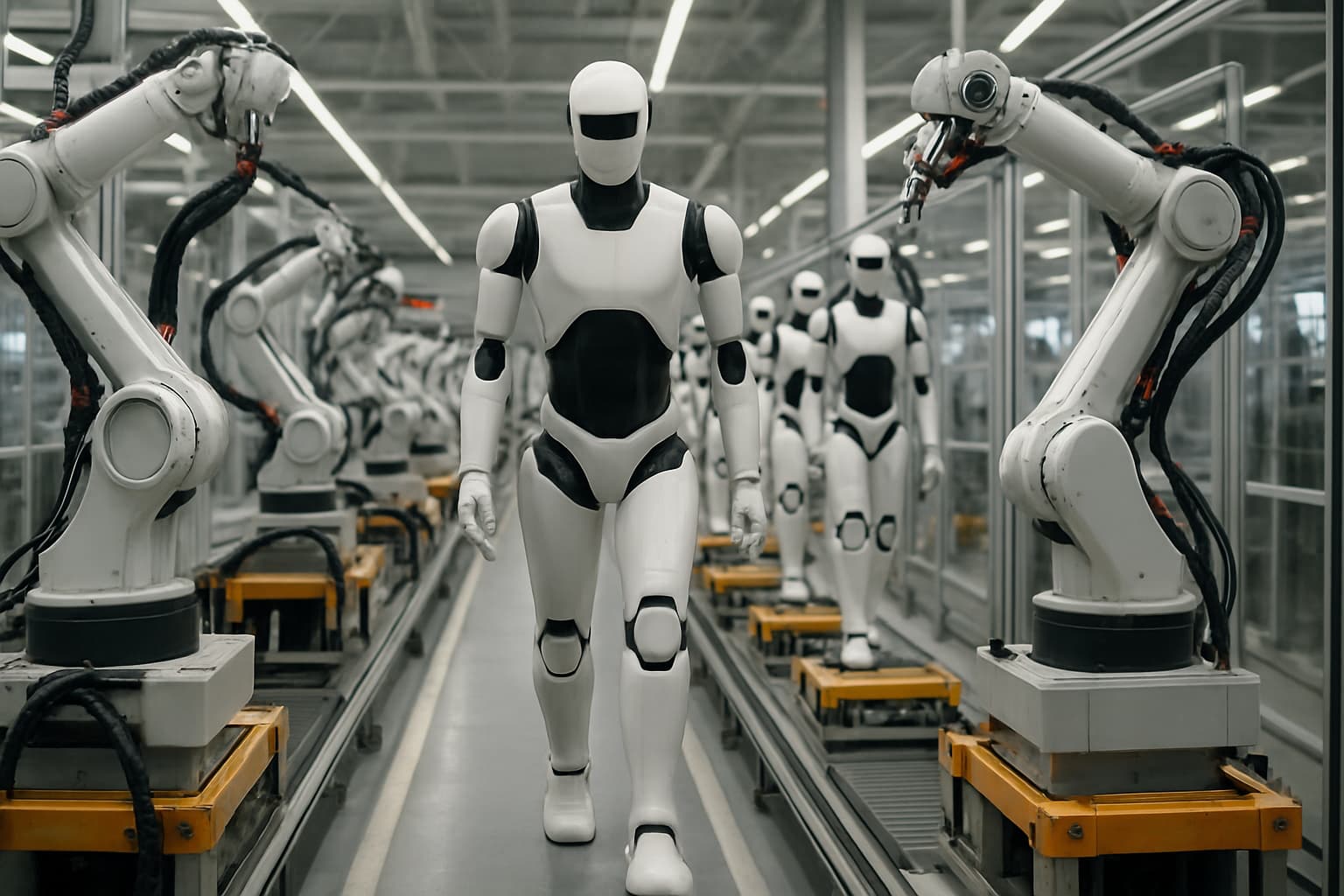



On September 9, 2026, XPeng announced that its automated humanoid production line had begun operating, with the first IRON robot completing final assembly and walking off the line entirely on its own power. The company said more than 80 percent of core processes on the line are now automated, a figure that puts XPeng among the most aggressive humanoid manufacturers in translating factory promises into working hardware. The milestone lands amid a wave of 2026 deployments from Hyundai, Schaeffler, UBTECH, and AgiBot, but XPeng's claim stands out because it describes robots assembling robots, not just robots assisting human workers. It is a small but symbolically loaded step in an industry still searching for proof that humanoids can move beyond staged demonstrations.
For the past two years, humanoid robotics has been defined by viral videos and carefully choreographed showcases, leaving investors and manufacturers alike questioning how much of the hype reflects real industrial capability. XPeng's announcement, alongside a broader set of 2026 deployments spanning Hyundai's Atlas rollout plan, Schaeffler's partnership with Humanoid, and UBTECH's multi-week factory trials, suggests the sector is entering a more consequential phase. The question is no longer whether humanoids can walk or pick up objects, but whether they can be produced, deployed, and kept running reliably enough to matter economically. XPeng's self-assembling line offers one of the more concrete data points yet, even as broader industry evidence shows humanoids remain confined to narrow tasks far from full production-line speed.
A Robot Line Building Robots
XPeng's disclosure centers on a striking detail: the company's IRON humanoid did not simply get bolted together by human technicians and hauled off a bench. According to the company, the robot completed final assembly and then walked off the production line under its own power, an event XPeng frames as proof that its manufacturing process has matured beyond prototype tinkering. The company says more than 80 percent of core processes on the line are automated, a figure that, if it holds up under scrutiny, would place XPeng ahead of most peers in translating humanoid ambition into actual throughput.
The symbolism is not incidental. A production line that is itself highly automated and produces a humanoid capable of walking away unassisted suggests a kind of manufacturing maturity that most competitors have not yet claimed publicly. It also plays into XPeng's broader identity as an electric vehicle maker pivoting hard into robotics and physical AI, leveraging its existing manufacturing expertise and supply chain relationships to shortcut some of the tooling and automation challenges that have slowed smaller, pure-play humanoid startups.
The Rest of the Field Is Moving Too
XPeng's announcement did not happen in isolation. Hyundai Motor Group has said it plans to deploy Boston Dynamics' Atlas humanoid robots at its U.S. factory in Georgia starting in 2028, beginning with parts sequencing before expanding toward component assembly by 2030. Humanoid, a separate company, announced a phased deployment agreement with automotive supplier Schaeffler in May 2026, with the first systems expected to go live in Germany before the end of this year. UBTECH, meanwhile, reported that its Walker S Lite robot worked for 21 consecutive days at Zeekr's smart factory, packing and securing cargo, alongside new manufacturing partnerships with Geely and Miracle Automation Engineering.
Other 2026 deployment reports cite AGIBOT G2 units operating at Longcheer Technology, Agility Robotics' Digit working at both Schaeffler and Toyota Motor Manufacturing Canada, and UBTECH's Walker S2 drawing orders from BYD, Foxconn, and six other manufacturers. Taken together, these deployments paint a picture of an industry moving in parallel across multiple companies and geographies, rather than a single breakthrough driving the shift. What is notable is how consistently the actual tasks skew toward material handling, kitting, parts transfer, and simple assembly support rather than anything resembling full-line replacement of human labor.
What Humanoids Are Actually Doing on the Floor
Strip away the marketing language and the documented use cases become notably modest. The most consistently reported tasks across manufacturers include bin picking, kitting, parts transfer, and precision loading and unloading at electronics test stations. One widely cited example involves a humanoid handling bearing components between a stamping press and a washing machine, a task chosen precisely because it requires human-like reach and mobility in a workspace originally designed for people, not because it demands anything approaching the speed of a dedicated industrial robot arm.
Other reported deployments include cleanroom asset monitoring in pharmaceutical manufacturing, where a humanoid's ability to navigate human-scale corridors and interact with human-designed equipment matters more than raw throughput. This pattern reinforces a central truth about where humanoids currently fit into factories: they are valuable in spaces built for people, not necessarily in spaces built for speed. No widely documented humanoid system is yet operating at automotive-line production rates, and the industry's own reporting acknowledges that most current deployments remain pilot or early-commercial in scale.
The Numbers Behind the Narrative
Market data released in 2026 helps contextualize how early this transition still is. Global humanoid shipments in the first half of 2026 reached roughly 19,000 to 22,000 units, according to one industry report, with Chinese manufacturers holding an overwhelming 93 to 97 percent share of that volume. Industrial and commercial applications accounted for more than 70 percent of units shipped, underscoring that factories, not homes or hospitals, remain the primary proving ground for humanoid robotics right now. XPeng, based in China, sits squarely within the geographic center of this shipment surge.
That concentration of manufacturing and shipment volume in China also reflects the broader ecosystem advantages Chinese firms enjoy: dense supply chains for actuators, sensors, and batteries, along with government-backed industrial policy support for robotics as a strategic sector. Complementary technology from companies like NVIDIA, including Isaac GR00T open models, Cosmos world models for synthetic training data, and new Jetson T3000 and T2000 edge modules, is lowering the barrier for humanoid makers everywhere to add perception and reasoning capabilities without building foundational AI stacks from scratch. AgiBot's claim that its Real-World Reinforcement Learning system lets robots learn new skills in minutes on a pilot production line points toward where the real competitive edge may eventually lie: not in the hardware walking off the line, but in how quickly that hardware can be retrained for the next task.
We are not trying to replace every worker on a line overnight. We are proving that a humanoid form factor can be built, tested, and deployed inside a real automated environment, which is the precondition for everything that comes after.
A Milestone, Not a Turning Point
It would be easy to overread XPeng's announcement as evidence that humanoid manufacturing has arrived. The more accurate reading is that the industry has moved from pure demonstration into a phase of repeatable, if narrow, production workflows, a shift echoed across Hyundai's timeline, Schaeffler's phased rollout, and UBTECH's multi-week factory endurance tests. The gap between an 80 percent automated line producing a single humanoid that can walk off unaided and a factory floor where humanoids handle a meaningful share of assembly work remains substantial.
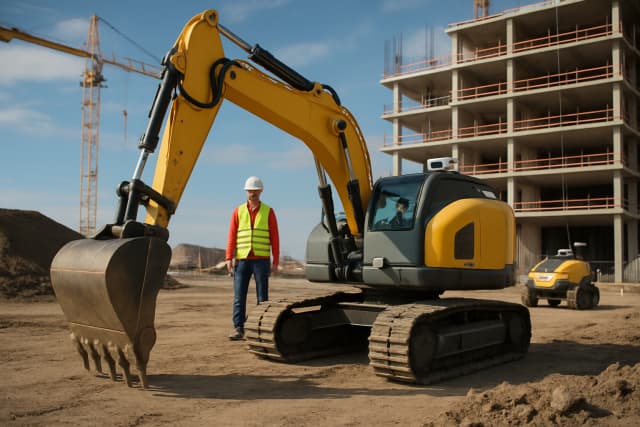
Still, incremental proof points like XPeng's matter because they establish the operational plumbing, tooling, quality control, automated final assembly steps, and validation processes, that any eventual scale-up will depend on. Investors pouring capital into physical AI, from Vention's $110 million raise to Gravis Robotics' $200 million round for autonomous construction machinery, are betting that this plumbing work happening now across humanoids, warehouse robots, and autonomous machinery converges into a broader physical AI economy within the next several years. Whether XPeng's self-walking IRON robot becomes a footnote or a milestone will depend less on this single event and more on whether the company, and its rivals, can repeat it at meaningfully larger scale.
Sources
- https://www.therobotreport.com/
- https://www.roboticstomorrow.com/stream/news/
- https://www.therobotreport.com/category/news/
- https://www.therobotreport.com/robotics-news/
- https://www.businesswire.com/newsroom/industry/technology/robotics
- https://www.turingpost.com/p/roboticsnews
- https://www.therobotreport.com/top-10-robotics-stories-of-may-2026/
- https://www.therobotreport.com/category/robots-platforms/industrial-robots/
- https://www.sciencedaily.com/news/computers_math/robotics/
- https://www.roboticstomorrow.com/newsfeed/robotics/
- https://ifr.org/P6
- https://ifr.org/news
- https://www.therobotreport.com/top-10-robotics-developments-march-2026/
Leave a Comment