



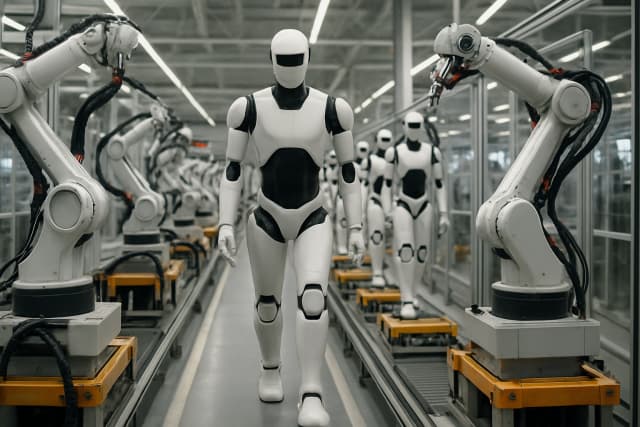
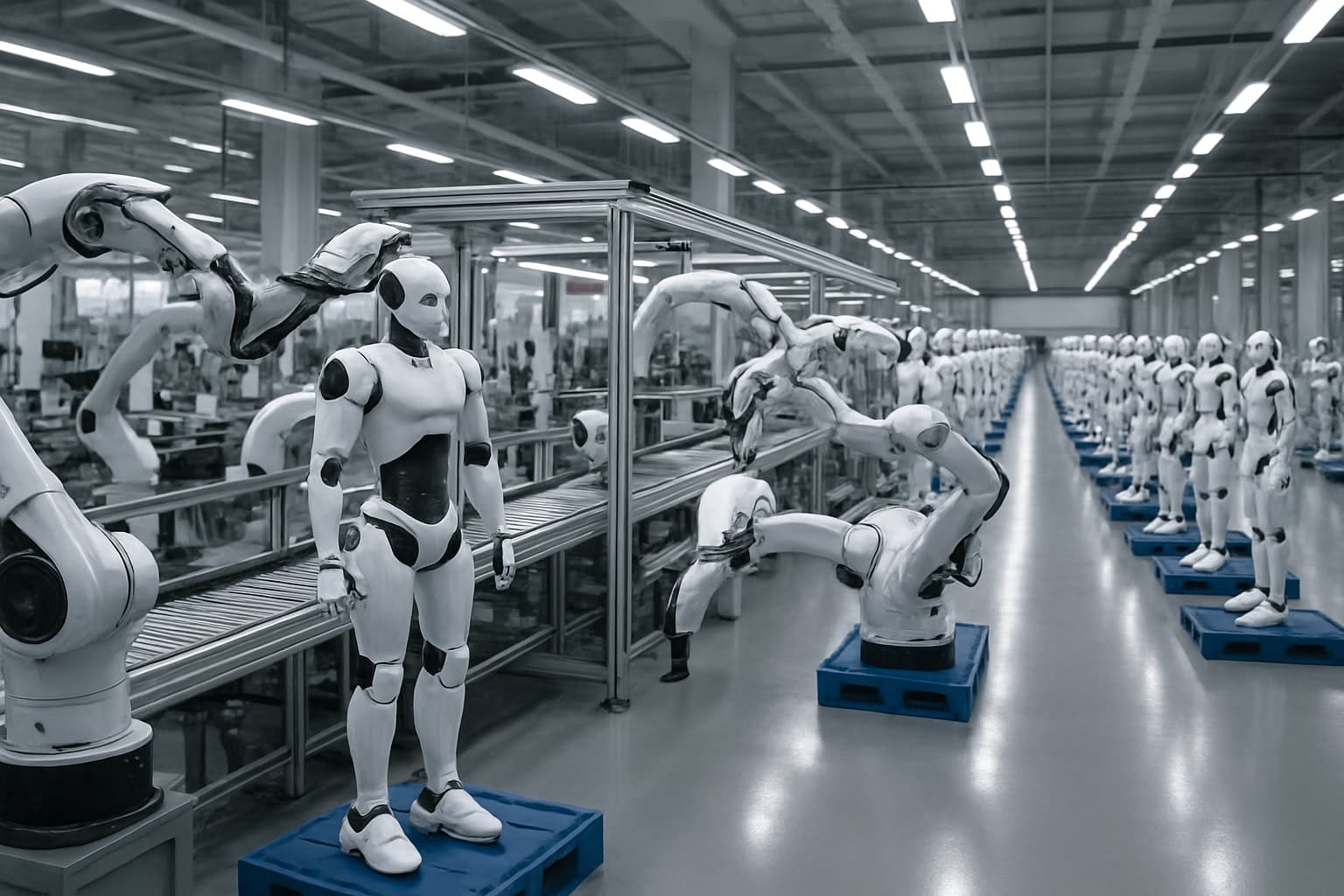










UBTECH has opened a 14,000-square-meter humanoid robot factory in Liuzhou, China, designed to produce more than 10,000 robots annually at a takt time of one unit every 10 minutes. The facility itself runs on automation, deploying collaborative robots, autonomous guided vehicles, unmanned logistics systems and flexible manufacturing cells to assemble the very machines it sells. It is one of the clearest signals yet that the humanoid robotics industry has entered a new phase, where the central challenge is no longer proving a robot can walk and grip, but proving it can be manufactured at industrial scale.
For years, humanoid robotics has been defined by viral demo videos and small pilot deployments numbering in the dozens. UBTECH's Liuzhou plant, alongside a wave of parallel announcements from Schaeffler, Hyundai and XPeng, marks a pivot toward something far more consequential: mass production infrastructure built specifically for humanoids, with robots increasingly used to build other robots. The shift matters because manufacturing capacity, not algorithmic novelty, has become the binding constraint on how fast humanoids can move from warehouses and factory floors into broader commercial use.
A Factory Built to Build Factories' Workers
UBTECH's Liuzhou facility is notable less for its output target than for its method. Rather than relying on traditional manual assembly lines staffed by human workers, the plant uses collaborative robots, AGVs, unmanned logistics systems, robotic arms and flexible manufacturing cells to produce humanoid units. A takt time of one robot every 10 minutes implies a level of process standardization that has been largely absent from an industry still associated with hand-built prototypes and limited-run pilots.
This self-referential approach, robots manufacturing robots, is emerging as a broader pattern across Chinese humanoid makers. XPeng has said more than 80% of the core processes on its IRON humanoid production line in Guangzhou are automated. Together, these moves suggest that Chinese manufacturers are treating humanoid production itself as an automation problem to be solved first, before scaling deployment into customer factories and warehouses.
The Global Deployment Race Accelerates
UBTECH's manufacturing buildout arrives alongside a string of deployment commitments from major industrial players. Humanoid, a robotics company, signed a binding phased deployment and supply agreement with German auto supplier Schaeffler in May 2026, with first systems expected to go live in Germany before the end of the year; other reporting suggests the partnership could eventually scale to thousands of wheeled humanoid robots across Schaeffler's global plants by 2032. Hyundai Motor Group, which owns Boston Dynamics, has said it plans to deploy Atlas humanoids at its Georgia factory starting in 2028 for parts sequencing, with broader assembly use targeted for 2030, and has set a goal of building a factory capable of manufacturing 30,000 Atlas units annually by that same year.
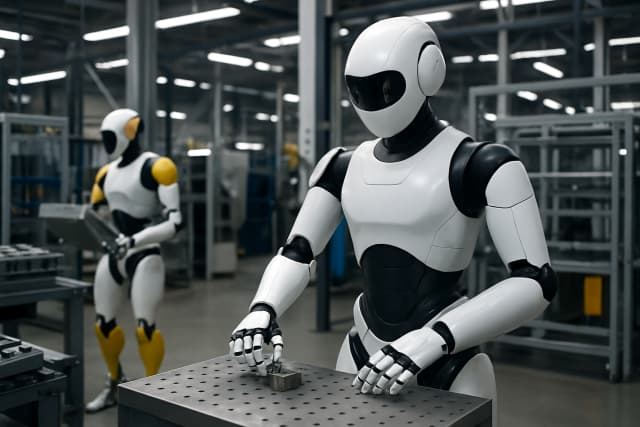
These commitments underscore a critical distinction in the current wave of humanoid enthusiasm: manufacturers are not yet promising to replace conventional industrial robots on high-speed assembly lines. Instead, the near-term opportunity is concentrated in tasks like palletizing, material handling, parts transfer, bin picking and simple assembly support, jobs where a human-shaped machine can use existing tools and reach workstations designed for people without requiring costly facility redesigns.
Why Scale Matters More Than Sophistication Right Now
Industrial reviews of 2026 humanoid deployments describe a landscape still confined to a small number of sites and narrow task categories, with none yet operating at automotive-line production rates. Reuters has reported similarly, noting that most current humanoid deployments focus on repetitive or higher-risk jobs rather than full assembly-line replacement. That reality makes manufacturing capacity, rather than raw capability, the more urgent bottleneck: a company can only prove commercial viability at scale if it can actually build enough units to place broadly across customer sites.
This is where UBTECH's bet on an automated, high-throughput factory becomes strategically significant. A production capacity of 10,000 units a year would represent an order-of-magnitude increase over the low-hundreds production runs that have characterized the industry to date. If the Liuzhou facility hits its targets, it could give UBTECH a first-mover advantage in supplying humanoids to logistics operators, manufacturers and other commercial buyers who have been waiting for available inventory rather than better robots.
The National Strategy Backdrop
UBTECH's expansion does not exist in isolation. The International Federation of Robotics has reported that China has placed robotics at the center of its industrial strategy, with a state-backed robotics and AI fund expected to attract nearly 1 trillion yuan, or roughly $138 billion, over the next 20 years. That scale of state-directed capital gives Chinese manufacturers like UBTECH a significant structural advantage in building out the kind of heavy manufacturing infrastructure that mass humanoid production requires.
Executives in China's robotics sector have also signaled aggressive timelines for capability improvements. A leading Chinese robot brain startup told Reuters it expects humanoid robots to complete most general-purpose tasks from verbal instructions as soon as next year, with a self-described GPT-3.0 milestone for embodied AI targeted for mid-2027. Whether or not those timelines hold, the combination of state investment, manufacturing scale-up and aggressive AI development goals suggests China intends to compete on humanoid robotics across the entire value chain, not just at the software layer.
The strongest current use cases are intralogistics and light material handling, not precision, high-throughput assembly.
What Comes Next
The gap between manufacturing capacity and proven commercial demand remains the industry's central uncertainty. Building 10,000 robots a year means little if buyers are not yet ready to deploy them beyond pilot programs, and most verified use cases today remain limited to intralogistics and light material handling rather than the complex, high-precision assembly work that would justify factory-wide adoption. UBTECH, Schaeffler, Hyundai and XPeng are each making a bet that demand will materialize as capability and reliability improve, and that having manufacturing capacity ready in advance is worth the risk of building ahead of the market.
For now, the Liuzhou factory stands as a concrete marker of how far the humanoid robotics industry has moved from its demo-stage origins. The question through 2027 and beyond will be whether real-world orders, from automakers, logistics firms and industrial suppliers, can grow fast enough to fill the production lines that companies like UBTECH are racing to build.
Sources
- https://www.businesswire.com/newsroom/industry/technology/robotics
- https://techcrunch.com/category/robotics/
- https://www.turingpost.com/p/roboticsnews
- https://www.therobotreport.com/
- https://ifr.org/news
- https://www.reuters.com/world/asia-pacific/founder-chinese-startup-spirit-ai-says-robot-brains-set-2027-breakthrough-2026-09-18/
- https://ifr.org/P6
- https://newatlas.com/robotics/
- https://www.sciencedaily.com/news/computers_math/robotics/
- https://aiweekly.co/ai-news-today/robotics-ai-news
- https://www.sciencedaily.com/news/matter_energy/robotics/
- https://www.roboticsintl.com/category/research
- https://www.roboticstomorrow.com/stream/news/
Leave a Comment