










GitHub announced general availability of its open-source license compliance feature on October 16, giving GitHub Enterprise Cloud customers centralized, ruleset-based control over dependency licensing across their organizations. The feature, which requires GitHub Code Security, arrives alongside a parallel rollout of workflow dependency lockfiles for GitHub Actions and a generally available Xcode 27 runner image. Together, the releases mark one of the most consequential weeks for enterprise software governance in recent memory, as organizations grapple with managing code whose provenance is increasingly uncertain.
The timing is not incidental. As AI coding agents generate, suggest, and assemble growing shares of production codebases, the question of what licenses govern that code, and whose dependencies it pulls in, has become a boardroom-level risk rather than a niche compliance concern. GitHub's move to apply policy enforcement directly at the platform level, rather than through bolt-on scanning tools, signals that the industry's center of gravity is shifting from writing code quickly to governing it responsibly at scale.
A Governance Layer for the Agent Era
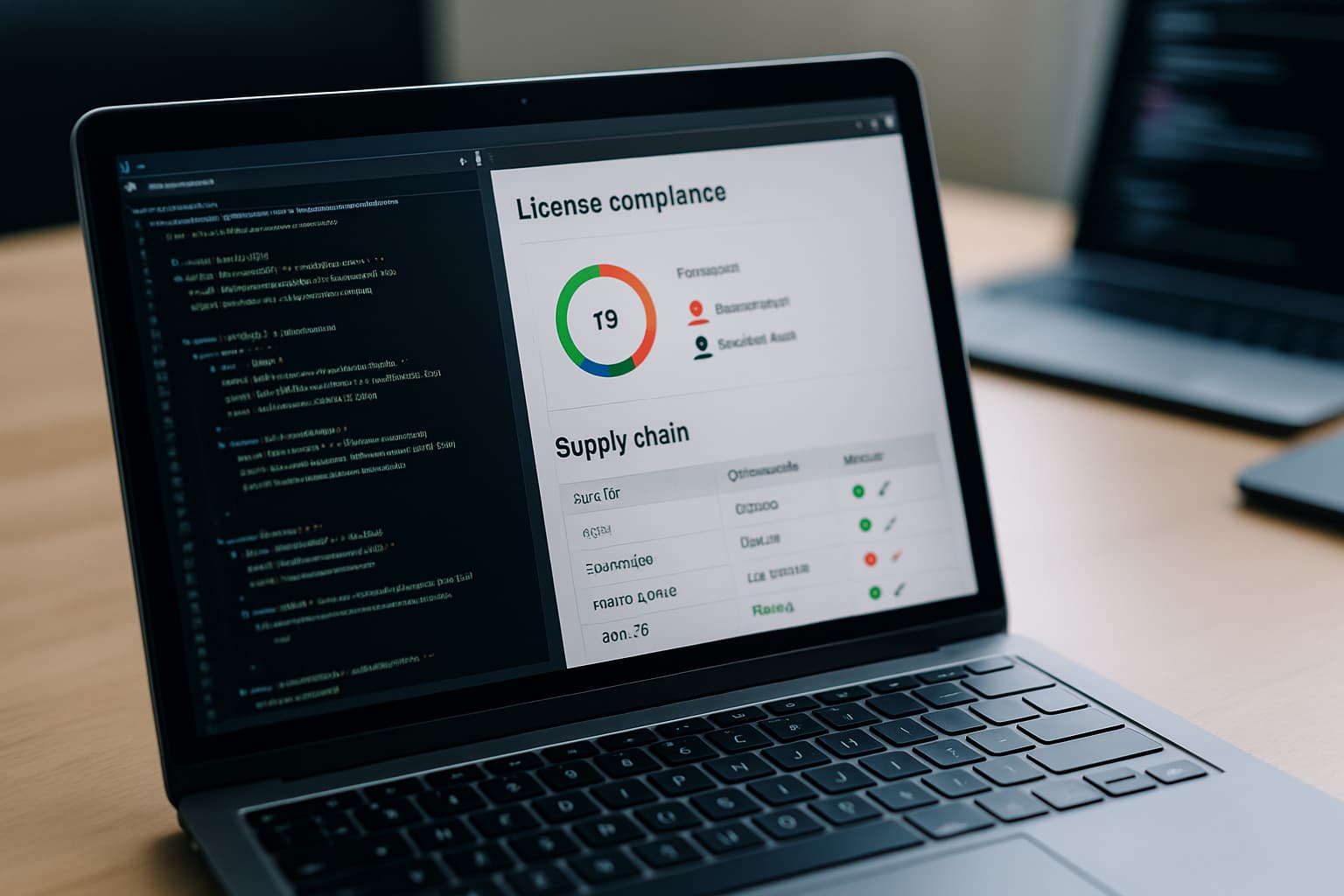
GitHub's open-source license compliance feature, now generally available for GitHub Enterprise Cloud customers, allows organizations to apply centralized rulesets governing which dependency licenses are acceptable across potentially thousands of repositories. Critically, the feature extends to customers using data-resident GitHub Enterprise Cloud, meaning multinational enterprises subject to regional data-sovereignty requirements can enforce the same policies without exempting entire business units. The requirement that repositories carry GitHub Code Security underscores how tightly Microsoft-owned GitHub is now bundling security and compliance into a single commercial tier.
This is not a cosmetic addition. Enterprises have struggled for years with dependency trees that balloon into thousands of transitive packages, many carrying licenses incompatible with commercial distribution, patent-restrictive terms, or copyleft obligations that can force companies to open-source proprietary code if triggered carelessly. Manual auditing of these trees has never scaled, and the problem has only intensified as AI coding assistants pull in libraries automatically, often without a developer ever reading a license file.
The feature's arrival alongside workflow dependency lockfiles, now in public preview for GitHub Enterprise Cloud, Team, and Free plans, suggests GitHub is building a two-pronged defense: one for the code dependencies that ship inside applications, and another for the CI/CD pipelines that build and deploy them. Lockfiles let teams pin exact versions of actions and workflow dependencies, closing a long-standing gap in which a compromised or altered third-party GitHub Action could silently inject malicious behavior into a build process.
Why AI-Generated Code Raised the Stakes
The urgency behind these releases is inseparable from the broader shift documented across this week's developer-tool news. Python added roughly 850,000 contributors over the past year, a 48.78 percent year-over-year growth rate GitHub attributes substantially to AI project creation, while TypeScript has overtaken both Python and JavaScript to become GitHub's most-used language, a rise linked directly to how well static typing constrains and guides AI coding models. When a growing share of commits originates from Codex CLI, OpenCode, or similar agents rather than a human typing line by line, the traditional assumption that a developer has personally vetted every imported package starts to break down.
That assumption gap is precisely what license compliance tooling is built to close. OpenAI's Codex CLI, now at version 0.163.0 and distributed through npm, and OpenCode, which shipped three point releases in a single week, both exemplify a new category of local, terminal-based coding agents capable of pulling in dependencies autonomously during a session. Without platform-level guardrails, an agent instructed to "add logging" or "parse this file format" could just as easily introduce a package carrying an AGPL license or an abandoned, vulnerable dependency as a well-vetted one.
Cloudflare's decision to open-source Void, its internal platform for deploying and managing AI-built applications, reflects the same anxiety from a different angle: once AI agents are writing and shipping software continuously, someone needs an operational control plane to track what was deployed, by which agent, and under what governance rules. The emergence of OpenClaw Enterprise, a vendor-neutral control platform for persistent AI agents backed by OpenAI, Nvidia, and Red Hat, points toward an industry consensus that agent governance cannot remain fragmented across proprietary silos.
A Broader Infrastructure Shift
GitHub's governance push did not arrive in isolation. The same week saw general availability of the Xcode 27 runner image for GitHub Actions, letting Apple-platform teams build and test against the latest Xcode toolchain directly in CI, and the release of Visual Studio Code 1.142, though Microsoft's changelog offered little detail on what changed under the hood. Smaller but notable releases, including Ollama 0.40.6 for local large-language-model inference and an open-source Lakehouse Compute Fabric that picked up 108 GitHub stars in its first week, point to a developer ecosystem investing heavily in local-first and self-hosted alternatives to hosted cloud services.
Accession's Workbench, a local-first orchestration platform for coordinating multiple AI coding agents across persistent projects, and REA, an open-source MCP server for reverse-engineering native binaries and network traffic without source access, both extend this theme further. Agents are no longer confined to writing new code; they are increasingly being tasked with understanding, auditing, and modifying systems whose original source is unavailable or undocumented, a capability that raises its own set of intellectual-property and security questions that license compliance tools alone cannot resolve.
Taken together, the week's releases suggest the open-source tooling ecosystem is bifurcating into two reinforcing tracks: one focused on making AI agents more capable and autonomous, and another focused on constraining, auditing, and governing what those agents produce. GitHub's general availability announcement sits squarely at the intersection of the two, applying enterprise-grade policy enforcement to a software supply chain that is increasingly assembled by machines rather than humans.
The industry spent the last two years optimizing for how fast AI agents could write code. Now we're seeing the inevitable second act: figuring out what that code actually depends on, and whether anyone bothered to check.
What Comes Next for Enterprise Compliance Teams
For compliance and legal teams, GitHub's rollout offers a template that rivals including GitLab and Atlassian are likely to match quickly, given how central dependency governance has become to enterprise risk management. The requirement to pair license compliance with GitHub Code Security also signals a commercial strategy: Microsoft is positioning security and legal governance as inseparable features sold as a bundle, rather than as optional add-ons that security-conscious customers can decline.
Sources
- https://www.infoq.com/Programming-Languages/news/
- https://www.heise.de/thema/Programmiersprachen
- https://www.itmedia.co.jp/spv/keywords/programming.html
- https://www.infoworld.com/development-tools/
- https://www.educative.io/blog/developer-new-tech-updates
- https://www.infoworld.com/software-development/
- https://builder.aws.com/content/3I3J6XH9wDCjcbqaydW0qe8DyLI/software-development-news-today-latest-trends-and-updates
- https://news.mit.edu/topic/programming-languages
- https://github.blog/news-insights/octoverse/what-the-fastest-growing-tools-reveal-about-how-software-is-being-built/
- https://www.anthropic.com/news/impact-software-development
- https://techgig.com/tag/developer+tools






Leave a Comment