





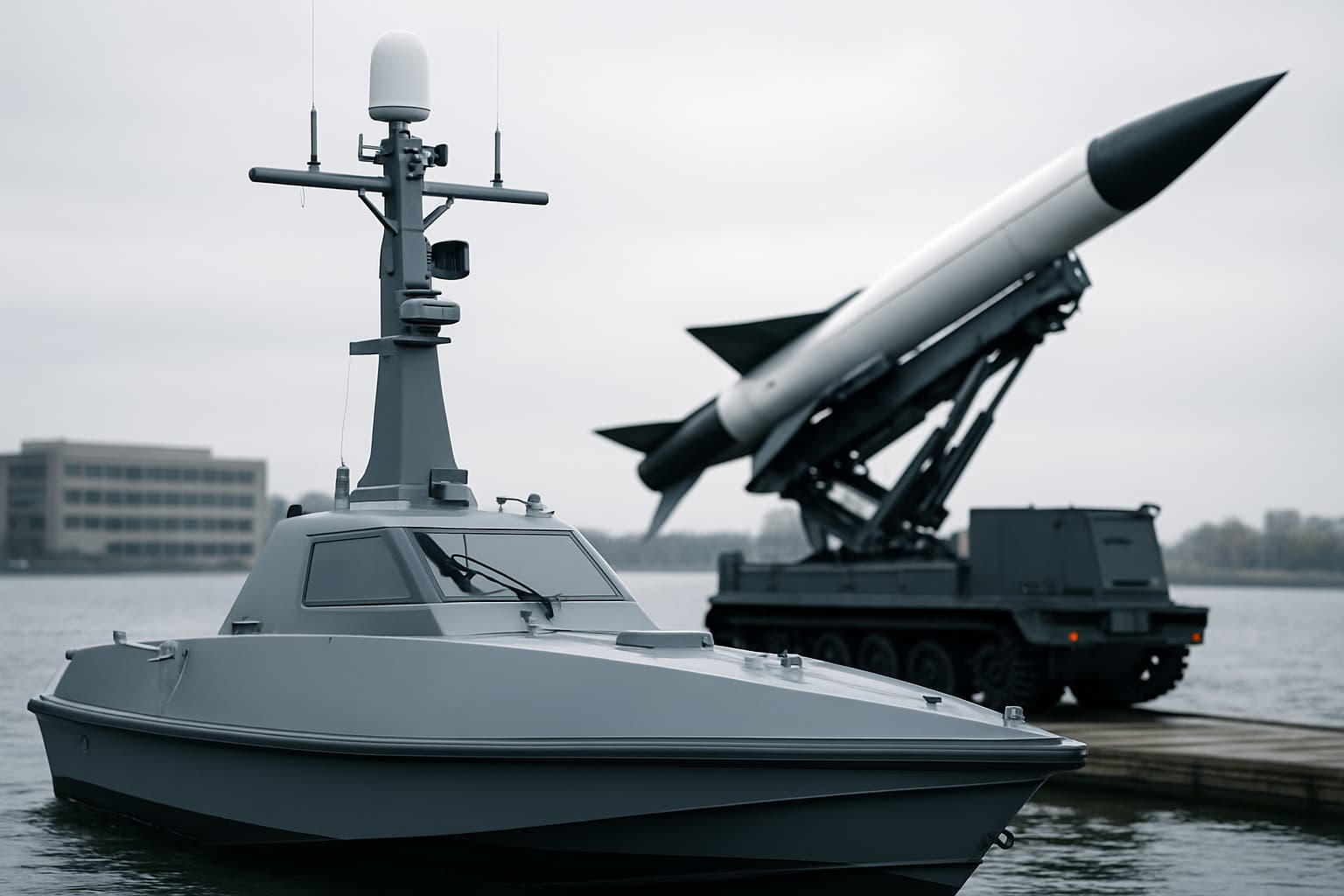














Two defense technology startups pulled in a combined $2.55 billion this week, led by Saronic's $1.75 billion Series D for autonomous warships and Castelion's $1.05 billion round for hypersonic strike missiles. The scale of the raises, arriving within days of each other, marks one of the largest concentrated bets on defense startups in recent memory. Both companies are racing to build hardware the Pentagon has publicly said it needs faster, from unmanned surface vessels to missiles capable of striking targets in minutes rather than hours. Investors are betting that a new generation of venture-backed defense contractors can out-innovate the legacy primes that have dominated the sector for decades.
The rounds land amid a broader surge of capital into hard-tech and national-security startups, a category that has historically struggled to attract venture money due to long procurement cycles and government red tape. That calculus appears to be shifting fast. Alongside Saronic and Castelion, aerospace startup True Anomaly closed $600 million this week for space defense technology, while physical AI company Atoms, founded by former Uber chief Travis Kalanick, raised $1.7 billion, suggesting defense and physical-world automation have become the venture industry's newest gravitational center.
A Record Week for Autonomous Warfare Capital
Saronic's $1.75 billion Series D stands as one of the largest single funding rounds ever raised by a defense startup, and it arrives just over a year after the company was valued at a fraction of its current size. The Austin-based company builds autonomous surface vessels designed to patrol coastlines, conduct surveillance, and eventually operate alongside crewed naval fleets without putting sailors at risk. Its rapid ascent reflects a broader shift in how the U.S. military is thinking about naval dominance, favoring fleets of cheaper, expendable autonomous craft over exquisite, expensive manned ships.
The timing is notable. Saronic's raise comes as the Navy has publicly struggled to keep pace with shipbuilding targets, and as tensions in the Indo-Pacific have pushed the Pentagon to look for faster, cheaper ways to project maritime power. Venture investors, sensing an opening left by traditional shipbuilders' inability to scale quickly, have poured capital into the company at a pace usually reserved for consumer AI startups rather than hardware-heavy defense primes.
Castelion Bets Big on Hypersonic Strike
Castelion's $800 million Series C, paired with $250 million in debt financing, gives the hypersonic missile developer more than $1 billion in fresh capital to accelerate testing and production. The company is developing long-range strike missiles capable of traveling at more than five times the speed of sound, a capability the Pentagon has identified as a strategic priority as China and Russia field their own hypersonic arsenals. Unlike legacy defense contractors that typically rely on multi-year government contracts to fund development, Castelion has leaned heavily on private capital to move faster through prototyping and flight testing.
The debt component of the round is itself a signal of how mainstream defense tech financing has become. Lenders are increasingly willing to extend credit against hardware and manufacturing assets in a sector once considered too risky and too slow-moving for anything but equity investment. That hybrid financing structure, mixing traditional venture equity with asset-backed debt, may become a template for other hypersonics and munitions startups seeking to scale production without diluting ownership further.
True Anomaly and the Space Domain
Rounding out the week's defense-tech haul, True Anomaly raised $600 million in Series D funding led by Eclipse and Riot Ventures to build spacecraft and sensors aimed at monitoring and countering adversary satellites. The company has positioned itself at the center of an increasingly contested orbital environment, where the U.S. Space Force has warned that rivals are developing anti-satellite weapons and inspection craft capable of disabling American space assets. True Anomaly's technology is designed to give the Pentagon eyes on, and potentially countermeasures against, those threats in real time.
Together, the three raises, Saronic, Castelion and True Anomaly, total more than $3.15 billion in a single week, an extraordinary sum for a sector that just a few years ago struggled to attract institutional venture capital at all. The convergence suggests investors now view defense technology not as a niche category but as a core pillar of the broader hard-tech and physical AI investment thesis that has also fueled bets on companies like Atoms and Wonder.
The character of naval warfare is changing, and the navies that adapt fastest to autonomous systems will have a decisive advantage.
Why Investors Are Rushing In Now
Several forces are converging to make defense tech venture capital's hottest sector. Geopolitical tension with China and Russia has created sustained bipartisan political will in Washington to modernize military capability quickly, while the Pentagon's own acquisition reforms have opened new pathways for startups to win contracts without going through decades-old procurement bureaucracies. At the same time, later-stage venture funds flush with capital from AI-driven exits are looking for the next category with comparable growth potential, and defense hardware, once dismissed as too capital-intensive, now looks attractive precisely because it is hard to replicate.
Skeptics caution that defense tech valuations may be running ahead of proven revenue, since many of these companies remain reliant on a small number of government contracts and pilot programs rather than diversified commercial demand. Still, the sheer scale of this week's rounds, alongside comparable raises for Anduril and other defense-tech peers in recent quarters, suggests investors are willing to underwrite that risk. If Saronic, Castelion and True Anomaly can convert their war chests into fielded systems, they could reshape not just their own balance sheets but the competitive landscape facing legacy contractors like Lockheed Martin, Raytheon and General Dynamics.
Sources
- https://vcnewsdaily.com/
- https://genztech.blog/funding-tracker/
- https://techfundingnews.com/
- https://news.crunchbase.com/venture/biggest-funding-rounds-ai-defense-fintech-robotics/
- https://startupcorners.com/digest/funding-digest-2026-07-25
- https://startupcorners.com/digest/funding-digest-2026-07-18
- https://news.crunchbase.com/venture/biggest-funding-rounds-physical-ai-fintech-defense-atoms/
- https://news.crunchbase.com/venture/biggest-funding-rounds-ai-defense-wearables-energy-saronic/
- https://news.crunchbase.com/venture/biggest-funding-rounds-security-ai-cloaked-frore/
- https://www.fundedstartupsdaily.com/
- https://www.techbible.ai/learn/tech-startup-funding-rounds
- https://news.crunchbase.com/venture/biggest-funding-rounds-june-5-2026/
Leave a Comment