






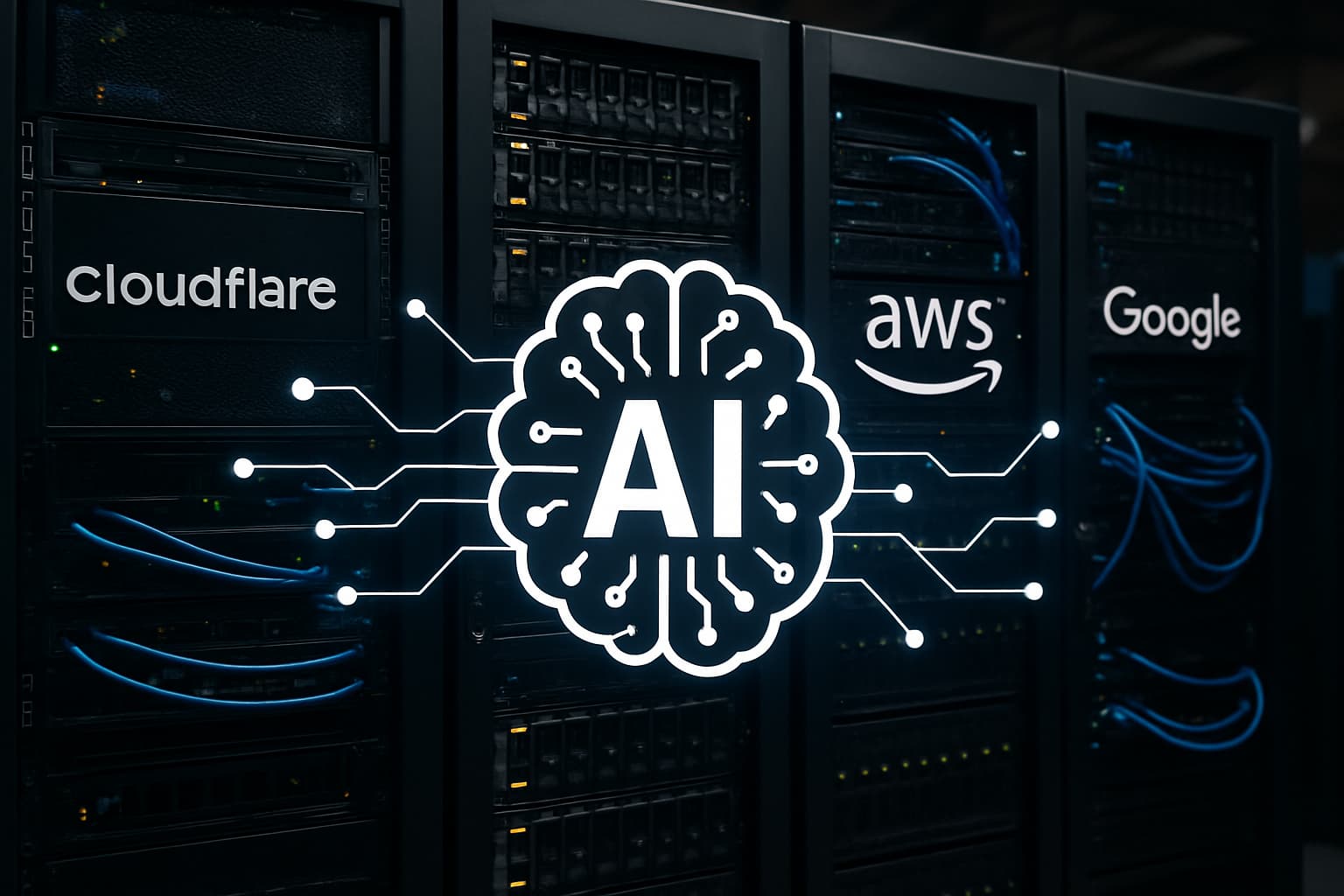











This week marked one of the busiest stretches yet for infrastructure built specifically to run AI agents in production. Cloudflare's Agents Week 2026 shipped a sweeping suite of tools including Artifacts, a generally available Sandboxes product, and a new Agent Readiness score, while AWS pushed out Loom, an open-source governance platform for enterprise AI agents, and Google's Genkit added a full Agents API for TypeScript and Go. Nutanix and Galileo separately released their own agent-facing tools, underscoring that agent infrastructure has become the industry's most contested new front.
For years, developer tooling conversations centered on editors, version control, and CI/CD pipelines. Now a parallel infrastructure layer is emerging rapidly, one designed not for human coders but for the AI agents those coders are building. The releases this week from Cloudflare, AWS, Google, Nutanix, and Galileo suggest the industry has moved past experimentation and into a scramble to standardize how agents are sandboxed, governed, monitored, and connected to enterprise systems.
Cloudflare's Agents Week Delivers a Full Stack
Cloudflare used its Agents Week 2026 event to release what amounts to a complete operating layer for agentic applications. The lineup included Artifacts for packaging agent outputs, a generally available version of Sandboxes for isolated code execution, and Outbound Workers for Sandboxes to let agents safely reach external services. Durable Object Facets and Cloudflare Mesh round out the infrastructure side, giving developers primitives for persistent state and distributed coordination that agents need to operate reliably over long sessions.
Perhaps more telling than the technical releases is Cloudflare's new Agent Readiness score, a metric apparently designed to help enterprises assess how prepared their systems are to support autonomous agents at scale. Paired with Managed OAuth for Cloudflare Access and an initiative called Project Think, the announcements signal that Cloudflare is positioning itself not just as a CDN and edge compute provider, but as the default control plane for agent-native applications. That is a significant strategic bet, given how much of the current agent boom still runs on improvised scripts and unmanaged API keys.
AWS and Google Push Governance and Orchestration
AWS's contribution this week centered on Loom, an open-source reference platform built specifically to govern AI agents at enterprise scale. Governance has become a pressing concern as companies deploy agents with real permissions to touch production systems, customer data, and financial workflows, and Loom appears aimed at giving enterprises an auditable framework rather than leaving governance to ad hoc internal tooling. AWS also opened up its Smithy API Models for public access, a move that should make it easier for third-party developer tools to integrate cleanly with AWS services.
Google, meanwhile, extended its Genkit framework with a new Agents API that supports detached turns and human-in-the-loop workflows across both TypeScript and Go. The human-in-the-loop capability is notable because it directly addresses one of the most common enterprise objections to agentic systems: the fear of fully autonomous action without a checkpoint for human review. By building that pause-and-approve mechanic directly into the framework rather than leaving it to individual application developers, Google is effectively standardizing a safety pattern that many teams have been building manually and inconsistently.
Nutanix and Galileo Target Narrower but Critical Gaps
Nutanix took a more infrastructure-specific approach, releasing an MCP server for its Nutanix Cloud Platform that exposes the Prism V4 API directly to AI assistants and developer tools. The release, versioned 0.8, is explicitly labeled an open-source Technical Preview and not intended for production workloads, a caveat that reflects how much of this agent tooling ecosystem remains in active flux even as vendors rush to ship. Still, the move shows how quickly the Model Context Protocol has become a default interface for connecting enterprise infrastructure to AI systems.
Galileo took a different angle entirely, releasing an open-source control plane for managing agents under the permissive Apache 2.0 license. Its standout feature allows operators to modify or update agents without taking them offline, a capability that addresses a real operational pain point as agents move from prototypes into always-on production services. Combined with continued momentum around LocalStack 2.0 for local cloud development and Radius achieving CNCF Sandbox Project status, the week's releases paint a picture of an ecosystem building redundancy and choice into agent infrastructure rather than consolidating around a single vendor.
What This Means for Developer Workflows
These releases arrive against a backdrop of tools that developers already rely on daily, from Visual Studio Code and IntelliJ IDEA to GitHub, GitLab, Jenkins, and Docker. AI coding assistants like GitHub Copilot, Cursor, JetBrains AI, Codeium, and Tabby have already reshaped how code gets written. What is happening now is a second wave: infrastructure that determines how the agents built with those assistants actually run, get governed, and get audited once they leave the sandbox of a developer's laptop.
The practical effect for engineering teams is a widening toolchain. Where a team once needed an IDE, a CI/CD pipeline, and a cloud provider, they may now need an agent sandboxing layer, a governance control plane, and a readiness framework just to deploy an autonomous system responsibly. Whether this fragmentation resolves into a handful of dominant standards, similar to how Git consolidated version control or Kubernetes consolidated container orchestration, will likely define which vendors win the next phase of enterprise software spending.
Every major cloud and infrastructure vendor is now racing to answer the same question: who controls the runtime, the guardrails, and the governance layer for autonomous agents before the market settles on a standard.
An Ecosystem Still Finding Its Footing
The explicit technical-preview status attached to Nutanix's MCP server is a useful reminder that much of this infrastructure remains experimental, even as major vendors ship it publicly and enthusiastically. Enterprises evaluating these tools will need to weigh the appeal of early access against the real risk of building critical workflows on top of software vendors themselves warn is not production-ready.
Even so, the sheer volume and coordination of this week's releases, spanning edge computing, cloud infrastructure, API governance, and open-source control planes, suggests the industry views agent infrastructure as the next major battleground after the coding assistant wars. For developers and engineering leaders, the message is clear: the tools used to build software are evolving again, and this time the target audience is not just humans typing in an editor, but the autonomous systems those humans are increasingly asked to supervise.
Sources
- https://www.cloudzero.com/blog/software-development-tools/
- https://visualstudio.microsoft.com/
- https://thectoclub.com/tools/best-software-development-tools/
- https://www.timechamp.io/blogs/best-software-development-tools
- https://www.g2.com/best-software-companies/top-development
- https://github.com/agamm/awesome-developer-first
- https://riseuplabs.com/software-development-tools-to-use/
- https://spacelift.io/blog/software-development-tools
- https://thectoclub.com/tools/best-software-development-tool/
- https://www.greptile.com/content-library/14-best-developer-productivity-tools
- https://www.designrush.com/agency/software-development/trends/best-software-development-tools
- https://geekflare.com/software/best-software-development-tools/
Leave a Comment